Showing posts with label Fitzwilly. Show all posts

Tuesday, January 1, 2013

On How Crime Does Not Pay - Even in the Movies

Team Bartilucci's hubby half, Vinnie Bartilucci, is in the spotlight this time, with one of our favorite genres, Heist movies!  Take it away, Vinnie!
Heist movies have been around as long as movies.  The Great Train Robbery was one of the first films, made in 1903, a staggering twelve minutes long.  And for almost all of that time, until the Seventies at least, the rule was that the criminals could not get away with their gains. They'd be caught, shot, betrayed, done under by their own greed, or some combination of the above. The idea was all based around what we now call "Imitable Action," what they analyze children's TV shows for. The idea is if something looks cool, people will try to do it. We claim that's a lot of flummery, but about 47% of YouTube videos put the lie to that.

Even Alfred Hitchcock, on his classic TV show Alfred Hitchcock Presents, was forced to add codas to his stories that revealed that no matter how perfect the murders or crimes were, the miscreants were found out after the cameras stopped rolling.   Sometimes they were witty epilogues, like the one in the classic Lamb to the Slaughter, but more often than not they were almost throwaway, half mumbled, "Of course they were eventually found out and convicted for their crimes" that almost ended with a wink. That rule about The Guilty Must Suffer was all but inviolate.

Heck, even in The Treasure of the Sierra Madre, they couldn't get the money, and they didn't even STEAL it. All they did is get greedy, and it was only ONE of them. One almost gets the impression that the message trying to be hammered home wasn't "Don't steal," but "Don't try to better yourself, stay in your place."  But of course, that would be excessively paranoid, wouldn't it?
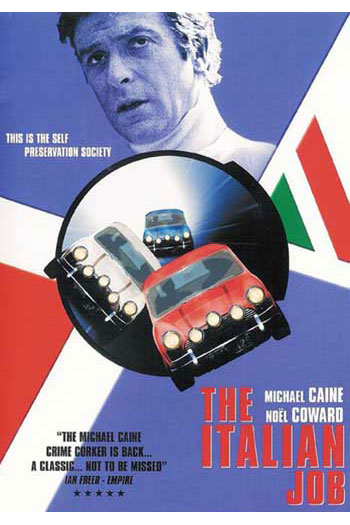
Come the Sixties, we started to see a subtle shift to the Caper Movie; the planning was much grander, and the payoffs larger than ever. Instead of a mere carefully-planned bank robbery or some such, we'd see a meticulously organized break-in, or perhaps a complicated con job. Plans so outlandish and daring that you want them to get away with it out of sheer respect.   But still that rule had to go and piss on the fish. They came up with a new twist, though; the caper-planners might be able to avoid incarceration, but they could still never get away with the money. So in the original Ocean's Eleven, the money gets burned up as carcinogenic co-conspirator Tony Bergdorf  (Richard Conte) gets unexpectedly cremated. Michael Caine and the gang from The Italian Job get placed in a deadly balancing act with the escape bus teetering on the brink, with the lovely lolly at the far end over the cliff. Every time they try to creep forward to grab it, the bus CREEEEKS precariously forward. I always thought this ending was what was being tributed at the end of Guy Ritchie's Lock, Stock and Two Smoking Barrels. Even my beloved Fitzwilly couldn't get away with the money, no matter how benevolent his reasons.

The Wife analyzed Topkapi a few months back, another example of a cast that you really want to see get away with it, but simply can't. We admire and  appreciate the work of the mastermind of a fine caper, and enjoy watching the exploits of such films come together, as much as we hate watching them fall apart at the end.

The more outlandish the capers got, the more you wanted them to get away with it. They tried everything - they made the miscreants likable, even noble. Two films with somewhat similar capers were also forced to slap on the ironic punishment.  1967's Who's Minding the Mint? (available from the Warner Archive) put Jim Hutton (TV's Ellery Queen) in a position where he's forced to break into the mint to print off legal tender to make up for an accidental destruction of fifty thousand dollars to avoid incarceration.   Long story short, it balloons into printing millions of dollars, and results in a goddamn brilliant madcap comedy. But again, they can't possibly be allowed to get away with the money, so it accidentally gets picked up as trash, leading to a mad chase across town to catch up with the garbage truck before the money is dumped on a barge and lost. This being one of the cases where the crime was for a good reason, enough is salvaged to save Jim's bacon, but no more. At least in this case, they added a coda to suggest they might yet succeed, as over the closing credits, the cast is in scuba gear, heading down to try to retrieve their surreptitious spondulix.  Another house favorite, Gambit, has a similar "Maybe it's not too sad an ending," where while Michael Caine won't benefit from his crime, another cast member might.

Ocean's 11 (1960)
A year later, Seven Times Seven was released in Italy with the same crime - break into the Mint and print a bunch of cash. This one was a bit more complex - the plotters were in prison, so they would have to break OUT of prison, INTO the Mint, then back INTO prison, wait out their sentences, and pick up the cash when they're released. The big soccer final gives them a perfect opportunity, as the guards' eyes will all be glued to the TV, and only occasionally to the security monitors. So a film loop of the convicts milling around the common area will suffice for their cover. It goes pretty smoothly, even with a last-minute reprieve at the end, and they make it back in time.   But of course, The Guilty Must Suffer, so when they go for the money after they're all released, it turns out they used the wrong ink in the printing, and it's faded, rendering the bills worthless. Now one could ask why they had fading ink in the Mint, but that would just confuse things, wouldn't it? It also had a damn fine theme tune.

Ocean's 11 (2001)

It wasn't for some time that the film industry decided there were some cases where it was okay to see the caperists get away with it. Maybe they're really doing it as part of a larger benevolent action like The In-Laws, or they're stealing from a bad guy like in The Sting, or in the case of the remake of Ocean's 11, someone whom we've been educated is just Not Nice. The rise of the antihero helped this along, where we're supposed to like the bad guy, so theoretically that helped. One could argue that the desire to see the bad guy win had been there for years - John Dillinger and Bonnie & Clyde were folk-heroes at the time they were in action, on and off the screen. But on the whole, people just like to see people get away with it, especially if, as mentioned, they're stealing from a person or organization that is deemed "bad". Brett Ratner's recent Tower Heist was better than the attention it got, and is worth a look on cable. And while I didn't get a chance to see Robot and Frank, everything I've heard suggests I should.

I've mentioned before how much I look forward to the return of the Gentleman Bandit genre. George Clooney's version of Danny Ocean is very close to that; I've often said I think Will Smith could do a great Raffles. Combined with an outlandish Caper Plot, a new Raffles film could burn up the box office.

Friday, December 24, 2010

The Thin Man Meets Fitzwilly! Team Bartilucci's Favorite Christmas Movies

As The Beatles once sang, Christmastime is here again! Here at Team Bartilucci H.Q., that means it’s time for family, festivities, and films! Ah, but our favorite Christmas-themed films go well beyond the likes of It’s A Wonderful Life. (Call us Grinches, but we find that particular Frank Capra classic so dark and downbeat before the happy ending that it’s always struck us as a film noir.)

Dorian’s Christmas Fave:  The Thin Man (TTM), 1934

This smart, snappy romantic comedy-mystery couldn’t have avoided becoming a classic if it wanted to, despite its relatively humble beginnings as a B-movie shot in about two weeks by director W.S. “Woody” Van Dyke.  TTM is so wryly sophisticated that, among other things, it makes boozing look fun (but please drink responsibly. Okay, sermon over!). The romance between TTM author Dashiell Hammett and Lillian Hellman inspired the dashing, retired detective Nick Charles (William Powell) and his beautiful, effervescent heiress wife Nora (Myrna Loy in a performance that forever changed the exotic temptress stereotype she’d been stuck in).

Nora: "What hit me?" Nick: "The last martini."
(Actual dialogue from the film!)
The couple and their adorable terrier, Asta, visit NYC during Christmas week, but there’s no time for sightseeing or caroling: murder’s afoot! Nick and Nora find themselves plunged into a murder mystery involving old friends, the eccentric Wynant family. Dorothy Wynant (Maureen O’Sullivan at her most endearing) enlists Nick’s help in seeking her beloved father, who had promised to return to New York in time for Dorothy’s December wedding.  Dorothy’s missing dad is absentminded genius Clyde Wynant (Edward Ellis), the “thin man” of the film’s title, though the name stuck to Nick when the film became a hit, spawning a six-film series. Our happy, cheeky duo wade through gunplay; glam gowns by Dolly Tree; drinks mixed to dance rhythms (“A Manhattan, you shake to fox-trot time….”); witty repartee, courtesy of Oscar-nominated screenwriters Albert Hackett and Frances Goodrich (in fact, major Oscar nominations went to everyone in TTN except Loy! Her Oscar snub is the only thing I don’t like about the film! But I digress….); and swell parties, including a dizzy Christmas Eve soiree that perhaps later inspired Holly Golightly in Breakfast at Tiffany’s, and the swanky dinner party where villains are revealed and tough-guy waiters snap, “Have a cocktail!” to rattled guests/suspects. (We taught the kids in our lives to say it, too!)

Aw, who can resist Nora's cute "scrunchy face"?
Still, tenderness shows between the bouts of zaniness. In addition to the breezy, loving chemistry between Powell and Loy as Nick and Nora, Dorothy has affectionate relationships with her dad and her supportive fiancĂ© Tommy (Henry Wadsworth). Thank God she had them, because all the rest of the clan is either screwy or greedy! TTM proves that when a film is well-written and performed, a happily married couple can be far more witty, sexy, and just plain fun to watch and hear than the childish bickering that too many writers mistake for sexual tension. A good bit of the dialogue was taken verbatim from Hammett’s novel, including this Team Bartilucci favorite from Gertrude Short as Nunheim’s (Harold Huber) fed-up moll Marion:
“I don’t like crooks. And if I did like ’em, I wouldn’t like crooks that are stool pigeons. And if I did like crooks that are stool pigeons, I still wouldn’t like you!”

Is it any wonder that TTM, along with the 1941 film version of The Maltese Falcon and the 1942 film version of The Glass Key, got me interested in reading Hammett’s books, turning me into one of his fans?  TTM is not only one of my favorite lighthearted mysteries, it’s also one of my favorite New York-set movies; as a native New Yorker, I’m a sucker for flicks set in my hometown. Considering TTM takes place during Christmas week, it quickly became one of my fave Christmas movies, too. The whole Thin Man movie series is a joy to watch, but in my opinion, the first one is still the best!

Vinnie's Christmas Fave: Fitzwilly, 1967

Dick Van Dyke is one of those misleading actors, the ones you think has a limited skill set, and then a film comes along that shows a whole new direction and ability. Van Dyke is a stellar comedian and song & dance man, but some of his other works display a varied dramatic ability. He did a TV movie about alcoholism called The Morning After, and an all but forgotten film called The Comic about a fictional silent film star that fell on hard times. This past year, the darling people at the MGM arcives (their Print-on-Demand service) released two of my favorite films of his on DVD, Cold Turkey (about which I can and shall wax rhapsodic another time) and Fitzwilly (about which I shall wax rhapsodic now)

Van Dyke plays the titular character, Claude "Fitzwilly" Fitzwilliam, the latest in a family line of 13 butlers in the service to Miss Victoria Woodworth, played by the delightfully wacky Dame Edith Evans. As the film starts, we see Fitzwilly engage in a series of amazing con-jobs with the assistance of his domestic staff, massive purchases on Fifth Avenue being charged to other millionaires, diverted to other addresses via moles in the shipping room, and liquidated for cash. We learn quickly that he's not doing it for himself, but to keep Miss Vicki solvent. She's bankrupt, and Fitzwilly and his staff spend nearly every waking moment scrambling to rake in enough cash to keep her living in the style to which she's been accustomed, never letting her know of the situation. At the same time, he's manufacturing hobbies for her to keep her mind active, including a pseudo-Cub Scout troop for sons of millionaires and a dictionary for mis-spellers. For the latter hobby, she needs the assistance of a secretary; she hires Juliet Nowell (Barbara Feldon), the only person in the house who isn't in on the scam, and is immediately seen as a threat to the operation. So while they're trying to keep her out of the loop, they're still trying to bring in enough money to cover the occasional checks Miss Vicki sends out to charities that they can't intercept.

Lovebirds Juliet and Fitzwilly get face time between capers
As time passes, Juliet begins to realize that Fitzwilliam's standoffish attitude is merely overprotectiveness for Miss Vicki.  Her curiosity continues to prove troubling, and by the time she and Fitzwilly fall in love (like you doubted?) and she's let in on the totality of the operation, she's already inadvertently sent the ledger wildly into the red by mailing out a $50,000 donation.  Fitzwilly is forced to concieve a massive Superfly-like "One Last Big Deal" to cover the donation, various other operations that have fallen behind, and set up enough of a nest egg to keep Miss Vicki set for the rest of her remaining days.  He hatches a scheme to rob Gimbels on Christmas Eve in a style and grandeur worthy of (either version of) Ocean's 11.  It's a wonderful climax that runs smooth as silk...rather.

"Dad, I see Miss Vicki's household is chock full o'nuts."
This is a wonderful bit of work which provides a new entry in the classic "Gentleman Bandit" genre. Indeed, it's so good a film that I want to do a remake starring Will Smith and Thandie Newton in the leading roles.  Ever since their planned appearance in Jonathan Demme's remake of Charade went awry back during the Writer's Strike and became the abysmal, Smith-less The Truth About Charlie, The Wife and I had been trying to come up with a fun project to get those two glorious people together.  An all-black cast would be a neat idea.  I'd always imagined Lena Horne as Miss Vicki, but alas, that was rendered impossible this year. No worries, Nichelle Nichols was my backup all along, and I think she'd kill it.  Will Smith played an excellent con man in his first film, Six Degrees of Separation, and sadly, he's never gone back to the type.  If I can't have him as Raffles, I think Claude Fitzwilliam will do nicely.