Showing posts with label North by Northwest. Show all posts

Friday, July 22, 2011

An Analysis of The Paranoia Flick, or: You're Not Paranoid if They Really ARE Out to Get You! - By Team Bartilucci

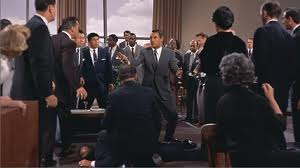
"You gentlemen aren’t really trying to kill my son, are you?”
Jessie Royce Landis, unconvinced that thugs Adam Williams and Robert Ellenstein want to do just that to Cary Grant in North by Northwest (1959)
The spy film typically features a suave, sophisticated man about town who shoots at suave evil men about town over, say, a vital document that both parties are after. A horror film pits some everyday nebbish against some slimy, slithery fiend from Hell that nobody understands, but that everyone can at least see. But when you merge these two concepts, pitting the everyday nebbish against the suave men about town over something that only the suave guys know about and the nebbish doesn’t even know he or she has, you have the beginnings of one of Team Bartilucci’s favorite types of films: The Paranoia Flick.

Foul Play: I'll be watching you! (And vice-versa!)
The basic idea of The Paranoia Flick is simple. Place a total nobody into a situation involving spies, secret codes, beautiful members of the (traditionally) opposite sex, and almost certain death, and watch them collapse. In these films, the most important factor is the actors in the assorted roles. The target must be somebody you can believe is scared. Clint Eastwood, for example, would never succeed as a paranoia target! Even at his age, you’d be sure Clint would come through it all, cool as an October breeze. But some vulnerable yet likable sort like, say, Goldie Hawn, who was wonderful in Foul Play (1978), works perfectly in such a role. In fact, the late Colin Higgins, writer/director of Foul Play and writer of Silver Streak (1976), had a gift for paranoid comedy-thrillers with a Hitchcockian flair.

It doesn’t matter why the star of the film is being chased hither and yon, either. Cary Grant asked Alfred Hitchcock why his character was being chased all over the map in North by Northwest. Hitchcock (and consequently, Leo G. Carroll as the spymaster known as The Professor) answered, “Oh, I don’t know. Government secrets, perhaps?” Hitchcock, of course, gave us movie fans the term “MacGuffin” for the plot device that gets the story and the characters moving. Our favorite use of this was in, of all things, a G.I. Joe episode, in which both Joe and COBRA were in heated battle over a weapon known as “The MacGuffin Device.”

The Man From U.N.C.L.E. used the idea of the innocent person asked to assist with spy activities on a regular basis, said person usually being a lovely young woman who either worked for the bad guy, or used to go out with him, or some other vague connection they could exploit. While the guest star knew the situation she was getting into , there were still lots of opportunities for them to become convinced that everyone was a Thrush operative except, of course, for the ones who were.

Paranoia Flicks are generally comedies; if the plot is not being played for laughs, it ends up being more of a thriller like the aforementioned North by Northwest (NxNW), or the pretty solid early Will Smith film Enemy of the State, but the basic pieces of the puzzle are usually there. All Paranoia Flicks, be they comedy or thriller, must have certain essential scenes in order to make the Paranoia Cut:

The Drop Scene.  This is when the main character receives the MacGuffin, often literally dropped into their hands, and pretty much everyone on the planet notices except our unsuspecting protagonist.

In the case of a film like
NxNW, Roger Thornhill (Cary Grant) doesn't get an object; he's simply mistaken for someone else, the mythical George Kaplan. In the 1947 classic The Secret Life of Walter Mitty (TSLoWM), Rosalind van Hoorn (Virginia Mayo) slips the book of stolen Dutch treasures into poor schlub Walter Mitty's (Danny Kaye) coat while he's busy dithering. In The Man with One Red Shoe, the oft-forgotten 1985 American remake of the 1972 French comedy classic The Tall Blond Man with One Black Shoe, Tom Hanks is himself the drop! He's identified as the contact who's carrying incriminating evidence by Edward Herrmann, but no such information exists he's really just an unsuspecting decoy to give the other group of spies someone to chase and follow.

Gotcha! - Smoke gets in your eyes, spies get in your strudel..
The Misdirected MacGuffin.  Often, our protagonist thinks he knows what the MacGuffin is, and he ends up guarding some worthless object with his life, leaving the real MacGuffin at the villains’ mercy.

There’s a classic example in the delightful yet surprisingly underrated 1985 comedy-thriller Gotcha!  In East Berlin (long story), the lovely and mysterious Sasha Banacek (Linda Fiorentino) has handed a package to our innocent college-boy hero Jonathan Moore (Anthony Edwards) behind the Iron Curtain. Since Jonathan has been immersed in paranoia-inducing antics for a while at this point in the movie, when Sasha tells him the package contains strudel, Jonathan thinks it’s code for, oh, Secret Government Strudel, perhaps (“Strudel, riiiight, strudel….”).

Gene Wilder doesn't support his local sheriff!
The Explanation Sequence.  This is Team Bartilucci’s personal favorite amongst Paranoia Flick tropes! Heres where our hero must convince friends and/or loved ones that he’s in real danger, and not insane. Some of the best lines usually happen here, as the main character babbles a Cliffs Notes version of the script, with all the credible stuff left out, and a lot of iterations of “I’m not crazy!” put in.

Since it's the easiest scene to make funny, there are scads of examples of classic explanation sequences.
In NxNW, perplexed hero Roger Thornhill tries to convince the Glen Cove police that he really was forcibly plied with bourbon by henchman Leonard (Martin Landau) and nearly killed in what was supposed to look like a drunk-driving accident. In a great twist, we don't hear Roger explain the events, we hear his lawyer (played by Get Smart's "Chief" Edward Platt) explain it all to the judge with a look of weary resignation on his face.

In
TSLoWM, not only does Walter try in vain to convince everyone that The Boot’s henchmen are trying to kill him, but thanks to a Mickey Finn, he awakens to find one of the chief bad guys, Dr. Hugo Hollingshead (Boris Karloff), pulling a Gaslight routine on him, claiming he only imagined his dream girl Rosalind.

In Silver Streak (1976), Colin Higgins’ first great paranoid Hitchcockian comedy-thriller screenplay, our hero George Caldwell (Gene Wilder), who
s been traveling on the titular cross-country train, tries to explain the mysterious events and rising body count surrounding the MacGuffin to Sheriff Oliver Chauncey (Clifton James). In this case, the MacGuffin’s a book, The Rembrandt Letters, which contains startling revelations that would embarrass and disgrace the art-world bad guys if they don’t knock George off (and we don’t just mean the running gag about George constantly being knocked off the train). Naturally, our frazzled hero’s explanation is causing more confusion than enlightenment:  
Sheriff Chauncey: Is he with the feds?”
George Caldwell: “Who?”
Sheriff Chauncey: This guy Rembrandt.”
George Caldwell: Rembrandt is dead!”
Sheriff Chauncey: “Dead? That makes four. Listen, fella, are you sure you’re not making this up as you go along? I’m an officer of the law and I got a lot better things to do than listen to that kind of funnin’. [Buzzer sounds] That's my hotline. Now you take your time to get your facts straight, ’cause when I come back, I want your answers clear and to the point. Got that? And you can start with who shot Rembrandt!”
The False Alarm.  Here’s where the main character overreacts to every snap of a twig, and thinks each stray glance means a spy or some other no-goodnik is on his trail. It’s usually at these points in the films that all the innocent people get hurt and/or humiliated, making the poor main character look even crazier. In Gotcha!, Jonathan runs a driver off the road when he mistakes them for Russian thugs following him, and pulls over to phone the police, frantically saying, "I want to report a following!"
The Turnabout.  Near the end of The Paranoia Flick, our protagonist has had enough of this evil folderol and fiddle-dee-dee, and finally gathers up all his intestinal fortitude and takes charge of the situation. This usually ends the film in a funny and/or exciting, suspenseful way, getting our hero back in the good graces of his friends and loved ones.

For example, after Walter Mitty finally finds and rescues his beloved Rosalind, he grows a backbone and starts using the tricks he picked up as a reader and editor of racy pulp magazines against his assailants, wiring doorknobs for electricity and setting up rope snares. Eventually he stands up to his family and so-called friends, and tells them off with a great bit of bravado
that even wows Walter’s fat-headed, credit-nabbing boss (Thurston Hall), to the tune of promoting Walter to Associate Editor:
“Now you’re all going to listen to me. For years I’ve been listening to you, and you nearly put me in a straitjacket! Your small minds are musclebound with suspicion. That's because the only exercise you ever get is jumping to conclusions. You ought to be ashamed of yourselves, every one of you!”
As an example of a film that hits every note perfectly, let's look at Dorian's personal favorite, Foul Play (1978), both written and directed by Colin Higgins, which, as good as it is, still beats the Higgins-penned Silver Streak to the title by 27 lengths.

Goldie Hawn plays lovable heroine Gloria Mundy (one of our favorite character names). Gloria lives in San Francisco (the film gives a nice tip of the hat to both Vertigo and Bullitt), but it’s no treat; she’s trying to adjust to her new life as a divorcee. Her friends suggest that she “take some chances.” So Gloria picks up a stranded but attractive motorist (Bruce Solomon of TV’s Mary Hartman, Mary Hartman and Lanigan’s Rabbi), and wouldn’t you know the cute motorist-in-need, Bob “Scotty” Scott, is an undercover police detective on a case? Scotty turns on the charm and makes a date with Gloria for that night at the local revival theater. He surreptitiously slips a roll of film into his half-empty pack of cigarettes (The Drop), then asks the unsuspecting Gloria to hold onto his cigarette pack until their date, claiming it’ll help him cut back on his smoking. Alas, the bad guys get Scotty first; he staggers into the dark theater wet and bleeding, spending his last moments trying to distract Gloria from the film noir onscreen, his last words being “Beware of the dwarf.” By the time Gloria realizes what’s happening and rushes to the manager (Team B. fave Chuck McCann) for help, Scotty’s corpse has vanished, and the paranoia has taken a ringside seat.


Soon Gloria’s being terrorized by a man with a scar (Don Calfa) and one Whitey Jackson (William Frankfather), an albino in a white suit. These evil jaspers work for a hit man known as “The Dwarf.” In the following excerpts, the bad guys had broken into Gloria’s apartment, looking for that cigarette pack. None of them realize its hiding in plain sight, having fallen out of Scarface’s hand during the attack at Gloria’s charming apartment. They’re also unaware that the film in that cigarette pack contains evidence about an assassination taking place that week! Alas, Gloria fainted after seeing Scarface shockingly killed by Whitey's flying dagger (loss of consciousness is a time-honored recurring theme in Paranoia Flicks), so by the time she comes to and finds her apartment tidied up and corpse-free, she has a hard time getting through The Explanation Sequence of her nerve-shattering experience to police detectives Lt. Tony Carlson (Chevy Chase in his first leading-man role) and Inspector “Fergie” Ferguson (Brian Dennehy):
Gloria: “The dead body! It’s gone! It vanished!”
Tony: “Well, maybe it was embarrassed. Come on in here. I think you’d better sit down.”
Gloria: “But you don’t understand. The body has disappeared.”

Fergie: “Whose body was it?”
Gloria: “I don’t know. A man with a scar. He tried to murder me, but I stabbed him with the needles.”
Fergie: “Oh, narcotics, huh?”
Gloria: “No, knitting….I’ve got it! It must have been the albino…He’s the one who killed the man with the scar.”

Fergie: “I thought you killed the man with the scar.”
Gloria: “I did. Except he killed him after I killed him. See, I didn’t really kill him, I just stabbed him with the needles, right after he heard the cuckoo.” (Cuckoo clock cuckoos on schedule.)
Fergie: “Why did he wanna kill you?”
Gloria: “I’m not sure, but I think it was because of the cigarettes.”

Tony: “He wanted a cigarette?”
Gloria: “No, he wanted the whole pack!”
Fergie: “Kind of greedy.”
Gloria gets a visit from Innocent Dwarf J.J. MacKuen (Billy Barty) after she's been assaulted a couple of times, and has a hilarious False Alarm all over him, giving Barty a chance to do the physical comedy he so excelled at. While they never actually find the MacGuffin in the film, it remains Misdirected in that they think the pack of cigarettes itself is what they're after, not the film canister within.

She gets a couple of Turnabout scenes in the film, one rather early in the proceedings as she takes out a comic-book-reading moron (*sigh* too long was comic-book-reading by an adult a shorthand for simple-mindedness. But I digress....) with the aid of some anti-rape gear provided by ubiquitous-at-the-time Marilyn Sokol. As Janet Maslin noted in her New York Times review of Foul Play, “…when a thug makes the mistake of catching Miss Hawn by surprise, she greets him with the most adorably indignant little shriek the movies have witnessed in years. Miss Hawn often looks frightened…but she even more often looks tremulously furious, and that’s her secret weapon…once (trouble) arrives, she’s never too out-to-lunch to lose her temper. And her anger, imbued with all the quivering, outraged self-righteousness Miss Hawn can muster, is enough to make the most hardened villain or moviegoer melt.”


Strangely enough, the greatest Paranoia Flick of all time is missing quite a few of the classic factors. We refer, of course, to writer/director Theodore J. Flicker's The President’s Analyst (1967), starring James Coburn, who had the coolest and scariest (in a good way) smile in show business. Coburn plays Dr. Sidney Schaefer, who’s appointed to be the titular role at the recommendation of his analyst Dr. Lee-Evans (Will Geer), after being thoroughly vetted by "CEA" agent Don Masters (Godfrey Cambridge). When Masters reveals his true identity, Sidney, used to having delusional patients before, asks for ID. Imagine his surprise when he gets it!

After a few sessions with the President, Sidney realizes that he is learning far too much in his position, and he starts worrying that all the world’s rival governments will try to kidnap him or even kill him for what he knows — and it turns out he’s right! At one point, when he realizes that even his lover, the sweet, gentle Nan (Joan Delaney), is a spy sent in to keep tabs on him (giving new meaning to the phrase "undercover agent"), Sidney flees Washington with the help of a typical suburban family (led by William "KITT" Daniels), only to find he’s being followed by every combination of the "Same Alphabet Soup" a la NxNW, up to and including the Canadian Secret Service.  As proof of the counterculture spin of the film, the only people in the entire film not out to capture or otherwise exploit Sidney is a busload of hippies he joins up with. Eventually he's captured and handed over to Kropotkin (the whamtaculous Severn Darden) who Sidney proceeds to psychoanalyze and turn to his cause.

The real enemy in the film comes from so far out in left field that it was playing in another stadium! If you’ve seen The President’s Analyst, I’m sure you’ll agree it’s one of the most devious paranoia flicks of all time. If you haven’t, it’s available on DVD, and through Netflix.
Got a favorite Paranoia Flick you’d like to praise to the skies, if you dare? Don’t be afraid — tell us about it before it’s too late!

A Paranoia Picture is Worth a Thousand Words!

Friday, January 14, 2011

NORTH BY NORTHWEST: Mad Men and Englishmen

It all began when composer Bernard Herrmann introduced his friend, screenwriter Ernest Lehman, to director Alfred Hitchcock. “I sat in my office,” Lehman explained in Destination: Hitchcock, one of the special features in the North By Northwest 2-disc DVD set, “trying to construct a story which began at
the United Nations…I said, ‘I want to make the Hitchcock picture to end all Hitchcock pictures. Something that has wit, sophistication, glamour, action, and lots of changes in locale.’ And that’s when I started writing….” Well, Lehman did all that and then some! In the 1950s, Hitchcock was at the peak of his powers with Strangers on a Train; Dial M for Murder; Rear Window; The Trouble with Harry; the 1956 remake of The Man Who Knew Too Much; To Catch a Thief;  and Vertigo (even if the latter wasn’t fully appreciated until years later). But North By Northwest (NxNW) was truly the jewel in Hitchcock’s crown at that time. Originally, MGM wanted Hitchcock to film Hammond Innes’s The Wreck of the Mary Deare from a Lehman script, but both men soon realized they were way more interested in making NxNW. Slyboots that he was, Hitchcock devised a way to slip out of  …Mary Deare by colorfully describing the high points of NxNW to the MGM brass, leaving them thinking they’d get two Hitchcock pictures! ….Mary Deare was eventually filmed by Michael Anderson, and everyone got what they wanted—except James Stewart. According to the IMDb, while Stewart and Hitchcock filmed Vertigo, Hitch gave Stewart a taste of what he had in mind for NxNW. Stewart was hooked—but much as Hitchcock liked Stewart, he felt (rightly) that Cary Grant was the ideal choice for the lead. Rather than outright turn down his friend and frequent leading man, Hitchcock delayed production on NxNW until Stewart was committed to shooting Otto Preminger’s Anatomy of a Murder—and then he offered the role to Stewart, who of course had to turn down the offer. Oh, that Hitchcock—such a finagler, bless him!

Poor Hitchcock, a victim of NYC rush hour traffic!
The opening credits alone sweep us viewers into the action before the bad guys even show up. Saul Bass’s sleek opening credit sequence works beautifully with Bernard Herrmann’s fandango-like opening theme music swirling tempestuously as Manhattan’s bustling citizens rush into subways and taxis—except for that distinguished, imposing gent who just missed the Fifth Avenue bus. Yep, it’s Hitchcock himself, literally trying to catch up with the credits. Just as well his cameo came early, because our hero gets few opportunities to relax and enjoy the scenery with the wringer he’ll be put through! Talk about Mad Men—as Madison Avenue ad man turned-red-herring Roger O. Thornhill, Cary Grant’s romantic panache and flair for comedy perfectly suit our literally dashing hero. The “O” stands for nothing, much like Roger himself at first. He’s a charming, slick executive used to having his own way in business and the boudoir, judging from the fact that he’s been married twice and is currently wooing a new gal with “candy from Blum’s, each piece wrapped in gold paper. She’ll like that; she’ll think she’s eating money.” Indeed, those aforementioned opening credits move at a rapid-fire pace, almost like one of the screwball comedies Grant made with Howard Hawks in the 1930s and ‘40s. We see that Roger is a man of smooth confidence, always in charge—until that fateful day at The Plaza Hotel’s Oak Bar when the name “George Kaplan” is called out at the wrong time, turning our hero’s life upside down! Roger has barely had time to knock back his cocktail before he’s kidnapped by the coolly sinister henchmen of a suave gent calling himself Townsend (Suave Hall of Famer James Mason). Seems these jaspers are convinced that Roger is really Kaplan, a government agent, and they’re not playing on Kaplan’s team. The outraged, bewildered Roger’s insistence that “I’m not Kaplan!” falls on deaf ears. He gets bourbon forced down his throat in Townsend’s gorgeous Glen Cove home, thanks to reptilian henchman Leonard (Martin Landau before TV’s Mission: Impossible made him a star and his performance as Bela Lugosi in Ed Wood made him an Oscar-winner), and is nearly killed in a funny/scary drunk-driving frame-up.

Roger, didn't Mother tell you
never to pick up strange knives?
From there, things go from bad to worse as Roger’s visit to the U.N. to confront Townsend results in more mistaken identity and our hero being framed for murder. And so the chase begins, monitored by spymaster The Professor (Leo G. Carroll, looking remarkably like one or both of the Dulles brothers)! Considering that NxNW is considered Hitchcock's greatest American film, it's ironic that its director and several of its stars happen to be British. Well, America is a melting pot, after all!

Yikes! Well, at least our heroes can't get sneezed on!
NxNW is truly the Hitchcock film to end all Hitchcock films, with all his pet themes covered with maximum wit, panache, and suspense: a wrongly-accused hero on the run, mistaken identity, a romance between Roger and soignée spy Eve Kendall (Eva Marie Saint in a sexy-cool change of pace from her Oscar-winning role in On The Waterfront) that's tender, sensuous, and full of surprises, on a chase that takes our hero from New York to Chicago to Mount Rushmore. But as engaging and dashing as Grant is, the smoothly villainous James Mason nearly out-suaves him. My husband Vinnie and I have joked that if Mason had played Roger, the film would have been over in minutes. With all due respect to Grant, if the imperious, unshakably confident Mason asked the Glen Cove police, "Do you honestly believe that this happened the way you think it did?" they would immediately reply, "Er, no, sir, you must be right, you're free to go, sorry we bothered you." NxNW was nominated for Oscars for George Tomasini’s film editing, the art direction and set decoration of Robert F. Boyle (who you may remember from last year’s sterling documentary Something’s Gonna Live), Merrill Pye, William Horning, Henry Grace, and Frank McKelvy (but not Best Director or Best Score, alas). Best of all, NxNW was nominated for Lehman's screenplay; in fact, he borrowed from it liberally for his suspenseful, rollicking script for the film version of Irving Wallace’s The Prize, starring Paul Newman! 

My copy of Ernest Lehman's great North by Northwest screenplay from the Rutgers collection
Roger wanted to catch a plane, but now the plane's
trying to catch him!

Why, no, porter, I don't have any fugitive-from-justice stowaways
here in my top bunk...not me, nope!


Feel free to share your favorite North by Northwest lore and/or anecdotes! 


"She's the kind of blonde that gets into a man's blood -- even if she has to shoot her way in!"
"Oh, shoot, darling, I can't stay mad at you!"

Friday, September 17, 2010

Part 2 of 2 - Movies That Need Remaking: How STILL OF THE NIGHT Could Have Been a Quality Hitchcock Pastiche

The maddening thing about Still of the Night (SotN) is that there were so many things director/co-writer Robert Benton and company could have done to make SotN a truly exceptional thriller as well as an affectionate salute to Alfred Hitchcock. If by some bizarre twist of fate, some producer gave me unlimited money and resources to remake SotN as the sleek, suspenseful thriller it could have been, here are the changes I’d make:

1.)    More emotion, please! What SotN desperately needs is more warmth, urgency, wit, passion—in short, more emotion! The cast tries hard, but the combination of aloof direction and a script with more emphasis on set pieces than characterization leaves them (and the audience) cold as a corpse in the Antarctic. Even the Spartan art direction, with its muted color scheme of blues and the occasional earth tone, adds a distinct chill to the emotional climate; more about that shortly.

2.)    Fill in those plot holes! For instance, I know Con Edison bills are high in NYC, but doesn’t anyone in this movie ever turn on their lights? How did Gail Phillips (Sara Botsford) get from Manhattan to Glen Cove so darn fast? (Was North by Northwest’s Roger Thornhill driving?) Speaking of Glen Cove, would a fiercely private person like the enigmatic, easily spooked Brooke Reynolds (Meryl Streep) really have a big sign outside her house with her last name on it for all to see? For that matter, would she allow her name to be listed in the Manhattan White Pages, where Sam finds out her address? Which brings us to….

3.)    Fewer “idiot plot” devices, please! Most of SotN’s “idiot plot” devices (as coined by Roger Ebert and Gene Siskel back in the day) involve our love-struck hero Dr. Sam Rice. Since Sam was played by Roy Scheider—who I’d always liked because he came across as tough, suave, sensitive and sensible all at once—the actions the script required of him seemed that much sillier. The things Sam must do simply because it’s in the script include sitting alone in a dim, creepy basement laundry room when a killer’s on the loose (with the lights going out to boot); sneaking into Brooke’s office during the auction (“This is dumb,” Sam mutters to himself. No argument from me!); and after dark, following a woman across the street who he thinks might be Brooke, never mind that the distance and her scarf render her unrecognizable. But Sam has to follow this mystery woman despite his better judgment so he can tail her to Central Park at night, so his coat can be stolen, so the mugger can wear it, so the killer can kill the mugger thinking he’s Sam…c’mon, that’s just lazy writing! And many of these idiot plot devices wouldn’t have been necessary if the script had….

4.)    More scenes with Sam and Brooke together, deepening their emotional bond and adding some much-needed romantic sizzle. Whenever Hitchcock made a romantic thriller in which one of the lovers seemed to be up to no good, among them The Lodger, Spellbound, Suspicion, Notorious, and North by Northwest, he made sure he threw the lovers together at every opportunity, leaving audiences titillated and terrified at the same time. Until SotN’s denouement, the so-called romantic leads are in surprisingly few scenes together, only kissing two or three times, tops.

For crying out loud, Sam and Brooke don’t even have a real date over the course of the film. The auction doesn’t count, as Brooke is working and thus separated from Sam. A friend scored me the novelization of SotN, and there was actually more romance and sex between Sam and Brooke in the book than in the movie; they should have filmed that! If I was in charge of a remake, I’d give the lovebirds more “getting to know you” time. For example, we find out Sam once wanted to be a Major League baseball player. How about a scene with him taking Brooke to a ball game? Let’s have fun with this; maybe Sam and his therapist pals play ball every weekend in Central Park. It’d be a great opportunity for humor (Brooke had a privileged upbringing; maybe she could call on her polo skills) and revealing banter as our protagonists get more comfortable with each other. Another opportunity for suspense: someone (Gail?) could follow Sam and Brooke after the game. Maybe Brooke panics when she sees something that reminds her of being nearly murdered by her dad, such as Delacorte Castle. A little heartfelt yet tastefully-rendered sex couldn’t hurt, and I don’t mean Sam’s comfy psychiatrist couch. One evening, Sam could sub for Brooke’s masseur, one thing can lead to another….

5.)    Better foreshadowing! If Benton and Newman had their hearts set on Gail being the killer, they should have given her more scenes and therefore more foreshadowing. Make Gail a three-dimensional character, not just a plot convenience. Drop more hints about Gail’s relationship with that cad Bynum, since it turns out that philandering Bynum had dumped Gail for Brooke, setting jealous Gail off on her murder spree. Why don’t male filmmakers think women can handle broken romances without turning violent? Anyway, Gail and Brooke could be out on their lunch break on payday and run into Sam, who’d accompany Brooke to the bank while “Greenbacks” declines; psychiatrist Sam could offer to cure her bank phobia. Gail could even run into our happy couple on the street and chat, maybe after following them in the park: “Oh, I was just on my way from lunch at the Boathouse, and I couldn’t help noticing your exciting ball game…”

6.)    Hell yes, we want Jess! Benton and company should have given the indomitable Jessica Tandy more screen time. SotN’s coldness thaws beautifully every time Tandy is onscreen. I would have loved to see Tandy and Streep share a scene or two; think of the give-and-take in Spellbound with loving but worried psychiatrist heroine Ingrid Bergman, her kindly old mentor Michael Chekhov, and tormented amnesiac hottie Gregory Peck.

7.)    A little less conversation, a few more visuals! Remember that long monologue wherein we learn Brooke’s shattering secret? Meryl Streep’s intense emoting was superb as always, but since film is a visual medium, this scene still cried out for more visual interest. (Granted, the sight of the luminous young Streep might be enough visual interest for fans.) In the film, it’s just Streep standing against the starless night sky, smoking, crying, and occasionally gesturing. If Streep’s monologue was indeed the result of a new last-minute ending as mentioned in Part 1, that would explain it. If I could remake SotN, I’d opt for a new scene, maybe even a suspenseful flashback or prologue, that would show—not just tell—what happened in Florence. Brooke’s big speech might even be kept in the scene as a voiceover.  More foreshadowing throughout the film would give this part of the plot more momentum and impact. For instance, let’s see those pictures of young Brooke (a.k.a. the little girl in Bynum’s dream) and her family at various points in SotN. Maybe Sam could see them during a little tête-à-tête at Brooke’s place in one of those hot new romantic scenes from Suggestion #4.

Sam and mom solve murders the family way!
8.)    Color SotN’s world! Speaking of visual interest, the usually capable Mel Bourne could have dressed up his sets a bit. No one in SotN seems to have heard of primary or pastel colors. Okay, Streep wore a dark blue dress toward the end of the movie, but that’s about it. Even the occasional bloodstains are invariably seen in dim light, so they could have used chocolate sauce a la Psycho for all I know. Were these dark colors intended to show off Streep’s shiny Hitchcock blonde tresses? Benton and company used similarly stark art direction in Kramer Vs. Kramer (except for the pastel sky in young Justin Henry’s bedroom), which helped dry out some of that sentimental tale’s overly soap-opera-ish elements. But if you’re aiming to emulate Hitchcock, you’ve got to go for his visual sense as well, and he usually provided plenty of eye appeal with handsome and colorful sets, costumes, and locations, except in his glorious black-and-white films, of course.

9.)  Lighten up, Meryl! To be fair, it’s hard to tell how much of leading lady Meryl Streep’s jumpiness could be attributed to her character Brooke Reynolds, Streep’s acting style, or Robert Benton’s direction. I wouldn’t be surprised if the most likely culprit was Benton and Newman’s script; Bynum has a line about how *ahem* “tense” Brooke is, and Sam wonders about it himself. Or maybe it is all those cigarettes. But seriously, the end result is that Brooke comes across as so afraid of her own shadow that she not only gets on one’s nerves, but any mystery buff worth his/her hemlock knows she can’t possibly be the killer; she’s just too obvious a suspect. It’s a relief when she finally smiles!
Yes, I know I should probably be using all this time, space, and ink to write more of my own stories instead of going into all this detail about a 28-year-old movie (I’m editing my first novel now). It’s just that I hate to see a project with such potential turn out so disappointingly. Even as is, SotN has enough glimmers of gold (hard to see through all those dark colors and dim lighting, but they’re there) to put a little ache in my thriller-loving heart. Well, who knows, maybe there really is some parallel universe where The Beatles filmed Joe Orton’s Up Against It, Winona Ryder played Mary Corleone in The Godfather: Part III…and Still of the Night turned out to be a crackerjack romantic suspenser after all. Anyone got a time machine they’re not using? I’ll bring it back in one piece, I promise!

For the record, if a SotN remake was green-lit today and I was in charge, I’d cast Adrien Brody as Sam, Nicole Kidman as Brooke, and as a tip of the hat, Meryl Streep as Grace. Any fun dream-casting choices you’d like to share? Don’t be shy!