Showing posts with label Oscars. Show all posts

Thursday, February 3, 2011

THE LOST WEEKEND Goes COLD TURKEY: “One’s Too Many and A Hundred’s Not Enough” by Team Bartilucci


This week, we of Team Bartilucci will take a look at substance abuse on film—the serious side and the satirical side, in that order!

Dorian’s Pick: The Lost Weekend (1945)
Films about people in the throes of substance abuse and all that goes with it usually depress and/or annoy me, especially since we’ve known alcoholics and other addicts of various stripes over the years. Sadly, some of these people were unable or unwilling to kick the habit until they became sick or dead, in spite of getting every possible form of treatment to overcome their demons (granted, treatment options have evolved over the years). But the frank, uncompromising 1945 movie adaptation of Charles R. Jackson’s searing novel The Lost Weekend (TLW) got under my skin because I’ve always found the story of protagonist Don Birnam’s painful lack of confidence (softened from the novel’s bisexuality) to be so movingly rendered in the screenplay by director Billy Wilder (one of my favorite directors) and Charles Brackett, and powerfully acted by Ray Milland in the performance of his career. Unlike cute, funny movie drunks like Dudley Moore as Arthur, or William Powell and Myrna Loy as The Thin Man’s hard-drinking yet endearing and high-functioning Nick and Nora Charles, Don is no lovable lush. The film follows Don as he’s nearing his lowest point, having been an alcoholic for the past six years and been on the wagon for the past ten days—until today. Don’s younger brother Wick (Phillip Terry) and his devoted girlfriend Helen (Jane Wyman, three years before she won her own Oscar for Johnny Belinda), have been trying to be supportive in every possible way, including tough love, but despite his good intentions, Don falls off the wagon hard every time, and alas, this day is no exception. One thing leads to another, and Wick leaves town for the weekend without Don, with Helen only sporadically available thanks to her job at Time (not that it stops her from hanging around his door, worrying). Now the real story begins as Don hits rock bottom at the start of a long weekend in New York City—really a long, dark four days and nights of the soul, running the gamut from petty larceny to a terrifying night in Bellevue and an escape to home with only the DTs for company. The Lost Weekend is as dark and intense as a film noir. John F. Seitz’s moody Oscar-nominated cinematography captures the signs of Don’s addiction in quietly chilling images: wet glass rings multiplying on a bar surface over time; unsold liquor bottles in store windows, silently taunting him; the shadow of a hidden bottle in a light fixture in his apartment, which Don treats as no less than a miracle. Great cast, too, including Howard da Silva, Frank Faylen, Doris Dowling in her film debut, and in a small but crucial role, one of my fave character actors, Douglas Spencer  (Double Indemnity, The Thing…, Diary of Anne Frank, etc.). Despite the downbeat subject matter, the film was a hit with critics and moviegoers alike—and actually inspired some damn funny TLW spoofing, such as the chandelier gag near the end of My Favorite Brunette and the 1947 Bugs Bunny cartoon Slick Hare, where Milland pays for his drink with a typewriter and gets several tiny typewriters as change. TLW’s many awards included 4 Oscars, including Best Picture, Best Adapted Screenplay, Best Director for Wilder and Best Actor for Milland, with nominations also going to editor Doane Harrison and the haunting theremin music of one of my favorite composers, Miklós Rózsa. TLW balances tragedy, terror, and gallows humor so beautifully, I can’t take my eyes off it whenever it’s on TV. Despite being released in 1945, TLW still packs an emotional wallop today.

Vinnie’s Pick: Cold Turkey (1971)
In our last collaboration, I went on about the untapped potential of Dick Van Dyke in respect to his titular role (a term I just love saying, and so rarely get the opportunity) in Fitzwilly. In said piece, I quickly mentioned the 1971 satire Cold Turkey, and am pleased to have the opportunity to elaborate on such here. It's an oft-forgotten film, known mostly for being one of Randy Newman's first forays into songs for the films.  But thanks to the growing print-on-demand DVD industry, the film has been made available to the general public again.

It's based on the classic comedy trope that has brought us films like The Producers, The Mouse That Roared, and Bamboozled; that of an outrageous plan intended to fail, and the chaos that erupts when it accidentally succeeds.  Mervin Wren (Bob Newhart) is a PR flack for the Valiant Tobacco company.  He proposes a way to make Owner and CEO Hiram C. Grayson (Edward Everett Horton's last role; he passed before the film's release) as beloved to history as Alfred Nobel: offer a prize of $25 million dollars (a princely sum in 1971) to the first town that can quit smoking en masse for thirty days. The idea was that no town could achieve such a feat, so the money would never be collected, but the offer alone would make him appear a humanitarian.

But the little town of Eagle Rock, Iowa had grown so distressed over the loss of a nearby military base (and its requisite jobs) that they saw this as a godsend, or at least its spiritual leader, Rev. Clayton Brooks (Van Dyke) did.  Usually trying to whip his flock into a frenzy (and succeeding only in barely keeping them awake), he now whips the entire populace into a desire to quit smoking.  He ends up driving one unable-to-quit citizen out of town for the month, and the townspeople get the last holdouts to sign the pledge by hook or by crook.  By the time of the deadline, only Eagle Rock has succeeded in getting everyone to quit.

The town turns to madness quickly, both as a result of the lack of tobacco and the sudden attention of the media their simple act has spurred.  The networks set up camp in town, and advertising opportunities stream in, along with tourists. Brooks becomes an overnight sensation, making the cover of Time.  And all along, Mervin Wren is madly trying to bollix up the town's low-nicotine situation. It ends bittersweetly, with helicopters, the President's cufflinks, and two people lying on the ground shot.  Like many films of the past, it is as topical today as it was upon its release.  The cash amounts are wildly larger now, but nowadays the tobacco companies are forced to finance their own negative campaigns via the multibillion dollar lawsuit that now funds (among many other things) the "Truth" ads you've seen for so long now.  People are still trying to quit, and the companies are still making it look like they want to help while all the while hoping they don't.  The news media has expanded its grasp as well, but they can still transform a town when they descend upon it for a story, and rarely for the better.

The script is simple, the directing capable, both the work of Norman Lear, approximately 18 minutes before All in the Family hit the air, and released shortly after.  The cast is a Who's Who of television soon-to-be stardom, including Jean Stapleton, Vincent Gardenia and Barnard Hughes.  But the film's three tentpoles (OK, technically four) are Van Dyke, Newhart and the comedy team of Bob & Ray. Van Dyke plays Brooks as an unswerving servant of God who slowly gets his head turned by the potential of fame this media circus has spawned.  Newhart is possibly the best Small Angry Man in film history.  His "slow burn" puts Edgar Kennedy on notice, the seething anger that whistles out his ears as his plans gang aft aglay is priceless.  Like Van Dyke and Andy Griffith, the roles he played in film were all but forgotten once he became a star on television, and that's a damn shame.  The dry humor of Bob & Ray threads its way through the film as they play the multiple roles of almost every member of the media we see on film, including parodies of Arthur Godfrey, Paul Harvey and Walter Cronkite. 
It's a vicious little film, filled with performances you never got to see these actors give again as their careers took such different paths.  And while many films look at such addictions with great seriousness, this one found a way to tackle a serious subject with humor, while still making the bad guys look like the bad guys.


Friday, January 14, 2011

NORTH BY NORTHWEST: Mad Men and Englishmen

It all began when composer Bernard Herrmann introduced his friend, screenwriter Ernest Lehman, to director Alfred Hitchcock. “I sat in my office,” Lehman explained in Destination: Hitchcock, one of the special features in the North By Northwest 2-disc DVD set, “trying to construct a story which began at
the United Nations…I said, ‘I want to make the Hitchcock picture to end all Hitchcock pictures. Something that has wit, sophistication, glamour, action, and lots of changes in locale.’ And that’s when I started writing….” Well, Lehman did all that and then some! In the 1950s, Hitchcock was at the peak of his powers with Strangers on a Train; Dial M for Murder; Rear Window; The Trouble with Harry; the 1956 remake of The Man Who Knew Too Much; To Catch a Thief;  and Vertigo (even if the latter wasn’t fully appreciated until years later). But North By Northwest (NxNW) was truly the jewel in Hitchcock’s crown at that time. Originally, MGM wanted Hitchcock to film Hammond Innes’s The Wreck of the Mary Deare from a Lehman script, but both men soon realized they were way more interested in making NxNW. Slyboots that he was, Hitchcock devised a way to slip out of  …Mary Deare by colorfully describing the high points of NxNW to the MGM brass, leaving them thinking they’d get two Hitchcock pictures! ….Mary Deare was eventually filmed by Michael Anderson, and everyone got what they wanted—except James Stewart. According to the IMDb, while Stewart and Hitchcock filmed Vertigo, Hitch gave Stewart a taste of what he had in mind for NxNW. Stewart was hooked—but much as Hitchcock liked Stewart, he felt (rightly) that Cary Grant was the ideal choice for the lead. Rather than outright turn down his friend and frequent leading man, Hitchcock delayed production on NxNW until Stewart was committed to shooting Otto Preminger’s Anatomy of a Murder—and then he offered the role to Stewart, who of course had to turn down the offer. Oh, that Hitchcock—such a finagler, bless him!

Poor Hitchcock, a victim of NYC rush hour traffic!
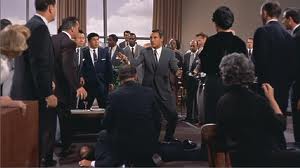
The opening credits alone sweep us viewers into the action before the bad guys even show up. Saul Bass’s sleek opening credit sequence works beautifully with Bernard Herrmann’s fandango-like opening theme music swirling tempestuously as Manhattan’s bustling citizens rush into subways and taxis—except for that distinguished, imposing gent who just missed the Fifth Avenue bus. Yep, it’s Hitchcock himself, literally trying to catch up with the credits. Just as well his cameo came early, because our hero gets few opportunities to relax and enjoy the scenery with the wringer he’ll be put through! Talk about Mad Men—as Madison Avenue ad man turned-red-herring Roger O. Thornhill, Cary Grant’s romantic panache and flair for comedy perfectly suit our literally dashing hero. The “O” stands for nothing, much like Roger himself at first. He’s a charming, slick executive used to having his own way in business and the boudoir, judging from the fact that he’s been married twice and is currently wooing a new gal with “candy from Blum’s, each piece wrapped in gold paper. She’ll like that; she’ll think she’s eating money.” Indeed, those aforementioned opening credits move at a rapid-fire pace, almost like one of the screwball comedies Grant made with Howard Hawks in the 1930s and ‘40s. We see that Roger is a man of smooth confidence, always in charge—until that fateful day at The Plaza Hotel’s Oak Bar when the name “George Kaplan” is called out at the wrong time, turning our hero’s life upside down! Roger has barely had time to knock back his cocktail before he’s kidnapped by the coolly sinister henchmen of a suave gent calling himself Townsend (Suave Hall of Famer James Mason). Seems these jaspers are convinced that Roger is really Kaplan, a government agent, and they’re not playing on Kaplan’s team. The outraged, bewildered Roger’s insistence that “I’m not Kaplan!” falls on deaf ears. He gets bourbon forced down his throat in Townsend’s gorgeous Glen Cove home, thanks to reptilian henchman Leonard (Martin Landau before TV’s Mission: Impossible made him a star and his performance as Bela Lugosi in Ed Wood made him an Oscar-winner), and is nearly killed in a funny/scary drunk-driving frame-up.

Roger, didn't Mother tell you
never to pick up strange knives?
From there, things go from bad to worse as Roger’s visit to the U.N. to confront Townsend results in more mistaken identity and our hero being framed for murder. And so the chase begins, monitored by spymaster The Professor (Leo G. Carroll, looking remarkably like one or both of the Dulles brothers)! Considering that NxNW is considered Hitchcock's greatest American film, it's ironic that its director and several of its stars happen to be British. Well, America is a melting pot, after all!

Yikes! Well, at least our heroes can't get sneezed on!
NxNW is truly the Hitchcock film to end all Hitchcock films, with all his pet themes covered with maximum wit, panache, and suspense: a wrongly-accused hero on the run, mistaken identity, a romance between Roger and soignée spy Eve Kendall (Eva Marie Saint in a sexy-cool change of pace from her Oscar-winning role in On The Waterfront) that's tender, sensuous, and full of surprises, on a chase that takes our hero from New York to Chicago to Mount Rushmore. But as engaging and dashing as Grant is, the smoothly villainous James Mason nearly out-suaves him. My husband Vinnie and I have joked that if Mason had played Roger, the film would have been over in minutes. With all due respect to Grant, if the imperious, unshakably confident Mason asked the Glen Cove police, "Do you honestly believe that this happened the way you think it did?" they would immediately reply, "Er, no, sir, you must be right, you're free to go, sorry we bothered you." NxNW was nominated for Oscars for George Tomasini’s film editing, the art direction and set decoration of Robert F. Boyle (who you may remember from last year’s sterling documentary Something’s Gonna Live), Merrill Pye, William Horning, Henry Grace, and Frank McKelvy (but not Best Director or Best Score, alas). Best of all, NxNW was nominated for Lehman's screenplay; in fact, he borrowed from it liberally for his suspenseful, rollicking script for the film version of Irving Wallace’s The Prize, starring Paul Newman! 

My copy of Ernest Lehman's great North by Northwest screenplay from the Rutgers collection
Roger wanted to catch a plane, but now the plane's
trying to catch him!

Why, no, porter, I don't have any fugitive-from-justice stowaways
here in my top bunk...not me, nope!


Feel free to share your favorite North by Northwest lore and/or anecdotes! 


"She's the kind of blonde that gets into a man's blood -- even if she has to shoot her way in!"
"Oh, shoot, darling, I can't stay mad at you!"