Friday, July 22, 2011

An Analysis of The Paranoia Flick, or: You're Not Paranoid if They Really ARE Out to Get You! - By Team Bartilucci

"You gentlemen aren’t really trying to kill my son, are you?”
Jessie Royce Landis, unconvinced that thugs Adam Williams and Robert Ellenstein want to do just that to Cary Grant in North by Northwest (1959)
The spy film typically features a suave, sophisticated man about town who shoots at suave evil men about town over, say, a vital document that both parties are after. A horror film pits some everyday nebbish against some slimy, slithery fiend from Hell that nobody understands, but that everyone can at least see. But when you merge these two concepts, pitting the everyday nebbish against the suave men about town over something that only the suave guys know about and the nebbish doesn’t even know he or she has, you have the beginnings of one of Team Bartilucci’s favorite types of films: The Paranoia Flick.

Foul Play: I'll be watching you! (And vice-versa!)
The basic idea of The Paranoia Flick is simple. Place a total nobody into a situation involving spies, secret codes, beautiful members of the (traditionally) opposite sex, and almost certain death, and watch them collapse. In these films, the most important factor is the actors in the assorted roles. The target must be somebody you can believe is scared. Clint Eastwood, for example, would never succeed as a paranoia target! Even at his age, you’d be sure Clint would come through it all, cool as an October breeze. But some vulnerable yet likable sort like, say, Goldie Hawn, who was wonderful in Foul Play (1978), works perfectly in such a role. In fact, the late Colin Higgins, writer/director of Foul Play and writer of Silver Streak (1976), had a gift for paranoid comedy-thrillers with a Hitchcockian flair.

It doesn’t matter why the star of the film is being chased hither and yon, either. Cary Grant asked Alfred Hitchcock why his character was being chased all over the map in North by Northwest. Hitchcock (and consequently, Leo G. Carroll as the spymaster known as The Professor) answered, “Oh, I don’t know. Government secrets, perhaps?” Hitchcock, of course, gave us movie fans the term “MacGuffin” for the plot device that gets the story and the characters moving. Our favorite use of this was in, of all things, a G.I. Joe episode, in which both Joe and COBRA were in heated battle over a weapon known as “The MacGuffin Device.”

The Man From U.N.C.L.E. used the idea of the innocent person asked to assist with spy activities on a regular basis, said person usually being a lovely young woman who either worked for the bad guy, or used to go out with him, or some other vague connection they could exploit. While the guest star knew the situation she was getting into , there were still lots of opportunities for them to become convinced that everyone was a Thrush operative except, of course, for the ones who were.

Paranoia Flicks are generally comedies; if the plot is not being played for laughs, it ends up being more of a thriller like the aforementioned North by Northwest (NxNW), or the pretty solid early Will Smith film Enemy of the State, but the basic pieces of the puzzle are usually there. All Paranoia Flicks, be they comedy or thriller, must have certain essential scenes in order to make the Paranoia Cut:

The Drop Scene.  This is when the main character receives the MacGuffin, often literally dropped into their hands, and pretty much everyone on the planet notices except our unsuspecting protagonist.

In the case of a film like
NxNW, Roger Thornhill (Cary Grant) doesn't get an object; he's simply mistaken for someone else, the mythical George Kaplan. In the 1947 classic The Secret Life of Walter Mitty (TSLoWM), Rosalind van Hoorn (Virginia Mayo) slips the book of stolen Dutch treasures into poor schlub Walter Mitty's (Danny Kaye) coat while he's busy dithering. In The Man with One Red Shoe, the oft-forgotten 1985 American remake of the 1972 French comedy classic The Tall Blond Man with One Black Shoe, Tom Hanks is himself the drop! He's identified as the contact who's carrying incriminating evidence by Edward Herrmann, but no such information exists — he's really just an unsuspecting decoy to give the other group of spies someone to chase and follow.

Gotcha! - Smoke gets in your eyes, spies get in your strudel..
The Misdirected MacGuffin.  Often, our protagonist thinks he knows what the MacGuffin is, and he ends up guarding some worthless object with his life, leaving the real MacGuffin at the villains’ mercy.

There’s a classic example in the delightful yet surprisingly underrated 1985 comedy-thriller Gotcha!  In East Berlin (long story), the lovely and mysterious Sasha Banacek (Linda Fiorentino) has handed a package to our innocent college-boy hero Jonathan Moore (Anthony Edwards) behind the Iron Curtain. Since Jonathan has been immersed in paranoia-inducing antics for a while at this point in the movie, when Sasha tells him the package contains strudel, Jonathan thinks it’s code for, oh, Secret Government Strudel, perhaps (“Strudel, riiiight, strudel….”).

Gene Wilder doesn't support his local sheriff!
The Explanation Sequence.  This is Team Bartilucci’s personal favorite amongst Paranoia Flick tropes! Here’s where our hero must convince friends and/or loved ones that he’s in real danger, and not insane. Some of the best lines usually happen here, as the main character babbles a Cliffs Notes version of the script, with all the credible stuff left out, and a lot of iterations of “I’m not crazy!” put in.

Since it's the easiest scene to make funny, there are scads of examples of classic explanation sequences.
In NxNW, perplexed hero Roger Thornhill tries to convince the Glen Cove police that he really was forcibly plied with bourbon by henchman Leonard (Martin Landau) and nearly killed in what was supposed to look like a drunk-driving accident. In a great twist, we don't hear Roger explain the events, we hear his lawyer (played by Get Smart's "Chief" Edward Platt) explain it all to the judge with a look of weary resignation on his face.

In
TSLoWM, not only does Walter try in vain to convince everyone that The Boot’s henchmen are trying to kill him, but thanks to a Mickey Finn, he awakens to find one of the chief bad guys, Dr. Hugo Hollingshead (Boris Karloff), pulling a Gaslight routine on him, claiming he only imagined his dream girl Rosalind.

In Silver Streak (1976), Colin Higgins’ first great paranoid Hitchcockian comedy-thriller screenplay, our hero George Caldwell (Gene Wilder), who
’s been traveling on the titular cross-country train, tries to explain the mysterious events and rising body count surrounding the MacGuffin to Sheriff Oliver Chauncey (Clifton James). In this case, the MacGuffin’s a book, The Rembrandt Letters, which contains startling revelations that would embarrass and disgrace the art-world bad guys if they don’t knock George off (and we don’t just mean the running gag about George constantly being knocked off the train). Naturally, our frazzled hero’s explanation is causing more confusion than enlightenment:  
Sheriff Chauncey: “Is he with the feds?”
George Caldwell: “Who?”
Sheriff Chauncey: “This guy Rembrandt.”
George Caldwell: “Rembrandt is dead!”
Sheriff Chauncey: “Dead? That makes four. Listen, fella, are you sure you’re not making this up as you go along? I’m an officer of the law and I got a lot better things to do than listen to that kind of funnin’. [Buzzer sounds] That's my hotline. Now you take your time to get your facts straight, ’cause when I come back, I want your answers clear and to the point. Got that? And you can start with who shot Rembrandt!”
The False Alarm.  Here’s where the main character overreacts to every snap of a twig, and thinks each stray glance means a spy or some other no-goodnik is on his trail. It’s usually at these points in the films that all the innocent people get hurt and/or humiliated, making the poor main character look even crazier. In Gotcha!, Jonathan runs a driver off the road when he mistakes them for Russian thugs following him, and pulls over to phone the police, frantically saying, "I want to report a following!"
The Turnabout.  Near the end of The Paranoia Flick, our protagonist has had enough of this evil folderol and fiddle-dee-dee, and finally gathers up all his intestinal fortitude and takes charge of the situation. This usually ends the film in a funny and/or exciting, suspenseful way, getting our hero back in the good graces of his friends and loved ones.

For example, after Walter Mitty finally finds and rescues his beloved Rosalind, he grows a backbone and starts using the tricks he picked up as a reader and editor of racy pulp magazines against his assailants, wiring doorknobs for electricity and setting up rope snares. Eventually he stands up to his family and so-called friends, and tells them off with a great bit of bravado
that even wows Walter’s fat-headed, credit-nabbing boss (Thurston Hall), to the tune of promoting Walter to Associate Editor:
“Now you’re all going to listen to me. For years I’ve been listening to you, and you nearly put me in a straitjacket! Your small minds are musclebound with suspicion. That's because the only exercise you ever get is jumping to conclusions. You ought to be ashamed of yourselves, every one of you!”
As an example of a film that hits every note perfectly, let's look at Dorian's personal favorite, Foul Play (1978), both written and directed by Colin Higgins, which, as good as it is, still beats the Higgins-penned Silver Streak to the title by 27 lengths.

Goldie Hawn plays lovable heroine Gloria Mundy (one of our favorite character names). Gloria lives in San Francisco (the film gives a nice tip of the hat to both Vertigo and Bullitt), but it’s no treat; she’s trying to adjust to her new life as a divorcee. Her friends suggest that she “take some chances.” So Gloria picks up a stranded but attractive motorist (Bruce Solomon of TV’s Mary Hartman, Mary Hartman and Lanigan’s Rabbi), and wouldn’t you know the cute motorist-in-need, Bob “Scotty” Scott, is an undercover police detective on a case? Scotty turns on the charm and makes a date with Gloria for that night at the local revival theater. He surreptitiously slips a roll of film into his half-empty pack of cigarettes (The Drop), then asks the unsuspecting Gloria to hold onto his cigarette pack until their date, claiming it’ll help him cut back on his smoking. Alas, the bad guys get Scotty first; he staggers into the dark theater wet and bleeding, spending his last moments trying to distract Gloria from the film noir onscreen, his last words being “Beware of the dwarf.” By the time Gloria realizes what’s happening and rushes to the manager (Team B. fave Chuck McCann) for help, Scotty’s corpse has vanished, and the paranoia has taken a ringside seat.


Soon Gloria’s being terrorized by a man with a scar (Don Calfa) and one Whitey Jackson (William Frankfather), an albino in a white suit. These evil jaspers work for a hit man known as “The Dwarf.” In the following excerpts, the bad guys had broken into Gloria’s apartment, looking for that cigarette pack. None of them realize it’s hiding in plain sight, having fallen out of Scarface’s hand during the attack at Gloria’s charming apartment. They’re also unaware that the film in that cigarette pack contains evidence about an assassination taking place that week! Alas, Gloria fainted after seeing Scarface shockingly killed by Whitey's flying dagger (loss of consciousness is a time-honored recurring theme in Paranoia Flicks), so by the time she comes to and finds her apartment tidied up and corpse-free, she has a hard time getting through The Explanation Sequence of her nerve-shattering experience to police detectives Lt. Tony Carlson (Chevy Chase in his first leading-man role) and Inspector “Fergie” Ferguson (Brian Dennehy):
Gloria: “The dead body! It’s gone! It vanished!”
Tony: “Well, maybe it was embarrassed. Come on in here. I think you’d better sit down.”
Gloria: “But you don’t understand. The body has disappeared.”

Fergie: “Whose body was it?”
Gloria: “I don’t know. A man with a scar. He tried to murder me, but I stabbed him with the needles.”
Fergie: “Oh, narcotics, huh?”
Gloria: “No, knitting….I’ve got it! It must have been the albino…He’s the one who killed the man with the scar.”

Fergie: “I thought you killed the man with the scar.”
Gloria: “I did. Except he killed him after I killed him. See, I didn’t really kill him, I just stabbed him with the needles, right after he heard the cuckoo.” (Cuckoo clock cuckoos on schedule.)
Fergie: “Why did he wanna kill you?”
Gloria: “I’m not sure, but I think it was because of the cigarettes.”

Tony: “He wanted a cigarette?”
Gloria: “No, he wanted the whole pack!”
Fergie: “Kind of greedy.”
Gloria gets a visit from Innocent Dwarf J.J. MacKuen (Billy Barty) after she's been assaulted a couple of times, and has a hilarious False Alarm all over him, giving Barty a chance to do the physical comedy he so excelled at. While they never actually find the MacGuffin in the film, it remains Misdirected in that they think the pack of cigarettes itself is what they're after, not the film canister within.

She gets a couple of Turnabout scenes in the film, one rather early in the proceedings as she takes out a comic-book-reading moron (*sigh* — too long was comic-book-reading by an adult a shorthand for simple-mindedness. But I digress....) with the aid of some anti-rape gear provided by ubiquitous-at-the-time Marilyn Sokol. As Janet Maslin noted in her New York Times review of Foul Play, “…when a thug makes the mistake of catching Miss Hawn by surprise, she greets him with the most adorably indignant little shriek the movies have witnessed in years. Miss Hawn often looks frightened…but she even more often looks tremulously furious, and that’s her secret weapon…once (trouble) arrives, she’s never too out-to-lunch to lose her temper. And her anger, imbued with all the quivering, outraged self-righteousness Miss Hawn can muster, is enough to make the most hardened villain or moviegoer melt.”


Strangely enough, the greatest Paranoia Flick of all time is missing quite a few of the classic factors. We refer, of course, to writer/director Theodore J. Flicker's The President’s Analyst (1967), starring James Coburn, who had the coolest and scariest (in a good way) smile in show business. Coburn plays Dr. Sidney Schaefer, who’s appointed to be the titular role at the recommendation of his analyst Dr. Lee-Evans (Will Geer), after being thoroughly vetted by "CEA" agent Don Masters (Godfrey Cambridge). When Masters reveals his true identity, Sidney, used to having delusional patients before, asks for ID. Imagine his surprise when he gets it!

After a few sessions with the President, Sidney realizes that he is learning far too much in his position, and he starts worrying that all the world’s rival governments will try to kidnap him or even kill him for what he knows — and it turns out he’s right! At one point, when he realizes that even his lover, the sweet, gentle Nan (Joan Delaney), is a spy sent in to keep tabs on him (giving new meaning to the phrase "undercover agent"), Sidney flees Washington with the help of a typical suburban family (led by William "KITT" Daniels), only to find he’s being followed by every combination of the "Same Alphabet Soup" a la NxNW, up to and including the Canadian Secret Service.  As proof of the counterculture spin of the film, the only people in the entire film not out to capture or otherwise exploit Sidney is a busload of hippies he joins up with. Eventually he's captured and handed over to Kropotkin (the whamtaculous Severn Darden) who Sidney proceeds to psychoanalyze and turn to his cause.

The real enemy in the film comes from so far out in left field that it was playing in another stadium! If you’ve seen The President’s Analyst, I’m sure you’ll agree it’s one of the most devious paranoia flicks of all time. If you haven’t, it’s available on DVD, and through Netflix.
Got a favorite Paranoia Flick you’d like to praise to the skies, if you dare? Don’t be afraid — tell us about it before it’s too late!

A Paranoia Picture is Worth a Thousand Words!

Friday, July 15, 2011

DIAL and DIAL Again!

"Can’t a fellow look beyond a tennis net without being out for something?" Farley Granger in Strangers on a Train (1951)

This week's TotED post salutes Dial M for Murder, both seriously (Alfred Hitchcock's classic film version) and funny-side-up (Scott Fivelson's one-act play Dial L for Latch-Key)! (Mind the spoilers!)


Dial M for Murder (1954)


From Woman in White with Tony
To answer Granger's question: not in an Alfred Hitchcock movie! Former tennis champ Tony Wendice (Ray Milland) comes off all smooth and debonair, but unlike Farley Granger as Guy Haines, Tony’s not a nice Guy! In Frederick Knott’s smashing, diabolical 1952 stage thriller, Dial M for Murder (DMfM). Tony makes caring, husbandly noises around his beautiful, wealthy wife Margot (Grace Kelly), but in the wordless opening sequence, it becomes clear that she’s really just a meal ticket to Tony. No wonder she and her former boyfriend, American TV writer Mark Halliday (Robert Cummings, a Hitchcock alumnus as the hero of 1942's Saboteur) are picking up where they left off.  To be fair, Margot and Mark seem to feel a little guilty, wanting to do the right thing, but those crazy kids are stuck on each other. Tony feels stuck as well, clearly realizing his days of sponging off Margot are numbered. To borrow a line from Anthony Shaffer’s Sleuth, Tony is finding murder less burdensome than alimony. So Tony hatches a cunning plan, involving blackmailing a fellow blackguard from his college days, one Captain Lesgate…or is it C.A. Swann? (Either way, he's played by Anthony Dawson from Dr. No, among others.) Like Cary Grant’s character in Charade (1963), Swann seems to have aliases aplenty, not to mention a trail of debts and at least one dead body: “Poor Miss Wallace....” So Swann falls in with the plan, which involves keys under a staircase carpet and the split-second timing of a fatal phone call. But you know what they say about the best-laid plans….
...to Lady in Red with Mark!

A smash hit on London’s West End and Broadway in 1952, it didn’t take long for Hollywood to come a’knockin’. Warner Bros. was keen to get Alfred Hitchcock to direct the 1954 film adaptation, and Hitch signed on, although his heart wasn’t quite in it. In Adam Philips’ excellent review of DMfM in his blog Hitchcock and Me, he also pointed out that John Williams’ character, Chief Inspector Hubbard, “may have rubbed Hitchcock the wrong way, as competent police officers in Hitchcock’s pictures are few and far between.” But once Hitchcock met his new leading lady, Grace Kelly, an actress-director dream team was born! Hitchcock and Kelly collaborated on three movies before she traded Hollywood royalty for Monaco royalty, the other two films being Rear Window (1954) and To Catch a Thief (1955). But the team-up with Kelly wasn’t the only “first” here for Hitchcock: it was also the first—and only—time Hitchcock used the original 3-D format. With that particular 3-D process being a big fad at the time, producers attempted to woo TV audiences back into theaters, complete with the original 3-D glasses, annoying though they were. Warner Bros. insisted that Hitchcock capitalize on the 3-D fad. The stereoscopic technique was a clunky, cumbersome nuisance, but Hitchcock agreed to use it, only to have DMfM released in a “flat” version anyway! Vinnie and I actually got to see the 3-D version several years ago in my hometown, at New York City’s Film Forum. Despite the glasses’ shortcomings, we thought it was pretty darn cool, especially the scene where our gal Grace manages to grab the scissors and kill Swann in self-defense! Admittedly, sometimes it also had us snorting with laughter for the wrong reasons, like when the liquor bottles on the Wendices’ wet bar seemed to be jumping out at us moviegoers. It got me wondering what a 3-D version of The Lost Weekend starring DMfM star Ray Milland might have been like!

Have you seen your husband, baby, standing in the shadows?
Considering DMfM was filmed in color (WarnerColor, no less! Technicolor, Schmechnicolor!), it makes great use of shadows and angles, especially when the camera slowly maneuvers upward. It’s almost as if God Himself is sternly looking down on Tony and Swann plotting Margot’s murder, thinking, “You two are gonna get it! Taste my wrath, you evil jaspers!” I love the look on Swann’s face as Tony shares his juicy story of stealing Margot’s love letter and blackmailing her. They’re almost like yentas gossiping over coffee and cake—or, considering this is set in England, tea and scones. And all the while, Tony is matter-of-factly wiping down incriminating fingerprints, the shifty old slyboots!

Vinnie Can’t Resist Chiming In: There was a Hallmark Hall of Fame version of Dial M... done back in 1958 – the only returning cast member was the wonderful John Williams. He too is a recurring figure in Hitchcock’s work. In addition to Dial M... and To Catch a Thief, Williams appeared on Alfred Hitchcock Presents eight times, playing functionally the same police inspector character three times, one being the epic three-part "I Killed The Count." John Williams had a heck of a career before he started telling us about the themes from “A Stranger In Paradise’ we first found in The Polovtsian Dance No. 2 by Borodin.


As Tony Wendice, Ray Milland gives one of his most compelling performances; indeed, I’d go so far as to name Tony among my Top Five Hitchcock Villains. Look at the way he manipulates Margot into staying home doing his “boring clippings” instead of going to a movie as she’d originally planned. After Tony gets home to discover that would-be victim Margot fought back and ended up killing Swann in self-defense, you can almost see the calculating in Tony’s eyes as he figures out how to make this “ghastly accident” work in his favor, the meticulous son of a bitch! (I still wince every time I see Swann fall on his back, plunging the scissors in deeper!) Grace Kelly won my sympathy as she proved to be perhaps the quintessential Hitchcock Blonde. (It didn’t hurt that her entrance is accompanied by Dimitri Tiomkin’s lushly romantic music.) Having said that, for me, North by Northwest’s Eva Marie Saint was a darn close second! In any case, John Williams steals the show as Chief Inspector Hubbard. He’s almost like a more dapper Columbo in that he can seem slightly absentminded, but when things get serious, he turns out to be a sly fox after all. When he does, you find yourself glad to be on his side!

Guess who came to dinner? Hitchcock's cameo!
Robert Cummings always seems to be written off as a lightweight, but I nevertheless found myself liking him as Mark Halliday. (Wonder if his character was named after crime author Brett Halliday?) Maybe it’s because I’m predisposed to like affable mystery writers, having known a few. Also, it seemed to me that Mark truly loved Margot, and vice-versa. I’ve always liked that bit in the apartment where Mark looks at Margot while talking about how it’s hard to write a perfect murder because “things don’t always work out”— and we know darn well he’s not talking about crime stories. C’mon, cut the guy some slack! He did save his sweetie, albeit with a little help from Hubbard. I thought Tony would soil himself when Mark unwittingly suggests a way to save Margot that sounds an awful lot like Tony’s murder plot. I always feel like cheering when Hubbard turns out to be truly on our heroes’ team: “They talk about flat-footed policemen. May the saints preserve us from the gifted amateur!” And such a British ending: cocktails in the face of adversity!


Dial L for Latch-Key (2010)

When fellow blogger Adam Philips of Hitchcock and Me reviewed Scott Fivelson’s 2010 comedy Dial L for Latch-Key (DLfLK) this past April, I thought it sounded hilarious, and I would have loved to see the much-praised live stage production if it had been within a reasonable distance of my Pennsylvania home. Alas, it was only playing at the New End Theatre in London, England, and the airfare alone was too rich for my blood. But in June, I got the next best thing: an invitation from Rick Tannenbaum of Hen House Press (http://loveandpublishing.com) , inviting me to read and review the paperback edition of Fivelson’s one-act play.

I’m pleased to say DLfLK was great fun to read, and chock full of affectionate madcap spoofing of not only DMfM and Alfred Hitchcock’s favorite tropes, but also Hitchcock-inspired thrillers ranging from The Manchurian Candidate to Charade. I could see the play’s zany absurdist shenanigans in my mind as I read it. The plot starts off in a Dial M for Murder vein, then veers cheerfully off in the wildest directions. Even the props—like the trunk festooned with such travel decals as “Tower of London” and “Alcatraz”— are a hoot. So are the stage directions. For example:


(Enter RAYMOND, an impeccable sophisticate with an insufferably self-satisfied air. Tropical shirt. Perfectly pressed Bermuda shorts. High socks. Brand new tennis shoes. Slicked-back shoe-polish dark hair. In a buoyant mood.)

(Enter G and BOB…G is grace personified. Her golden blonde hair and radiant bearing doing all they can to raise her above her current circumstances, mink coat only partially concealing the old-movie-style striped prison uniform worn beneath it.)
(At her side, Bob, American, a handsome cipher. HIS overcoat draped over one arm. Bob is at all times reining in a boundless, featureless energy, happy to be anywhere he is. Because HE’S there. In a word, American.)

You could make a drinking game out of the references to Hitchcock-style elements! (I’m a teetotaler, so I’ll be the designated driver.) DLfLK is grand smart-alecky fun, with a broad, affectionate wink to the thrillers we grew up loving, whether we first saw them in actual theaters or on TV. Hen House Press is also producing a radio play of Dial L for Latch-Key for an NPR affiliate in New York, so keep your eyes and ears open for further developments. For more information on Dial L for Latch-Key, contact Rick Tannenbaum at Hen House Press via Twitter (@eHenHouse) or e-mail (oppknx@yahoo.com).

Inspector Hubbard combs every inch...


Is there no end to the hot smooching?

Saturday, July 9, 2011

SLEUTH: Doppler Jeopardy

This post, Sleuth: Doppler Jeopardy, is my entry for the Vivien Leigh and Laurence Olivier Blogathon, hosted by Kendra Bean.

(Warning: You may find Spoilers amongst the clues!)

In honor of our Fearless Leader Kendra's Vivien Leigh and Laurence Olivier Appreciation Blogathon, we of Team Bartilucci are proud to participate by saluting one of our absolute favorite films of all time: the 1972 film adaptation of Sir Anthony Shaffer's diabolically suspenseful, witty international stage smash Sleuth.

Dorian says: Vinnie was particularly keen to participate, having loved Sleuth even before I did, so props to my dear hubby for writing the lion's share of this post! Director Joseph L. Mankiewicz of the Oscar-winning All About Eve (among so many other smart, entertaining movies) was a top-notch choice to direct the film version. Cole Porter songs are sprinkled throughout John Addison's sprightly, playful Oscar-nominated score. Ken Adam's production design for Andrew Wyke's grand home, Cloak Manor, is mouth-watering; we want to live there when we grow up! Mankiewicz’s dark, twist-laden, cracking good comedy-thriller works on many levels, including as an indictment of the class system. Too bad Sir Laurence Olivier and Michael Caine couldn’t have won some kind of Team Oscar for their work in this one; you know, like the Screen Actors Guild Awards. In 2007, Sleuth was remade with Kenneth Branagh at the helm, with Caine now in the Olivier role and Jude Law in Caine’s original role.  A great remake is rare (the best ones that leap to mind are the 1941 Maltese Falcon and the 2001 Ocean’s Eleven), but the first half of the Sleuth remake was sleek and entertaining, until it suddenly took a bizarre wrong turn into gay-bashing and humiliation—not our idea of fun! In the meantime, you can still find copies of the out-of-print DVD edition of Sleuth on Netflix or even your local video store, so by all means seek it out!  Take it away, Vinnie!

Vinnie says: In a perfect world, a mystery should keep the audience guessing. With enough twists and turns, you shouldn't have a clue (pardon the choice of words) of the outcome, while still playing fair enough that a viewer might succeed, or could at least admit that he could have once the facts were laid out in the dénouement.

Sleuth has an unfair advantage. It's not a mystery. There is no murder (OK, there's one), so there's no need to play fair with the audience. There are only two men, one pompous and petty, the other angry as hell, in a long game of cat and mouse. The scenes play out so long that your confidence that things are as they are is stretched just past the point of confidence, and as soon is it is, they pull the rug out from under you.

Cloak Manor in the merry month of maze
Sir Laurence Olivier plays Andrew Wyke, endlessly award-winning author of the St. John Lord Merridew mysteries. Andrew is a classic upper-class British aristocrat, and has filled his home and his life with an obsession for games, puzzles and other things used by the insufferably intelligent to prove they are smarter than "ordinary people." He's dictating the end of his latest mystery as the film begins, safely hidden within his vast garden maze, which is of course rigged with cheats so he can win. He's met by Milo Tindle (Michael Caine), a hairdresser who's been having an affair with Andrew's wife Marguerite. Andrew is remarkably polite and accepting of the situation; indeed, he wants to arrange a scenario where everyone wins.

We’re not in Brother Lightfingers’ abbey, we’re in a hurry!
Andrew lays out the board simply: if Milo runs off with Marguerite, she'll need a divorce, and she will take Andrew for far more than he wishes or feels she deserves. However, if Milo plays the role of a burglar, steals a large cache of Marguerite's jewelry from the house safe, and fences them with a gentleman whose contact information Andrew will supply, Andrew will be able to get reimbursed for the loss from his insurance, Milo and the lovely Marguerite will end up with more money than they would from a divorce (especially since it'll be under the table and tax-free), and everybody can walk away whole and unravaged by the law. Milo agrees, and Andrew drags him about the house in a mad pantomime of a robbery, dressing him in a clown costume, walking him through the robbery and guiding him as to what bits of the house he should upset to make it look as if a scuffle has taken place. This last portion is where Milo chooses to stray from the script and get a tad more zealous in his disarraying activity.  (Dorian says: As writers ourselves, we can empathize with Andrew's dismay as Milo tossed his new manuscript all over Andrew's luxurious home! OK, back to Vinnie!)

The Day The Clown Cried—For Help!
Things take a turn for the hearse when Andrew points his gun at Milo and informs him that this has all been a plan for Milo to incriminate himself as a burglar, so that Andrew could legally shoot him in defense of his home. Dropping the friendly attitude he's had through the larcenous romp, he declares himself so far above Milo in station and intellect that he barely considers this to be murder. He fires the gun at the base of Milo's skull, Milo tumbles down the stairs of the living room in a crumpled heap, and Andrew calmly heads back downstairs to tidy up.

End scene.
Not bad, eh?

It was at this point in the stage play that Alan Bates left the theater after being offered the role of Milo, as he thought a character that dies midway through the story a la Psycho was beneath his position as an actor. In fairness, he's not the first to have jumped to that conclusion. (Though it does show that it's wise to sit through the entire play before making up your mind!)

Laura, er, Marguerite is the face in the misty light...
The narrative continues an unspecified period of time later. Andrew is puttering about his home, alone (as he always is — we never meet his wife Marguerite, save for her portrait, painted to resemble Joanne Woodward) when the doorbell rings. It's Inspector Doppler (Alec Cawthorne) who comes to ask about the mysterious disappearance of one Milo Tindle. At first feigning any knowledge of the man, when the Inspector presents a note in Andrew's handwriting, found in Milo's home, asking that they meet, Andrew is forced to put his cards on the table. Milo, he explains, was here, put through a series of escapades, and finally, Andrew shot him.

With a blank.

The entire affair was to put Milo through such terror and humiliation as to find out his true mettle, to see if he was "worthy" of his wife. Andrew decided he was, and when he awakened, Milo was allowed to leave, if not with his pride intact, at least his head.


Oh, you've got brown eyes, oh, you've got blue eyes....
The inspector is appalled to learn that someone could play such a ghastly trick on another person, and insists that he inspect the home. Andrew agrees happily, but when Doppler begins to find evidence of a far more serious act than a mere April Fool's trick (blood on the stairway, Milo's clothes balled up at the bottom of the wardrobe), he puts forth the theory that Andrew had, in fact, killed Mr. Tindle, albeit accidentally, and has disposed of the body to make the problem vanish. Andrew is dumbfounded and protests his innocence, insisting that his tale is true, and more than a little offended that this flatfoot wouldn't just take the word of a gentleman at face value and leave. As he begins to panic that he may be arrested for a crime that never even happened, let alone one he didn't commit, Doppler lowers the boom. He begins to remove makeup and padding, standing revealed as...Milo Tindle (Caine)! With the help of some stage makeup artist mates and a key he obtained from another acquaintance, he set up this charade to take Andrew to that point of fear for his life that Milo experienced. Andrew begins to regain his composure, and immediately starts shoring up the levees that his panic nearly burst. He knew it was Milo all along, was playing along to give him the fun of the game, a verbose version of "I let you win." (Dorian says: Surrrre you did, Andrew.... See how you like it, buster! Back to Vinnie!))

And that's when Milo reveals Act Two. While at the house to set up the evidence, he met Andrew's mistress, a young bit of stuff named Téa. They spoke, she had no problem believing that Andrew would play such a trick, Milo shags her rotten...and then strangles her. He then explains that he has contacted the police. They will be there within the hour to ask Andrew about, not Milo's disappearance, but Téa's. And Milo has planted three pieces of incriminating evidence about his palatial home to connect Andrew to the murder . He's sure the police will find them soon enough, but for Andrew to do so within this tight time frame, he'll need to play Milo's game.

Is it me, or is Andrew a little TOO into his toys?
The film ends with one dead body, police at the door, and the laughter of Laurence Olivier over some jaunty harpsichord music. And we haven't spoiled the ending at all.

While they give credits for several actors (including the aforementioned Alec Cawthorne, which is "a virtual anagram" of the words "or Michael Caine" if you manipulate a couple letters), it's a two-man play, and both Olivier and Caine were nominated for Oscars, among other major awards. Anthony Shaffer won a Tony and an Edgar, among other prizes. Sleuth rivals Deathtrap as the perfect comedy-thriller.

Kenneth Branagh remade Sleuth in 2007, with Caine graduating up to Sir Larry's role and Jude Law stepping into Milo Tindle's pricey Italian loafers. The first half of the film is very well done, with many technological upgrades to make Milo's attempted robbery all the more embarrassing, and the threat of murder after the act more realistic and less imperious. But alas, the last act descends into an overlong game of "Fag."

Perhaps it wasn't called that in your circles. Back in the days of childhood, before we Knew Better, boys would go to great lengths to get their friends to admit that at times, in the secret part of their heart, they'd thought that that guy was attractive, or that they'd wondered fleetingly wht it might be like to touch certain things or have certain things in their mouth. As soon as they would, the other assembled friends, who attoseconds before were swearing it was just between them, no one would mock anyone, lifted their fingers and pointed like Donald Sutherland at the end of the 1978 version of Invasion of the Body Snatchers and scream "FAAAAAAAAG!!!!!!!"

It's annoying, outdated, and shoehorned in from so far out in left field that it makes one want to wash. In short, it can't hold a candlepin to the original. The 1972 version of Sleuth holds up today, and can still surprise new viewers. It is worth missing a hand or two of cards and watching.

* * * * * * * * * * * * * * * * * * * * * * * * * * * * * * * * * * * * * * * * * * * * * * * * * * * * *
Wow, I think this may have been one of Team Bartilucci's most prolific writing weeks to date! After you've read (and enjoyed, we hope!) our Sleuth blog post, feel free to visit Tales of the Easily Distracted for our very recent post about James Garner, "Discretion is the Garner Part of Valor." 

Friday, July 8, 2011

Discretion is the Garner Part of Valor

This week, we of Team Bartilucci are saluting one of our favorite actors, James Garner. We mentioned his playful suavitude as one of our Suave Hall of Famers last October in our "Flico Suave" blog post. But by golly, the former James Bumgarner deserves a post all his own, so here it is!


Dorian's Pick - Marlowe (1969): Out of the Past, Into the '60s
Before the good people of Warner Archive recently made Marlowe (1969) available on DVD, I think the last time I saw it was on the 4:30 Movie when I was a kid in the Bronx! But before we talk about James Garner’s performance as author Raymond Chandler’s iconic private detective Philip Marlowe, I think it’s important to provide some background. Marlowe has been played in the movies (and on TV and radio, too, but let’s stick to the movies for this post) by a remarkable variety of actors, with performances ranging from the sublime to the ridiculous. For me, I’m afraid Elliott Gould in The Long Goodbye wins in the “ridiculous” category. In Robert Altman’s version, Gould looks and acts like he’s auditioning for Columbo. Yes, I know the Gould/Altman version has its fans, and I’ve liked Gould in other roles, but I just don’t think he’s a good fit as Philip Marlowe. Years earlier, in 1947, George Montgomery had tried his hand at playing Marlowe in The Brasher Doubloon. I’ve never had an opportunity to see the film, alas, but judging from the trailer and the bits and pieces of the film I've seen on YouTube, young Montgomery was trying to look older behind a dapper mustache. Eventually, Montgomery quit show business to run a wildly successful furniture business. Does anybody here know if there's a legal DVD of The Brasher Doubloon available anywhere? But I digress….

Happily, the sublime Marlowes outshine and outweigh the lesser ones. My own favorites include Humphrey Bogart in Howard Hawks’s 1946 film version of Chandler’s first novel, The Big Sleep; Robert Montgomery directing himself in MGM’s offbeat but compelling 1947 adaptation of Lady in the Lake (I’ll admit that one’s an acquired taste, and by golly, I’ve acquired it!); and three different but thoroughly entertaining versions of Chandler’s 1940 novel, Farewell, My Lovely. The first film version actually used the plot for one of George Sanders’s Falcon movies, The Falcon Takes Over (1942). Instead of Chandler’s Los Angeles, The Falcon Takes Over is set in my beloved New York City, with Ward Bond as Moose Malloy and Team Bartilucci fave Hans Conried as Lindsay Marriott. Edward Dmytryk’s Murder, My Sweet (1944) was a far more faithful adaptation despite the title change; the producers were afraid that the title Farewell, My Lovely sounded too much like a musical. But by any title, Murder, My Sweet helped Dick Powell shatter his image as a crooner, establishing him as a big-screen tough guy forevermore. Dick Richards’s 1975 version restored the original Farewell, My Lovely title, and Robert Mitchum commands the screen as another one of my favorite Marlowes. Mitchum was terrific in Michael Winner’s 1978 version of The Big Sleep, too, although I wasn’t crazy about many other aspects of the film, especially its transplant from 1946 Los Angeles to 1978 England, and its overreliance on blood and violence to keep audiences awake.

Electric Company: Sparks fly between Marlowe and Dolores 
This leads us to Marlowe star James Garner at last! Vinnie and I have been die-hard Garner fans since we were kids. When we were growing up, we watched him on TV in his long-running TV series The Rockford Files, not to mention vintage reruns of Maverick and films like The Great Escape (1963), The Americanization of Emily (1964), 36 Hours (1965), The Thrill of it All (1963), and so many other terrific films of many genres. Garner is always a likable onscreen presence, with a touch of the antihero about him and more acting range than people give him credit for. Garner is another one of those actors who makes it look easy, rather like a laid-back American Cary Grant. He has a wry, breezy style (I get a kick out of his catchphrase “I’m a trained detective”), but he’s also tough, sardonic, and introspective when he needs to be. He even matches Marlowe’s description in the novels; what’s not to like?

Marlowe certainly has a promising pedigree, with a terrific cast and multi-award-winning screenwriter Stirling Silliphant (In the Heat of the Night, Charly, The Towering Inferno) adapting Marlowe’s script from Chandler’s 1949 novel The Little Sister. Indeed, the theme song was actually titled “Little Sister,” with music by Peter Matz and lyrics by Norman Gimbel, sung by the then-popular band Orpheus, who’d had a big hit with “Can’t Find the Time.” Lang Thompson’s absorbing article on the TCM Web site describes Orpheus as “a psychedelic pop band,” but for me, “Little Sister” and the other Orpheus songs I found on YouTube evoked The Lettermen’s greatest hits more than, say, The Strawberry Alarm Clock’s “Incense and Peppermints.”


The opening credits show a young man taking surreptitious photos of a sexy couple getting wet and wild in what’s obviously supposed to be a private pool. The woman turns out to be popular sitcom star Mavis Wald (Gayle Hunnicutt), who should perhaps use some of her sitcom earnings for better security, or at least better friends. You see, Mavis’s pool buddy turns out to be notorious mob boss Sonny Steelgrave* (played by H.M. Wynant, whose many TV and movie appearances include roles on 77 Sunset Strip, Alfred Hitchcock Presents, Maverick, and the genre spoofs of Team Bartilucci favorite Larry Blamire, of The Lost Skeleton of Cadavra fame). Can you say “blackmail”? I knew you could!


Party line-up with camera shop guy,
Marlowe, & his girl Friday, er, Julie
We first see Marlowe when he comes to question one Haven Clausen (love these names!) about Orrin Quest (Roger Newman), the missing person our hero is trying to find. The investigation comes to a literal dead end when Marlowe discovers Clausen with an ice pick in the back of his neck. Cut to our exasperated hero Marlowe and his memorably-named young client, Orrin’s sister Orfamay (Sharon Farrell, who moved on to even greater success in the long-running TV soap opera The Young and the Restless). To borrow a line from Clifton Webb in Laura, Orfamay seems to have “come from an incredibly rustic community where good manners are unknown,” not to mention common sense and emotional stability. Orfamay accuses Marlowe of not trying hard enough to find the long-missing Orrin, who’s apparently gone underground with the hippie/flower-child types, this being set in 1969. Maybe Orrin ran off to be an Orpheus roadie? In any case, Orfamay runs hot and cold under the best of circumstances, tearfully angry at Marlowe one minute and trying to seduce him the next, which might have interesting possibilities if she didn’t dress like a little kid wearing her granny’s dresses, among her other oddball qualities. As gallant as he is world-weary, Marlowe returns Orfamay’s retainer, but over the course of the film, she keeps popping up with her hot-and-cold routine. Look, Toots, Marlowe gave you back your retainer; quit pestering the poor guy and find another P.I. already!


Whodunit? Take your pick!
But even a pesky, emotionally unstable client is better than a dead one. That ice-pick killer is shaping up to be a serial killer, and the latest victim is one of Marlowe’s clients, Grant Hicks (Jackie Coogan). Marlowe calls from the boarding house, trying to get info about Hicks’s murder by feigning a folksy Southern drawl: “I’m a former tenant in Clausen’s roomin’ house. I was just checkin’ out when he tried to call you. That was before somebody mistook him for an ice block.”

Future Emmy-winner Paul Bogart directed; ironic, considering that Humphrey Bogart (no relation) was, in my opinion, the best movie Marlowe (no offense intended to the beloved star we’re saluting this week). Entertaining and well-cast though it is overall, Marlowe could have used a tweak or two. Silliphant’s script works hard to balance out the old and new elements, but the movie sometimes felt a bit unstuck in time to me. True, Quentin Tarantino has been doing that in his films since the 1990s, but Marlowe sometimes feels like its Chandler-esque elements are being shoehorned in. The characters’ first names sound very 1940s even though the setting is 1969 L.A., which might well have been intended as a tribute to Chandler’s original material. And I know the hairstyle Hunnicutt wears in the scene in Mavis’s apartment was probably cutting-edge in the late 1960s, but I wish she had cut it off instead. It makes the otherwise beautiful Hunnicutt look like she has ultra-long sideburns! Does the fact that Chandler’s 1949 novel was updated for the 1969 movie version make this a period piece for us 21st-century viewers? That said, when the ’40s elements work, they work quite well indeed, like placing Marlowe’s office in L.A.’s landmark Bradbury Building.

When Marlowe’s client gets knocked off, there’s hell toupee!
In addition to Garner, Hunnicutt, Farrell, and Coogan, Marlowe’s great cast sparkles with past and future award-winning TV and film stars, including Carroll O’Connor as Lt. Christy French, before the groundbreaking sitcom All in the Family put him on the map as bigoted loudmouth Archie Bunker; Rita Moreno, who later had a recurring role on The Rockford Files with Garner, as well as winning an Oscar (for West Side Story), a Tony (for The Ritz), a Grammy, and and Emmys, ALMAs, BAFTAS, and so many more, bless her! No wonder Moreno is listed in the Guinness Book of World Records! And let's not forget superb supporting actors William Daniels (not to be confused with the film’s Director of Photography, Oscar-winner William H. Daniels!); Jackie Coogan as the ill-fated Grant Hicks; and Kenneth Tobey (The Thing from Another World, among others) as Sgt. Fred Beifus.

Warning: Drugged cigarettes can be hazardous
to a private eye's health!
The plot has shades of old Hollywood, including a nice bit where Marlowe is in a TV station and finding himself more absorbed in a Greta Garbo film than in the live rehearsal going on. But with all due respect to Garner and company, it’s young Bruce Lee who steals the show as smiling, snappily-dressed henchman Winslow Wong, who basically beats up Marlowe’s office! Lee only has two scenes, but they’re the very best scenes, if you ask me. Good thing Marlowe doesn’t have any staff; someone could get hurt! Ah, the pros and cons of being an independent contractor!

Who needs HGTV? Leave your next office makeover to Winslow Wong!

*
“Sonny Steelgrave” was a character name also used by the late writer and TV producer Stephen J. Cannell, if I recall correctly. (Vinnie says: "She's right - he was a bad guy on the first season of Wiseguy, played by Ray Sharkey.")


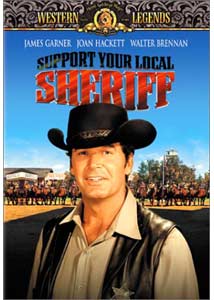
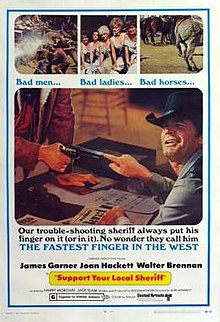
Vinnie's pick - Support your Local Sheriff (1968) : "We're All Behind Ya!"
Most of James Garner's greatest roles are virtuous men who know how to fight perfectly well, but choose to think, talk or bamboozle their way out of a situation, if not just plain run away, so they may live to to run another day. Jason McCullough, lead character of Support Your Local Sheriff, is a perfect example of this. He arrives in Calendar, Colorado a short time after gold is discovered in the open grave of one Millard Frymore. Everyone's so gold-mad that the few people in the service industries (and I don't mean Madame Orr's House) are able to charge eight dollars for a "tasty home-cooked meal" and twenty for an eight-hour shift on a cot, so Jason is forced to find work, and the position of Sheriff happens to be available. As opposed to the previous three holders of the position, Jason takes to it easily, using a combination of confidence, bluster, and a reputation that spreads like wildfire. Ten minutes on the job and he arrests Joe Danby (Bruce Dern) whom he saw kill a man in a gunfight earlier in the day. Now the brand new jail has no bars yet, but with the help of a few drops of red paint on the floor to pass as blood, Joe stays in his cell nice and tidy.

The town is filled with wacky characters played by beloved character actors, including Harry Morgan, Henry Jones and Jack Elam as Jason's deputy Jake. Joan Hackett plays the mayor's daughter Prudy, a tomboyish young lady who doesn't seem to know what to do with her hands when the Sheriff's around. Garner walks smoothly through the chaos unruffled, pulling his gun when he has to, but most of the time getting people to do what he wants by wits and generally confounding the hell out of everyone. When Pa Danby (Western legend Walter Brennan, parodying his role in My Darling Clementine) shows up to break Joe out of jail, Jason stops him by sticking his finger in Pa's gun barrel. After killing endless hired guns, he drives one out of town by throwing rocks at him.

When the Danbys assemble a small army to come after the Sheriff, he makes it clear that he plans to pack up and run. Expecting to be branded a coward, he's surprised when Prudy describes it as the most mature thing she's ever heard from a man. That so flusters Jason that he changes his mind and plans to stay and fight it out against the Danbys. The final gunfight is as good as in any classic western, but still packs in the laughs.

One of the coolest aspects of the character is how he really is a tremendous fighter and a better shot, but chooses to keep that under wraps, like a claw. When presenting himself for the position to the town council, they ask for his credentials. He replies with a simple "Oh, don't worry, you'll be glad you hired me". When they ask for some provenance, he takes a large washer, flings it up in the air and shoots through the center. The council is reticent to believe him, pastes a stamp over the hole, and asks him to repeat the stunt. He does, effortlessly. The change in tone from Harry Morgan is priceless.

James Garner produced the film through his company Cherokee, and like Humphrey Bogart's self-produced films through Santana, his films are tailor-made for him. He followed this up with Support Your Local Gunfighter, which did not feature the same characters, but did feature much of the same cast, giving the mistaken impression that it's a sequel. It doesn't hold up for me; for one thing, his character is more of a con-man in the film, and as I've mentioned, I prefer it when he plays a good guy, as opposed to my other favorite character type, the charlatan with a heart of gold.