This week, we of Team Bartilucci are saluting one of our favorite actors, James Garner. We mentioned his playful suavitude as one of our
Suave Hall of Famers last October in our "Flico Suave" blog post. But by golly, the former James Bumgarner deserves a post all his own, so here it is!


Dorian's Pick - Marlowe (1969): Out of the Past, Into the '60s
Before the good people of
Warner Archive recently made
Marlowe (1969) available on DVD, I think the last time I saw it was on the
4:30 Movie when I was a kid in the Bronx! But before we talk about James Garner’s performance as author Raymond Chandler’s iconic private detective Philip Marlowe, I think it’s important to provide some background. Marlowe has been played in the movies (and on TV and radio, too, but let’s stick to the movies for this post) by a remarkable variety of actors, with performances ranging from the sublime to the ridiculous. For me, I’m afraid Elliott Gould in
The Long Goodbye wins in the “ridiculous” category. In Robert Altman’s version, Gould looks and acts like he’s auditioning for
Columbo. Yes, I know the Gould/Altman version has its fans, and I’ve liked Gould in other roles, but I just don’t think he’s a good fit as Philip Marlowe. Years earlier, in 1947, George Montgomery had tried his hand at playing Marlowe in
The Brasher Doubloon. I’ve never had an opportunity to see the film, alas, but judging from the trailer and the bits and pieces of the film I've seen on YouTube, young Montgomery was trying to look older behind a dapper mustache. Eventually, Montgomery quit show business to run a wildly successful furniture business. Does anybody here know if there's a legal DVD of
The Brasher Doubloon available anywhere? But I digress….
Happily, the sublime Marlowes outshine and outweigh the lesser ones. My own favorites include Humphrey Bogart in Howard Hawks’s 1946 film version of Chandler’s first novel,
The Big Sleep; Robert Montgomery directing himself in MGM’s offbeat but compelling 1947 adaptation of
Lady in the Lake (I’ll admit that one’s an acquired taste, and by golly, I’ve acquired it!); and three different but thoroughly entertaining versions of Chandler’s 1940 novel,
Farewell, My Lovely. The first film version actually used the plot for one of
George Sanders’s
Falcon movies,
The Falcon Takes Over (1942). Instead of Chandler’s Los Angeles,
The Falcon Takes Over is set in my beloved New York City, with Ward Bond as Moose Malloy and Team Bartilucci fave Hans Conried as Lindsay Marriott. Edward Dmytryk’s
Murder, My Sweet (1944) was a far more faithful adaptation despite the title change; the producers were afraid that the title
Farewell, My Lovely sounded too much like a musical. But by any title,
Murder, My Sweet helped Dick Powell shatter his image as a crooner, establishing him as a big-screen tough guy forevermore. Dick Richards’s 1975 version restored the original
Farewell, My Lovely title, and Robert Mitchum commands the screen as another one of my favorite Marlowes. Mitchum was terrific in Michael Winner’s 1978 version of
The Big Sleep, too, although I wasn’t crazy about many other aspects of the film, especially its transplant from 1946 Los Angeles to 1978 England, and its overreliance on blood and violence to keep audiences awake.
 |
| Electric Company: Sparks fly between Marlowe and Dolores |
This leads us to
Marlowe star James Garner at last! Vinnie and I have been die-hard Garner fans since we were kids. When we were growing up, we watched him on TV in his long-running TV series
The Rockford Files, not to mention vintage reruns of
Maverick and films like
The Great Escape (1963),
The Americanization of Emily (1964),
36 Hours (1965),
The Thrill of it All (1963),
and so many other terrific films of many genres. Garner is always a likable onscreen presence, with a touch of the antihero about him and more acting range than people give him credit for. Garner is another one of those actors who makes it look easy, rather like a laid-back American Cary Grant. He has a wry, breezy style (I get a kick out of his catchphrase “I’m a trained detective”), but he’s also tough, sardonic, and introspective when he needs to be. He even matches Marlowe’s description in the novels; what’s not to like?
Marlowe certainly has a promising pedigree, with a terrific cast and multi-award-winning screenwriter Stirling Silliphant
(In the Heat of the Night, Charly, The Towering Inferno) adapting Marlowe’s script from Chandler’s 1949 novel
The Little Sister. Indeed, the theme song was actually titled “Little Sister,” with music by Peter Matz and lyrics by Norman Gimbel, sung by the then-popular band
Orpheus, who’d had a big hit with “Can’t Find the Time.”
Lang Thompson’s absorbing article on the TCM Web site describes Orpheus as “a psychedelic pop band,” but for me, “Little Sister” and the other Orpheus songs I found on YouTube evoked
The Lettermen’s greatest hits more than, say, The Strawberry Alarm Clock’s
“Incense and Peppermints.”
The opening credits show a young man taking surreptitious photos of a sexy couple getting wet and wild in what’s obviously supposed to be a private pool. The woman turns out to be popular sitcom star Mavis Wald (Gayle Hunnicutt), who should perhaps use some of her sitcom earnings for better security, or at least better friends. You see, Mavis’s pool buddy turns out to be notorious mob boss Sonny Steelgrave
* (played by H.M. Wynant, whose many TV and movie appearances include roles on
77 Sunset Strip, Alfred Hitchcock Presents, Maverick, and the genre spoofs of Team Bartilucci favorite Larry Blamire, of
The Lost Skeleton of Cadavra fame). Can you say “blackmail”? I knew you could!
 |
Party line-up with camera shop guy,
Marlowe, & his girl Friday, er, Julie |
We first see Marlowe when he comes to question one Haven Clausen (love these names!) about Orrin Quest (Roger Newman), the missing person our hero is trying to find. The investigation comes to a literal dead end when Marlowe discovers Clausen with an ice pick in the back of his neck. Cut to our exasperated hero Marlowe and his memorably-named young client, Orrin’s sister Orfamay (Sharon Farrell, who moved on to even greater success in the long-running TV soap opera
The Young and the Restless). To borrow a line from Clifton Webb in
Laura, Orfamay seems to have “come from an incredibly rustic community where good manners are unknown,” not to mention common sense and emotional stability. Orfamay accuses Marlowe of not trying hard enough to find the long-missing Orrin, who’s apparently gone underground with the hippie/flower-child types, this being set in 1969. Maybe Orrin ran off to be an Orpheus roadie? In any case, Orfamay runs hot and cold under the best of circumstances, tearfully angry at Marlowe one minute and trying to seduce him the next, which might have interesting possibilities if she didn’t dress like a little kid wearing her granny’s dresses, among her other oddball qualities. As gallant as he is world-weary, Marlowe returns Orfamay’s retainer, but over the course of the film, she keeps popping up with her hot-and-cold routine. Look, Toots, Marlowe gave you back your retainer; quit pestering the poor guy and find another P.I. already!
 |
| Whodunit? Take your pick! |
But even a pesky, emotionally unstable client is better than a dead one. That ice-pick killer is shaping up to be a serial killer, and the latest victim is one of Marlowe’s clients, Grant Hicks (Jackie Coogan). Marlowe calls from the boarding house, trying to get info about Hicks’s murder by feigning a folksy Southern drawl: “I’m a former tenant in Clausen’s roomin’ house. I was just checkin’ out when he tried to call you. That was before somebody mistook him for an ice block.”
Future Emmy-winner Paul Bogart directed; ironic, considering that Humphrey Bogart (no relation) was, in my opinion, the best movie Marlowe (no offense intended to the beloved star we’re saluting this week). Entertaining and well-cast though it is overall,
Marlowe could have used a tweak or two. Silliphant’s script works hard to balance out the old and new elements, but the movie sometimes felt a bit unstuck in time to me. True, Quentin Tarantino has been doing that in his films since the 1990s, but
Marlowe sometimes feels like its Chandler-esque elements are being shoehorned in. The characters’ first names sound very 1940s even though the setting is 1969 L.A., which might well have been intended as a tribute to Chandler’s original material. And I know the hairstyle Hunnicutt wears in the scene in Mavis’s apartment was probably cutting-edge in the late 1960s, but I wish she had cut it off instead. It makes the otherwise beautiful Hunnicutt look like she has ultra-long sideburns! Does the fact that Chandler’s 1949 novel was updated for the 1969 movie version make this a period piece for us 21st-century viewers? That said, when the ’40s elements work, they work quite well indeed, like placing Marlowe’s office in
L.A.’s landmark Bradbury Building.
 |
| When Marlowe’s client gets knocked off, there’s hell toupee! |
In addition to Garner, Hunnicutt, Farrell, and Coogan,
Marlowe’s great cast sparkles with past and future award-winning TV and film stars, including Carroll O’Connor as Lt. Christy French, before the groundbreaking sitcom
All in the Family put him on the map as bigoted loudmouth Archie Bunker; Rita Moreno, who later had a recurring role on
The Rockford Files with Garner, as well as winning an Oscar (for
West Side Story), a Tony (for
The Ritz), a Grammy, and and Emmys, ALMAs, BAFTAS, and so many more, bless her! No wonder Moreno is listed in the
Guinness Book of World Records! And let's not forget superb supporting actors William Daniels (not to be confused with the film’s Director of Photography, Oscar-winner William H. Daniels!); Jackie Coogan as the ill-fated Grant Hicks; and Kenneth Tobey
(The Thing from Another World, among others) as Sgt. Fred Beifus.
 |
Warning: Drugged cigarettes can be hazardous
to a private eye's health! |
The plot has shades of old Hollywood, including a nice bit where Marlowe is in a TV station and finding himself more absorbed in a Greta Garbo film than in the live rehearsal going on. But with all due respect to Garner and company,
it’s young Bruce Lee who steals the show as smiling, snappily-dressed henchman Winslow Wong, who basically beats up Marlowe’s office! Lee only has two scenes, but they’re the very best scenes, if you ask me. Good thing Marlowe doesn’t have any staff; someone could get hurt! Ah, the pros and cons of being an independent contractor!
 |
| Who needs HGTV? Leave your next office makeover to Winslow Wong! |
*“Sonny Steelgrave” was a character name also used by the late writer and TV producer Stephen J. Cannell, if I recall correctly. (Vinnie says: "She's right - he was a bad guy on the first season of
Wiseguy, played by Ray Sharkey.")
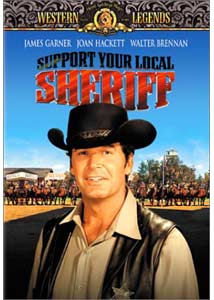
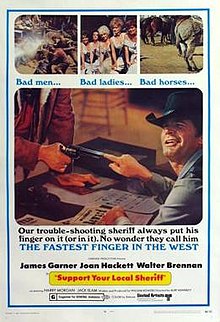
Vinnie's pick - Support your Local Sheriff (1968) : "We're All Behind Ya!"
Most of James Garner's greatest roles are virtuous men who know how to fight perfectly well, but choose to think, talk or bamboozle their way out of a situation, if not just plain run away, so they may live to to run another day. Jason McCullough, lead character of
Support Your Local Sheriff, is a perfect example of this. He arrives in Calendar, Colorado a short time after gold is discovered in the open grave of one Millard Frymore. Everyone's so gold-mad that the few people in the service industries (and I
don't mean Madame Orr's House) are able to charge eight dollars for a "tasty home-cooked meal" and twenty for an eight-hour shift on a cot, so Jason is forced to find work, and the position of Sheriff happens to be available. As opposed to the previous three holders of the position, Jason takes to it easily, using a combination of confidence, bluster, and a reputation that spreads like wildfire. Ten minutes on the job and he arrests Joe Danby (Bruce Dern) whom he saw kill a man in a gunfight earlier in the day. Now the brand new jail has no bars yet, but with the help of a few drops of red paint on the floor to pass as blood, Joe stays in his cell nice and tidy.
The town is filled with wacky characters played by beloved character actors, including Harry Morgan, Henry Jones and Jack Elam as Jason's deputy Jake. Joan Hackett plays the mayor's daughter Prudy, a tomboyish young lady who doesn't seem to know what to do with her hands when the Sheriff's around. Garner walks smoothly through the chaos unruffled, pulling his gun when he has to, but most of the time getting people to do what he wants by wits and generally confounding the hell out of everyone. When Pa Danby (Western legend Walter Brennan, parodying his role in
My Darling Clementine) shows up to break Joe out of jail, Jason stops him by sticking his finger in Pa's gun barrel. After killing endless hired guns, he drives one out of town by throwing rocks at him.
When the Danbys assemble a small army to come after the Sheriff, he makes it clear that he plans to pack up and run. Expecting to be branded a coward, he's surprised when Prudy describes it as the most mature thing she's ever heard from a man. That so flusters Jason that he changes his mind and plans to stay and fight it out against the Danbys. The final gunfight is as good as in any classic western, but still packs in the laughs.
One of the coolest aspects of the character is how he really is a tremendous fighter and a better shot, but chooses to keep that under wraps, like a claw. When presenting himself for the position to the town council, they ask for his credentials. He replies with a simple "Oh, don't worry, you'll be glad you hired me". When they ask for some provenance, he takes a large washer, flings it up in the air and shoots through the center. The council is reticent to believe him, pastes a stamp over the hole, and asks him to repeat the stunt. He does, effortlessly. The change in tone from Harry Morgan is priceless.
James Garner produced the film through his company Cherokee, and like Humphrey Bogart's self-produced films through Santana, his films are tailor-made for him. He followed this up with
Support Your Local Gunfighter, which did not feature the same characters, but did feature much of the same cast, giving the mistaken impression that it's a sequel. It doesn't hold up for me; for one thing, his character is more of a con-man in the film, and as I've mentioned, I prefer it when he plays a good guy, as opposed to my other favorite character type, the charlatan with a heart of gold.