Wednesday, August 22, 2012

Gene Kelly Unplugged: Half-Singing, Half-Dancing, All Acting Team Bartilucci Double-Feature!


This post is part of the CMBA Gene Kelly Blogathon, running from August 20 through August 25, 2012.   

We of Team Bartilucci have joined forces for another double-feature in the CMBA's salute to the one and only Gene Kelly!  We hope you'll enjoy our mad yet lovable ramblings! 

Dorian’s Pick: The Devil Makes Three (1952)

With so many of us writing about Gene Kelly’s musicals for the titular CMBA Blogathon, I thought it would be an interesting change of pace to focus on one of Kelly’s action-adventure films. Mine has a Salzburg Connection, though it doesn’t have a Helen MacInnes plot (that would be the bailiwick of our friend and fellow blogger Yvette Banek of …in so many words fame)!  I chose the 1952 action-drama The Devil Makes Three (TDM3). The title explains a tenet in Islam: an unmarried boy and a girl should never be alone together. It’s acceptable to have two boys or two girls in a room, or larger numbers and permutations. But if a boy and a girl are alone together, it’s said the devil is the third person in the room. With that in mind, I’d say the real devil to fear in this moody suspenser is the poverty and desperation which force hard choices on our protagonists, Captain Jeff Eliot (Kelly, excellent in a dramatic role); and the vulnerable yet determined Wilhelmina Lehrt (Pier Angeli of Somebody Up There Likes Me; Teresa; and Merry Andrew, who left us way too soon), or “Willie,” as Jeff affectionately nicknames her. But you know what really piqued my interest in TDM3? Two words: Snowmobile Nazis! How’s that for a high concept?


Disney on Ice is nowhere near as badass
as these snowbound Wild Ones on Ice!
Set in 1947 just after the war, we viewers get a catch-up prologue from Colonel James Terry (Richard Rober of The Well; Father’s Little Dividend; The Tall Target), with our story being “a composite of case histories taken from the Munich headquarters file, Criminal Investigation Division Corps of Military Police, United States Army.” Over footage of the notorious Braunes Haus that housed the Nazis, Col. Terry dryly notes, “There isn’t even a ‘For Sale’ sign on the lot where the Braunes Haus once stood.”  After this prologue, the action begins! Around the Christmas holidays, a woman (Charlotte Fleming) drives on an icy road, skidding. She stops, hurries into a phone booth, and speaks urgently—only to have her phone call cut off permanently when two motorcycle cops pull up and shoot her dead in a hail of bullets! Yikes! Talk about Hell on wheels! The only clue is a business card with the insignia “Silhouette.”

I see a little Silhouette of a club!
(Scaramouche! Scaramouche!)
Meanwhile, our hero Jeff has just left the U.S. to return to Germany (instead of vice-versa as one would expect). Jeff has been writing to the Lehrt family and sending them gifts since he returned to the States, and he’s brought all the trimmings of an old-fashioned Christmas to thank the Lehrts for saving his life during the war. But when he drives to the address he knew, he finds the place practically in ruins, with a German family that’s definitely not the Lehrts! The family now living there are strangers to Jeff; they shamefacedly admit nobody else has lived there for ages, and they’ve been accepting Jeff’s care packages all this time because otherwise, they’d be starving in the rubble of what’s left of their ramshackle home. Being a decent joe despite his frustration and puzzlement, Jeff gives the bombed-out family the gifts he’d intended to give the Lehrts, then sets out to see what the heck happened to them.

Our hero Captain Jeff Eliot thinks
he can see  his house from here!
When Jeff gets together with Lieutenant Parker (the versatile Richard Egan from Love Me Tender; Violent Saturday; Pollyanna), he and us viewers get more background. The Lehrts were a family of musicians and singers, and pretty young Willie was only 15 the last time Jeff saw her. He’d met the family during the war, when his outfit was captured in a raid over Innsbrook, then thrown into a nearby prison camp. Two days later, the Lehrts had managed to hide the injured Jeff in the family’s cellar. Shortly after New Year’s Day, the family smuggled him to an area where he’d be able to walk to safety. Parker suggests they check the Central Registry, where there’s a complete casualty list, even if it means forgoing his previously planned evening of beer, bratwurst, and knockwurst—now That’s Entertainment (not to mention friendship)!

In Germany, our heroes hope for the best,
but expect the wurst!
At the Central Registry, Jeff and Parker get the bad news: Mr. and Mrs. Lehrt were killed by bombs in July 1944, and there’s no further info about Willie on file. Parker deduces that Willie would be about 18 by now: “If she’s still alive, and she’s still pretty, there are just so many joints in Munich where she could be, and I know every one of them.”  Jeff is skeptical: “Not Willie. She wasn’t the type.”  Parker ruefully replies, “If she’s been hungry long enough, she’s the type.”  So the search for Willie begins. On the bright side, if all else fails, at least our heroes will get a pub crawl out of it!


Is that a bruise under Willie's eye?
Poor girl, she probably wishes
she could be marching home!
Their search bears fruit. Of all the gin joints in all the world, Jeff and Parker find Willie (Angeli) at her workplace—none other than Silhouette! It’s full of beautiful girl singers and tough-looking guys who aren’t exactly gentlemen. Let’s just say the gals at Silhouette aren’t working there because it’s their dream job. Willie has grown up into a lovely, doe-eyed young woman with a bruised psyche. Having been orphaned and living on her own, she’s become understandably cynical since she last saw Jeff. They talk as they walk among the bombed-out buildings in the moonlight (almost sounds romantic, in a film noir way):

Willie: “Enjoying the sights, Captain?”
Jeff: “Oh…from the air, it all looks different. You had one idea up there, and that was to navigate the plane to the aiming point.”
Willie (sarcastically): “You did a good job.”
Another of my favorite TDM3 lines:
Willie: “You will like it here at Silhouette. At midnight, Kris Kringle comes down the chimney and does a strip-tease.”

Jeff wants to make amends and thank Willie on account of her late parents having saved his life. He’d like to start by giving Willie the Christmas holiday with all the trimmings that she’d loved in happier, pre-war, pre-Nazi days. Since Jeff is doing well at his navigation instructor job in the States, he wants to go all out to show Willie a happy time, so they’re off to Salzburg for the holidays! I love Willie’s running gag about “getting a commission” from businesses around town, like at the car dealership. Ah, but as soon as Jeff and Willie hit the road, good ol’ Honest Oberlitz (Bum Krüger) scrambles into the garage, yelling in German, and who should come roaring out but those evil motorcycle guys, hell-bent for leather and burning rubber! What the heck do those no-goodniks want from our heroes?


As they drive on the Autobahn, which Jeff compares favorably to the Pennsylvania Turnpike (wow, the Autobahn must have been way less crowded in the 1950s!), Willie gives Jeff a history lesson:
Willie: “The Fuhrer built it. It was supposed to carry its conquering armies to glory. Now it carries the conquerors. How does it feel to be a conqueror?”
Jeff: “Most of the guys stationed here would rather be driving along the Turnpike. We’re not cut out to be conquerors.”

I must say I enjoyed TDM3’s touches of wry humor, poking good-natured fun at the gentler post-war changes at Germans vs. Austrians, such as the Austrian diner with a juke-box, where the personnel use American slang like “Adam and Eve on a raft.” I also loved the beautiful locations, with shots of the locations as pretty as a postcard, especially since this is probably the closest I’ll ever get to that part of the world!

I keep expecting to hear Gene Kelly and the kids
singing “I Got Rhythm” in German!
But things get serious when Parker discovers that, unbeknownst to Jeff, that German car is chock full of contraband—specifically, there’s gold under the car’s top coat!  It turns out Willie had to secretly drive contraband across the Austro-German border, though Willie is having second thoughts after falling in love with Jeff (can you blame her?), plus the poor phone booth gal killed earlier in the film was a friend of Willie’s, and she doesn’t want to meet the same awful fate. What’s more, apparently this dastardly Nacht de Legernogen (sic), described as “The Last Will and Testament of the Third Reich,” outlines chilling procedures after the hoped-for defeat. Grr! Nazis—I hate those guys (don't we all?)! Can Willie and Jeff conquer the bad guys and go on to live happy lives of baseball, hot dogs, apple pie, Chevrolets, and, for Willie, American citizenship?  Although Kelly doesn’t get any song-and-dance numbers, I found him both tough and tender as the determined yet caring Jeff, and I thought he and Angeli worked well together. I was especially moved as Willie did her best to survive with dignity while being forced into hard choices just to stay alive.

No mistletoe required!
TDM3 was filmed on location in Munich and Salzburg, with a screenplay by Jerry Davis (known for such Warner Bros TV series as 77 Sunset Strip, Bourbon Street Beat, Surfside Six, Bewitched, and The Odd Couple, as well as the 1955 horror thriller Cult of the Cobra), and based on a story by producer Lawrence P. Bachman, known for his 1960s series of comedy-whodunits based on Dame Agatha Christie’s Miss Marple mysteries, starting in 1961 with Murder, She Said. That movie series is dear to Team Bartilucci’s collective heart, especially since it starred the delightful Dame Margaret Rutherford (and we all know there’s nothing like a Dame!), as well as Children of the Damned, the 1964 sequel to the horror classic Village of the Damned.

Uh-oh! X doesn’t mark the spot in a good way here!  

Hurry, Jeff, distract the villain
with a dance number!
The film was directed by Andrew Marton, who was no stranger to action films and war films. His work included The Longest Day; the 1950 version of King Solomon’s Mines; science-fiction thriller Crack in the World, another Team B. fave; and the 1964 version of James Jones’ celebrated novel The Thin Red Line. (Terence Malick’s 1998 version included an all-star cast, including future Oscar-winner and Team Bartilucci favorite Adrien Brody, but that’s a story for another time.)  The driving rhythm of Bronislau Kaper’s music (Gaslight; Whistling in the Dark; The Naked Spur) sets an appropriate pulse-pounding pace as TDM3 moves along. But it’s not all action movie music by any means. Since the story is set in post-war Munich and Austria during the Christmas season, there's poignancy and grim reminders of the aftermath of World War 2. Bombed-out ruins, some of which housed the Nazis (good riddance, Nazi scum!), sit side-by-side with the new buildings of the ongoing reconstruction, while ironic reminders of the war appear along with holiday music such as “Oh, Christmas Tree” (in both English and German). The New York Times movie reviewer, identified only as H.H.T (the venerable Howard Thompson, perhaps?) was underwhelmed with Jerry 
“Hi, I’m Claus Clausen, I’ll be
your Otto Preminger for this evening….”
Boy, Oberlitz's coffee sure is a knockout!
Davis’ screenplay for the post-war adventure drama The Devil Makes Three (TDM3). Oh, well, can’t please everyone!


Vinnie’s Pick: What A Way to Go! (1964)

I must confess to bending the rules slightly with this entry.  This is undoubtedly a film that belongs to Shirley MacLaine.  Like a housecat who graciously lets people live in their homes, Shirley allows several leading men to share the screen with her, and each time she makes them feel comfortable, like they're the only man in the world.  Gene Kelly is the last of them, but it could be argued that his appearance is the grandest and most over the top.


Shirley plays Louisa May Foster, a shy, unassuming girl who through no fault of her own, appears to be cursed.  For every time she attempts to marry for love, her husbands seem to become bestowed with uncontrollable success.  Everything goes their way, they become engrossed in their work, and it ends with them dying in progressively outlandish fashions, leaving her alone, and each time, exponentially wealthier.  The film begins with her attempting to give all her money to the IRS in the form of a single check for 250 million dollars.  She is met with doubt, and is sent to a psychiatrist (Bob Cummings) to whom she bares her tale of woe. 
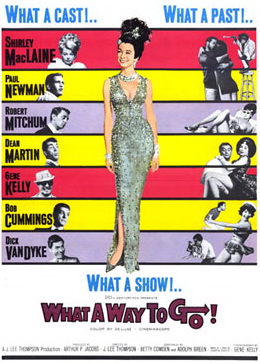
Starting with her childhood in Crawleyville, named after the town's richest family, she is pressed by her mother (Margaret Dumont!) to marry the Crawley's indolent son, Leonard (played by the indolent Dean Martin).  She instead turns her eye to Edgar Hopper (Dick Van Dyke), owner of a barely open general store, who lives his life by the tenets of Thoreau. They marry, and out of spite Crawley proceeds to make their life hell, mocking their meager existence.  Hopper snaps, and becomes a marketing dynamo, turning his general store into the most successful business in town, driving the Crawleys into bankruptcy.  The strain is too much for him, and he dies from a massive (and ironic) coronary, his last words being "a little hard work never hurt anybody!"

Louisa is now a wealthy woman, and travels to Paris to start anew.  There she meets Larry Flint - not that one, a struggling artist played by Paul Newman.  He lives the stereotypical life of an artist, in a loft surrounded by other eccentric creators, including a chimpanzee who's currently more productive than any of them.  Larry's medium is a mechanical painting device of his own invention that converts sound to brush strokes.  Louisa, happy to find another man who abhors wealth, marries him, and they live the simple life in their paint-stained loft.  But she whammies him as well, and when she suggests he play beautiful music for the machine to interpret, it paints a masterpiece.  He builds an assembly line of them, and is making money hand over waldo, leaving her alone again, first figuratively, and later literally when the machines turn on him and turn him into their living (for a while) canvas.

Her third try, she goes the opposite direction - Rod Anderson (Robert Mitchum) is even more staggeringly wealthy than she, and they hit it off immediately.  During a wild montage of parties and truly spectacular costumes (all created by the equally spectacular Edith Head), Rod is amazed to learn that athough he's been totally ignoring his business, he's actually made MORE money.  However, Louisa convinces him to sell everything and live his dream - to move back to a farm like the one he grew up on.  They do so, and are blissfully happy...until one morning, Rod accidentally tries to milk their prize bull, Melrose.  The moment is understated and only implied, but is truly hilarious - his last words, "Melrose, forGIVE me!", are preceded by a strained and surprised bovine bellow, and followed by him being kicked out the back of the barn.

Her next paramour comes in the form of Pinky Benson (Yes folks, you've been patient - it's Gene Kelly) an earnest but happy where he is song and dance man who performs in a local tavern called the Cauliflower Ear.  His act is pure schmaltz - he wears a clown getup, and does a fast hoofer nonsense number in the style of fifties performer Pinky Lee. He's barely noticed by the audience, which is just fine by the owner - a status quo that's lasted fourteen years.  Once again, Louisa thinks she's found a man who wants no more out of life than he's already got, and they wed.  And it all goes very well.  Until...


One of the recurring motifs in the film is Louisa's complimentary comparison of each of her marriages to a different kind of classic film. Her early time with Hopper was like a melodramatic silent film where love conquered all, her time in France like a French impressionistic picture, and the high-rent world of Rod like a series of lavish entrances in a "Lush Budgett" glamour film.  Her time with Pinky / Kelly, predictably enough, is portrayed as an over the top musical production.  Kelly, at 52 by the time of this film, is still staggeringly light on his feet, and Shirley more than keeps up with him.


Heading out for his birthday party after a performance, Louisa suggests he save time by not applying his makeup, and do the act in his street clothes.  He feels a bit shy without his costume, and he sings his number softly, and at half speed.  Rather than his clownish (naturally) buck and wing, he does a gentle soft-shoe number. As the raucous restaurant slowly grows silent to pay attention to him, Louisa realizes she's done it a again.  Pinky is discovered before they can finish a whip-pan, and Louisa is morosely lounging around a massive Hollywood mansion as Pinky works on a number of films at once.  Far from the soft-spoken hoofer she married, Kelly now plays Pinky in full-on parody mode, with a brassy voice and the traditional "My public" mode of the triple-threat mogul. 
At his latest premiere, they arrive in an all-pink Rolls, Louisa's head buried in a pink wig, and wrapped head to toe in pink mink.  The film, naturally, is a smash.  The surging crowd of fans are out of control, and his producers suggest he leave out the back entrance.  Just as they're about to leave, he realizes he can't do it to his fans, and pops out from the alley to surprise them.  BAD move.  They thunder toward him, their advance deftly mixed with shots (and sound effects) of stampeding elephants.  He is literally trampled to death by his adoring public.

As the dream sequences get progressively longer, so too her time spent with each husband, which means that Kelly gets the most time on screen.  He gets to play a good spectrum, from the shy tavern performer, to the lovestruck husband to the bombastic movie icon.  MacLaine is adorable throughout the film, eternally desperate for love, spending most of her time swathed in the most astounding finery, alternately covering her entirely, and leaving so little to the imagination you wonder how brother Warren didn't storm onto the set and slap all the cameramen. Her high pitched voice sounds like if she were in a comic book, it'd have little musical notes in her word balloons, like Melody from Josie and the Pussycats did.

I deliberately tried to keep my summaries of the rest of her paramours brief, as this is a Gene Kelly tribute.  But let me assure you, I left out a LOT of detail, and it's all worth a look.  The film's been making the rounds on cable, and is pretty easy to catch up with.  And well worth doing, as well.

Tuesday, August 21, 2012

Happy Second Anniversary to TALES OF THE EASILY DISTRACTED!


Great heavenly days! As of August 22nd, 2012, Tales of the Easily Distracted (TotED, for any newcomers) is two years old today! Where the heck does the time go?   Time to party!

Timber-r-r-r! Could Holly Golightly (Audrey Hepburn) throw a shindig, or what?

What a difference two years makes! I’ve made so many friends, and I’ve read so many fascinating and entertaining blogs, and learned so much more about classic movies than I ever imagined. I also got the hang of Blogathons, thanks to talented folks like Page Inciardi from My Love of Old Hollywood, as well as Becky Barnes from ClassicBecky’s Brain Food, who, along with my sweet and supportive hubby Vinnie Bartilucci and our favorite inspiration, our 15-year-old daughter Siobhan, gave me the courage to put on my own Blogathon this past July, The Best Hitchcock Movies (That Hitchcock Never Made), for which I continue to be grateful!  The support from my family and friends also spurred me to finish writing and polishing my suspense novel The Paranoia Club, and thanks to my wonderful editor Nicole Bokat (if you need a great editor, Nicole is your go-to gal!), I’ve finally begun sending queries to agents. I know getting published is a long, hard road more often than not, but I’m going to give it my all; nothing ventured, nothing gained. Wish me luck!

Revisions, revisions, always revisions!
( Kate Hudson and Luke Wilson in Rob Reiner's Alex and Emma)

Thanks so very much, everyone, for welcoming me among all you wonderful people in the dark—and out of the dark, for that matter!  Here’s to another year of film fun and frolic, with many more to come, I hope!


Our favorite contemporary Oscar-winning actor 
and all-around nice guy Adrien Brody approves!

Interested in the origins of TotED? Check out the link below!


Saturday, July 7, 2012

How Christina and Nicole Spent their Weekend Vacation

This post is part of The Best Hitchcock Movies (That Hitchcock Never Made) Blogathon, running from July 7th through July 13th, 2012. On July 7th, please wish Sir Alfred Hitchcock's lovely and talented daughter Patricia Hitchcock O'Connell a very happy 84th Birthday!

Henri-Georges Clouzot, the director of French suspense films such as The Wages of Fear and Le Corbeau, premiered his 1955 thriller Diabolique in New York City at what was then The Fine Arts Theater. How ironic that this premiere was doubling as a benefit for the Herald Tribune Fresh Air Fund, considering the moviegoers found themselves gasping for breath from terror!  Produced by Vera Films, named after Clouzot’s leading lady in real and reel life, Vera Clouzot (The Wages of Fear; Les Espions), Diabolique continues to haunt audiences not only because of its fear factor, but also for its moving characterizations and performances. Diabolique’s title translates variously as Les Diaboliques; The Fiends; and The Devils, but as far as I’m concerned, it’s one of cinema’s most suspenseful films in any language! (For those of us who don’t speak French, distributor Janus Films provided subtitles.)
You're witnessing a rare sight:
Christina DeLassalle smiling!
It’s been said that no less than Team Bartilucci’s favorite fearmeister Alfred Hitchcock was itching to get the rights to the source material, the French suspense novel She Was No More (Celle qui n'tait plus) by Pierre Boileau &  Thomas Narcejac, only to find Clouzot had just beaten Hitch to the punch. Either way, Hitchcock made darn sure he got the rights to another Boileau & Narcejac thriller pronto: D’Entre Les Morts, translated as From Among the Dead—or as Hitchcock and company more intriguingly titled it, Vertigo. In any case, for Diabolique, director Clouzot worked with co-writers René Masson, Frédéric Grendel, and Jérôme Géronimi to adapt Diabolique for the big screen.

Over Diabolique’s opening credits, there’s a tight close-up of already-brackish water, accompanied by a quote from French author Barbey D’Aurevilly, who specialized in tales of mystery and suspense exploring hidden motivations, hinting at evil without being explicitly concerned with anything supernatural:


“A painting is always quite moral when it is tragic, and it gives the horror of the things it depicts.”

D’Aurevilly is starting to sound like the French granddaddy of film noir to me! Heck, even Armand Thirard’s saturated black-and-white cinematography plunges us viewers into a sense of eerie foreboding without even trying. Just watching a lady walking with an open umbrella primed me to get ready to flee, or at least duck!

Our story begins at Institution DeLassalle—or as the subtitles I.D. it, DeLassalle Boarding School, which has clearly seen better days.  It’s bad enough that Headmaster Michel DeLassalle (Paul Meurisse of Army of Shadows; The Truth; Le deuxième soufflé) is sadistically cruel to his lovely but sickly wife, Christina (Ms. Clouzot), who has a serious heart condition. Michel’s idea of kindness and sympathy is to cruelly tease Christina about being a “cute little ruin.” But Michel doesn’t stop there; he even mistreats his mistress and fellow teacher Nicole Horner (Simone Signoret, Oscar-winner for Room at the Top and nominee for Ship of Fools, among her other triumphs).  Indeed, when we first meet teachers Christina and Nicole, they’ve long since bonded over their mutual love-turned-hatred for Michel, to the amazement of the rest of the school’s mostly male staff. On top of that, Christina is paying for the school in every sense; she’s not only footing the bills (it’s clear Michel married Christina for her money), but she’s also paying in emotional abuse, including her sorrow for the way the schoolboys have to eat lousy food, and how she has to beg for every little thing, as if she was some kind of servant instead of being the head of the school.  No wonder she and Nicole have joined forces to put Michel’s lights out—and we’re not talking about the school’s electric bills! The murder plot has poor Christina even more jittery than usual, since she’s a staunch Catholic, and she takes the whole “Thou shalt not kill” thing seriously.  (Sadly, those were the only three films Vera Clouzot made; ironically enough, it turned out that like the character she played in Diabolique, she really did have a weak heart, and she died in 1960.) 

Anyone can have a love triangle,
but these three have a hate triangle!
Although Christina is glum and/or fearful more often than not, when she’s walking and talking with her fellow teachers early in the film, we briefly see her as the bright, happy young woman she must have been before Michel wormed his way into her heart and bank account in her native Brazil. The holiday weekend has begun, and Christina is wearing a perky little outfit and twirling her parasol.  Her lovely smile almost breaks my heart, because life with Michel gives her so few things to smile about. Let this be a lesson, all you headstrong movie romantics: Get to know your sweeties before you decide to make a life with them!  Heed the lessons learned the hard way by Christina, Audrey Hepburn as Reggie Lampert in Charade, and so many others! Oy!

You know, if the DeLassalle Boarding School was a real place and its shabby conditions were discovered today, some hotshot news team would make it a cause célèbre even before anyone got wind of the murder plot Nicole and Christina are hatching!  I can see it all now: muscular, no-nonsense Robert Irvine of The Food Network’s Restaurant: Impossible storming in to kick the entire staff’s collective butt while overhauling the menu big-time, then force-feeding Michel DeLassalle his own disgusting rotting fish. Meanwhile, the equally tough-as-nails Anthony Melchiorri of The Travel Channel’s Hotel Impossible would overhaul the kids’ shabby dorms, too!  Do the boys’ parents ever actually visit this neo-hellhole? If Diabolique took place today, there would be lawsuits galore!  By the way, fans of Michel Serrault, perhaps best known to us Yanks as the star of La Cage Aux Folles and its two sequels, as well as Nelly & Monsieur Arnaud and Deadly Circuit, plays one of the teachers, Monsieur Raymond. He and the other teachers mostly put-up and shut-up; I guess they figure a job in a crummy boarding school with a nasty headmaster and unappetizing food is better than no job at all. And don’t get me started on that nasty, brackish swimming pool; the best use for it would be for a remake of Creature from the Black Lagoon…or an ingeniously wicked murder plot which ultimately pulls our gals into a murderous game in which death is only the beginning of their nightmare! I can say no more!

Nobody will be seated during
the disgusting rotting fish scene
!
As is the case with Hitchcockian thrillers such as, say, Stanley Donen’s 1963 thriller Charade, Clouzot’s Diabolique is one of the (say it with me, people) Best Hitchcock Movies that Hitchcock Never Made! The crucial difference is that Charade and other playful Hitchcockian thrillers (as opposed to genuine Hitchcock films by Big Al himself) recall Hitchcock’s polished, soignée-yet-cheeky side a la North by Northwest, while Diabolique is more like a precursor of Hitchcock’s darker, more sinister thrillers such as Psycho; Shadow of a Doubt; The Wrong Man; Strangers on a Train; or Frenzy. I’ll admit it would have been fascinating to see how Hitchcock would have approached Diabolique. Darkly magnificent as Psycho is, Diabolique’s gloomy, misogynistic take on the story sinks into your gut and haunts your dreams, especially with the film’s taunting suggestions that perhaps there’s a touch of the supernatural in all this that nobody can escape. Even Diabolique’s opening credit sequence immediately makes us uneasy with that merciless close-up of the rainy, run-down DeLassalle Boarding School’s murky swimming pool, accompanied by children shrilly singing Georges Van Parys’ music off-key and off-screen. The film starts out at a leisurely pace, but as it goes along, the tension tightens like a noose, helped by skillful use of shadows and light. Without giving away its twists, I’ll only say that Diabolique gives new meaning to the phrase “cruel to be kind.”

“First I add a generous portion of gasoline. Then some nitroglycerine… a goodly amount of gunpowder…some Uranium 238…shake well, strike an ordinary match, make Michel drink it, and voila!”
"Do you have Prince Albert in the can?"
Has Michel come back to life just for
the school picture? Now that’s school spirit!
"Here's looking at you, kids!"
Vera Clouzot and Simone Signoret are electrifying as partners in suffering and murder. As the women plot to kill the bastard, Ms. Clouzot’s delicate loveliness and her anxious air plays beautifully off Signoret’s sexy, smoldering intensity and streetwise demeanor. As Christina and Nicole try to act like nothing is wrong after Michel takes his final dip in the DeLassalle School’s pool, weird things keep happening that make them wonder if Michel is somehow still alive after all their efforts. Michel’s suits unexpectedly turn up from the local cleaners, and in the school picture, there’s a shadowy figure who looks unnervingly like Michel!  Is the creep still alive and messing with the women’s heads, or is it karma, or could there really be something supernatural going on? (*GULP!*)  

On top of that, Inspector Fichet (Charles Vanel of Clouzot’s The Wages of Fear and Hitchcock’s To Catch a Thief, as well as several Tintin movies!) has been trying to help Christina in his kindly Columbo-esque way, but is this likable shaggy dog of a man actually a bulldog hot on the scent of the women’s guilt? That’s not to say there aren’t touches of comedy, albeit of the pitch-black variety. I especially got a kick out of of the scenes earlier in the film, when Nicole and Christina come to town for the next phase of their murder plot. As Christina and Nicole lure Michel to come to town for a permanent dip in the bathtub, their upstairs neighbors, Monsieur and Madame Herboux (Noel Roquevert and Therese Dorny) are unable to hear whether or not they won a prize on the radio show, because the tub the women use to weigh Michel down gets noisy when they have to drain the tub!  Diabolique is even darker than Hitchcock at his darkest! Which is scarier, the water sports in Diabolique or in Psycho? Watch them and decide for yourselves! :-)

I won't spoil the big shocker ending for you; I'll just repeat the request from the filmmakers:


"Don't be devils! Don't ruin the interest your friends could take in this film. Don't tell them what you saw. Thank you for them."
Trust me, your patience will be rewarded!

Sunday, June 24, 2012

Hitchcock Blogathon update - lock in yer dates!

We've got 48 folks signed up for our Best Hitchcock Films Hitchcock Never Made Blogathon, which is a wonderful response, and thanks to all for wanting to participate!
With two weeks to go, we want to get the schedule for everybody's posts in place.  So if you're participating in the blogathon, please send me an email and let me know what day you'd like to post your contribution.  For the folks who haven't chosen a film, do let me know your choice as well!
To keep things spread out, we want to limit it to about six posts a day. So if more than six people ask to post on any one day, we'll take the first requests we get.
The deadline to reserve a day is Friday, June 29th.  After that, we'll assume you're able to post any day, and we'll assign days randomly, and post the final schedule that Saturday. 

(If you can't get your post up on the day selected, we won't send Leonard after you; just get it up as close as you can!)
When you post your contribution, please send me an email with the address of the post, so I can update the schedule quick like a bunny!

Feel free to link to the main info page on your blog to let everyone know about the event, and share the news with everybody!

Saturday, June 23, 2012

HUDSON'S BAY: Eager for Cregar!

Take a gander at Laird Cregar as
lovable rogue Gooseberry!
To some people, the name Hudson’s Bay (HB) may simply bring to mind the famous Canadian department store, but of course there’s a rich history behind it—rich enough for 20th Century-Fox to green-light it as a lavish biopic directed by Irving Pichel (The Most Dangerous Game; the 1935 version of She), with a remarkable all-star cast!  Hudson’s Bay’s leading man was the great actor Paul Muni, whose amazing four-decade career included stage triumphs (born Meshilem Meier Weisenfreund, Muni got his start in the Yiddish theater); movies (Muni won the Best Actor Oscar for the 1936 biopic The Story of Louis Pasteur, with another nomination in 1937 for The Life of Emile Zola, and six other Oscar nominations, along with a New York Film Critics Circle award for …Zola); and an Emmy nomination for his performance in the 1956 Playhouse 90 TV drama “The Last Clear Chance.”  No wonder: Muni was a true chameleon, renowned for his amazing ability to dive into every aspect of his roles. I wonder if Meryl Streep considered him as one of her role models? (Click here for a scene from the film!) 

That said, as awesome as Muni was, I must confess that although he gets top billing in HB, it was actually a member of HB’s fine supporting cast that really made me eager to see it: Laird Cregar (Samuel Laird Cregar, for completists)! I’ve been a fan of Cregar’s ever since I first saw him as the smilingly sinister NYPD Inspector Ed Cornell in the film adaptation of Steve Fisher’s novel I Wake Up Screaming. I found myself fascinated by Cregar’s relentless pursuit of Victor Mature, wondering if there was more to it (if you haven’t seen the movie, I won’t spoil it for you).  I had to know more about this actor!  With each new (to me) Cregar film, I’ve been wowed by his ability to be a witty, smooth-talking adversary, or a tormented but terrifying foe. In fact, for those of you who may not have read Team Bartilucci’s Flico Suave blog post, here’s our entry about our lad Laird:
LAIRD CREGAR. Silky-voiced, Philadelphia-born Cregar looked like a fearsome mountain of a man, an image that served him well in such classics as I Wake Up Screaming (1941), Heaven Can Wait (1943), and the 1944 remake of The Lodger. However, he blazed his own trail, mounting his own acclaimed stage productions of Oscar Wilde and The Man Who Came To Dinner. His smooth voice served him well in radio plays, including the role of Caspar Gutman in a production of The Maltese Falcon. But Cregar longed to leave his villain roles behind and move into romantic leading man parts, and to his frustration, his 300-pound girth stood in his way. He slimmed down on an insane crash diet in order to look as suave as his voice sounded. Tragically, the diet took a terrible toll on Cregar’s health, and he died of heart failure at the age of 31, just before the debut of the film that essentially killed him, Hangover Square (1945). Ah, the suavity that could have been….  For more about our special Flico Suave post, in which Fredrico Fabuloso of noirbabes.com has joined forces with Team Bartilucci to craft a terrific slide show devoted to Cregar, please click this link:
The Supremes, in a command performance!
When our friend and fellow blogger Laura of Laura’s Miscellaneous Musings recently wrote about several films showing up on the Fox Movie Channel, I was intrigued when I saw HB would be among them. It seemed like a typical costume epic, certainly a departure from the film noirs and comedy-thrillers that I usually blog about here at TotED. But once I saw Cregar’s name among the cast members, I was definitely interested, especially when it became clear that both Muni’s and Cregar’s characters would be more scrappy and lighthearted, with lots of joking and brawling—and don’t forget those suave French-Canadian accents! Alfred Newman’s score understandably leans on instrumental versions of the moving anthem “O Canada.”  HB frequently uses another song whose title escapes me. It’s derived from a beloved traditional folk tune, but I keep remembering hearing it in, of all things, the Elvis Presley comedy-thriller Double Trouble, with these lyrics: “I only love one girl/The one I have my arms around/I only love one girl/One in every town!” (Just as well I never opted for a career in music—but if you need a gal who can hum or whistle, let me know!)

For those of us who were too easily distracted to give our history classes our full attention back in school (and even if we had, I’m betting 20th Century-Fox probably took liberties with the real facts anyway), the script by Lamar Trotti (The Razor’s Edge; The Ox-Bow Incident; There’s No Business Like Show Business) helpfully provides this preamble:

“In 1667 Canada, under the French flag, was a vast uncharted wilderness. Montreal and Quebec were hardly more than trading posts on the St. Lawrence River. Our story opens farther south, at the Albany Government House, in the British colonies.” Does it ever! First we viewers see Indians getting thrown in prison for alleged thievery at the hands of stern-looking upper-class twits with long curly wigs and fancy clothes. One of the stuffed shirts sniffs, “These savages must realize that New York is a British possession…twenty lashes in the public square!” I couldn’t help thinking of a sarcastic line from Witness for the Prosecution: “Lovely you all look in them wigs.…”  As the understandably sullen Indians are given the heave-ho, two fur trappers/traders arrive: diminutive Pierre Esprit Radisson (Muni) and tall, wide, bear-shaped Médard Chouart Sieur des Groseilliers, a.k.a. Gooseberry (Cregar). (I’m guessing this is where/how today’s Radisson Hotel chain got its name?) It’s clear that these French-accented, smooth-talking yet scrappy trappers have been here before, asking for the money and supplies they need for an expedition into the north country. Radisson and Gooseberry kinda freak out the stuffed shirts with their boisterous barging-in, their ruddy cheeks, handmade buckskin, and fur hats; I liked them immediately!

Pierre gets no kick from champagne,
but he’s always up for a brawl!
The bewigged bigwigs aren’t interested in our boys’ proposed expedition to Canada’s Hudson’s Bay because “His Majesty’s government is not in the fur trade,” and besides, they’re convinced that Radisson and Gooseberry must be “rogues,” if they can’t get the funding from their own government.  Humph! They say “rogues” like it’s a bad thing! Those silly “suits” in suits don’t realize our boys aren’t the types to meekly take no for an answer, especially when they’re threatened with jail. It’s clobbering time as a royal rumble breaks out! Radisson and Gooseberry get tossed in Ye Olde Holding Cell, but at least it’s a good place to make friends: Lord Edward Crewe (John Sutton from Jane Eyre; My Gal Sal; A Yank in the R.A.F.) is cooling his heels in the slammer, too!  Seems Lord Eddie was banished by Prince Charles (the great Vincent Price, one of Team B.’s favorite scene-stealers) on account of drunken pranks that went too far. Edward convinces Radisson and Gooseberry to help him blow this popsicle stand, and after our scamps hit Montreal, Radisson and Gooseberry sell Edward on the idea of putting up capital for their Hudson’s Bay expedition.
It helps that Radisson happens to be best buds with the Indians, and he’s adamant about sharing their booty with them, fair and square. In fact, Orimha (Chief Thundercloud, who graced many a Western and even comedies like The Cat and the Canary during his 21-year film career) is Radisson’s Indian foster dad. Still, it takes lots of brawling to make Edward and the other city-boy white guys get their act together, stop treating the helpful Indians like “savages,” and get it into their fool heads that you can’t just pay the Indians in trinkets and brandy if you’re serious about making Hudson’s Bay a solid nation full of decent, fair-minded human beings. As Radisson explains in his charming patois during what I like to think of as his Yoda Moments:
“Wine very bad for Indians—make him crazy like the wolf. He get one little drink, pretty soon he drunk, go on warpath, kill everybody, cut their throat, maybe get his own throat cut. Then he don’t know where he is. What he do? By and by, he don’t hunt no more, he don’t fish, he don’t catch the beaver, he don’t do nothing but make trouble. He in pretty bad fix, no?”
Frankly, I was itching to see Edward get punched in the nose in the 1660’s equivalent of a playground!  With a little help from Radisson and Gooseberry, who are already tight with their Indian pals, “Holier than Thou” Edward eventually gets an attitude adjustment, courtesy of Yoda Radisson:
This Country, this Canada, she’s like a pretty woman, waiting for big, strong fella to come live with her, raise big family. She say, ‘Look, I have fine prairie to make big farm. I have nice trees for house, rivers to fish. I have big heart to love all the world, make you very happy.’ And she say, ‘Those fellows who live in Europe, they crazy, they fight all the time, kill one another for a little dirt that don’t grow anything. (Sarcastically) They got to bow down when Edward Crewe comes in the room. But here, I give you nice big place to live in, I give plenty to eat, I not let anybody be better than you. ‘Then she say, ‘But you must not cheat my little children because they are not so strong as you. You must not make them drunk, bring war with you. You will love, like the Bon Dieu planned, or I give you big tweak in the nose…I think maybe this Canada have plenty happy people someday, feel same way. Them maybe people, they say, ‘This Radisson, he big fool, but he’s right. Now I think we talk too much.”
(Lamar Trotti not only knew how to write rousing speeches, he knew when to stop!)
As Lady Barbara, lovely Gene Tierney
is worth risking prison for!
“Think of it, darling, there are millions
of beavers waiting to be caught!”
(Actual line from the film!)
All the agita of starting a new colony is finally paying off—until French Governor  D’Argensen seizes our heroes’ furs (polyester and microfibers weren’t invented yet) as “payment” for fines enacted that very morning! So Radisson and Gooseberry indignantly steal their furs back and return to England with Edward; that’ll show ‘em!  Eddie’s nervous about being back in England—remember, he’s supposed to be banished—but Edward’s cousin Sir Rupert (Nigel Bruce—Dr. Watson himself!—not to mention Bruce’s supporting roles in Hitchcock’s Rebecca and Suspicion) is willing to help sort things out, with encouragement from the intrigued Prince Charles, who admits to liking “rogues” (there’s that word again!), and is willing to help Radisson, Gooseberry, and Edward as long as they can keep it on the QT until they get their booty. Besides, news of fabulous furs from the New World goes a long way toward our guys being forgiven, especially when Edward is reunited with his beloved fiancée, Lady Barbara Hall (Gene Tierney at her most beautiful and winsome). I love the way Edward and Barbara only have eyes for each other as Prince Charles’ scolding falls on deaf ears; Charles might as well be talking in that Peanuts “blah blah blah” gibberish!  Radisson sagely notes, “These English, they like to make a little money, no?” Prince Charles gives them the supplies and boats they need, though he cautions them: “There will be no talk of a charter until we see 300,000 pelts that the Governor of New France did not steal.” Radisson sweetens the pot by naming the first Hudson’s Bay post Fort Charles after the King himself.

No lackeys in Canada?
You mean I have to w-w-w-work?!
Lady Barbara is so impressed with Edward’s new success, maturity, and overall manly-man qualities that she suggests that when they return to Hudson’s Bay, they should bring her younger brother Gerald (Morton Lowry of The Hound of the Baskervilles; The Picture of Dorian Gray; How Green was My Valley). Bad move, guys! The novelty wears thin fast for spoiled baby brother Gerald Whiny-Pants;  he’s more interested in plying the Indians with brandy and cheap useless tchotchkes than in making Hudson’s Bay succeed and flourish by getting off his bratty butt and *gasp* pull his weight! When Gerald disobeys Radisson’s rules, drunken violence erupts all over the colony, and a friendly Indian tribe is senselessly slaughtered. This means war, since the Indians are understandably furious at these Eurotrash white guys making a mess of things. Having witnessed similar massacres in his time, Radisson reaches a grim decision: in order to patch things up with the warring Indians, he elects himself judge, jury, and executioner, ties up Gerald, and shoots him dead. Our heroes aren’t exactly happy campers (even though Gerald had it coming, in my opinion).  When Radisson, Gooseberry, and Edward return to London and explain the tragedy, Prince Charles fumes: “The very idea, going around shooting my subjects, and without my consent!”
Lesson learned: Don't bring troublemaking
siblings to faraway outposts!

Mother of Mercy, is this the end of Radisson, Gooseberry, and Edward? Luckily for our boys, riches triumph over dead trouble-making relatives: 4,000 pelts in perfect condition is an end that justifies the means, big-time! In fact, as Edward urgently points out, if Radisson and Gooseberry are hanged, there won’t be any Hudson’s Bay Company, because Canada would then belong to France, not England! Turns out our lovable slyboots Radisson fixed it in advance with the Indians that if anything happened to them in England, the Indians would take all those lovely, expensive furs to the French, Radisson’s biggest fans!  All is forgiven; I think even Lady Barbara knew in her heart of hearts that Gerald was a little good-for-nothing creep. Our roguish heroes are the toast of the town, Radisson and Gooseberry walk off singing, boy gets girl, Hudson’s Bay is born—what’s not to love?


Asterix and Obelix


Vinnie imagines Laird Cregar
and Paul Muni as Obelix & Asterix!
My husband Vinnie is a big fan of the Franco-Belgian series of Asterix comics created by René Goscinny and illustrated by Rene Goscinny and Albert Uderzo (if you haven’t had the pleasure of reading Asterix, click this link), and he noticed that Muni and Cregar had a striking resemblance to Asterix and his big pal Obelix! Anyway, just hearing the cheerfully boisterous Cregar doing a French-Canadian accent made me smile.

It was fun to see another side of our lad Laird, since I’d seen him showing a flair for comedy even in his bad-guy roles. To my surprise and delight, Muni and Cregar turned out to be a rollicking comedy team, stealing their scenes and my heart!  With their rambunctious, devil-may-care shenanigans and great buddy chemistry, Muni and Cregar make a totally appealing pair! Muni has a playfulness about him, and a clever way of talking around things when the suits in London and France get restless; nevertheless, when push comes to shove, he does the right thing when it counts most.  HB has great production values, too, with Travis Banton’s costumes including posh threads at the palace and buckskin in the wilderness, as needed. For my money, Muni and Cregar are so good together, I was wishing 20th Century-Fox had figured out a way to make one or more sequels about Radisson and Gooseberry’s exploits. Even their accents and mischievous grins had me laughing and smiling (for all the right reasons)! In particular, Vinnie and I thought it was tons of fun to watch Cregar launch his monstrously huge body at smug, unsuspecting fops and dandies, knocking those pretty-boys over like bowling pins!  Go, Team Gooseberry!

"Poor lady!" (Another actual line from HB!)

It's Spring Break in Canada, and they're gonna party like it's 1667!

You can meet the most interesting people at these pot luck dinners!
(Left to right: Laird Cregar, Nigel Bruce, Vincent Price, and Virginia Field)


Hey, Gooseberry cleans up pretty good!
He's going do-me-do-ing in his do-me-do duds!

Radisson's livin' on a wink and a prayer!

Iron bars do not a prison make — when the prisoner is Gooseberry!

Hey, just imagine Laird Cregar, Paul Muni, and John Sutton cleaned up some, wearing musketeer garb. Would Laird have been an awesome Porthos, or what?