Saturday, April 12, 2014

Witness for the Prosecution: Jury of the Peerless!

This revised version of Witness for the Prosecution is hosted by the Diamond & Gold Blogathon, hosted by Caftan Woman and Wide Screen World.  Enjoy!

Witness for the Prosecution (WftP), another one of my all-time favorite movies, sizzles, sparkles, and surprises from its opening credits in the Old Bailey, to its rollercoaster twists and turns, to its jaw-dropping climax. In fact, one of the things I love about the plot twists of this 1957 thriller is that they play fair with the audience, unlike so many films that don’t care if a twist doesn’t make a lick of sense as long as viewers get a momentary shock, however cheap and sloppily executed. The Billy Wilder Touch adds cynical wit to his sparkling adaptation of Dame Agatha Christie's suspenseful, internationally-beloved courtroom drama with some of the best lines in a Wilder movie since Double Indemnity, thanks to writers Wilder, Harry Kurnitz, and Larry Marcus.  Sir Wilfrid’s query about the features of defendant Leonard Vole’s eggbeater, "Is that really desirable?" has become a catchphrase in our household, as well as the title of one of Team Bartilucci's blogs.  Indeed, the only thing keeping me from putting WftP on my list of “Best Alfred Hitchcock Movies That Hitchcock Never Made” is the fact that even Hitchcock himself admitted that courtroom dramas weren’t among his considerable strengths or interests.
Miss Plimsoll, won't you join me
in a duet of "Baby, It's Cold Outside"?

Not sure you can trust your client? 
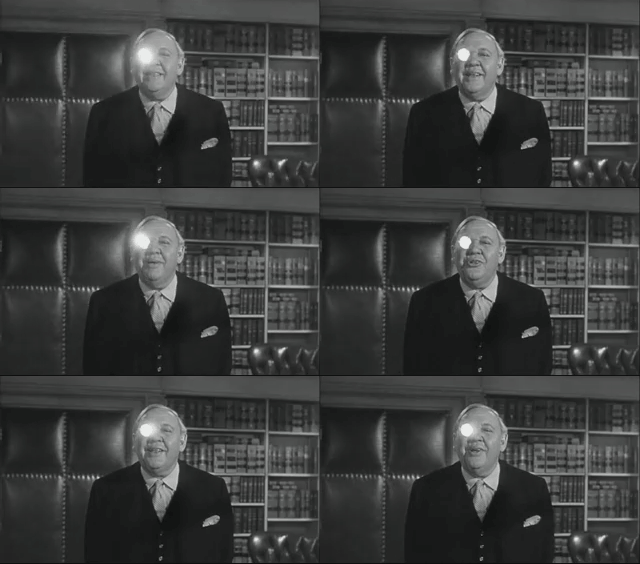
Sir Wilfrid's Monocole Test Never fails!
Sir Wilfrid Robarts comes home, recovering from his "teeny-weeny heart attack" as nurse Miss Plimsoll reveals he wasn't released, he was expelled -- conduct unbecoming a cardiac patient!
(Sir Wilfrid to Miss Plimsoll: "Put these in water, blabbermouth")
Talk about powerhouse stars!  The versatile Charles Laughton (his many great roles include his Oscar-winning The Private Life of Henry VIII; Hobson’s Choice; The Big Clock) plays Sir Wilfrid Robarts, a.k.a. “Wilfrid the Fox,” a brilliant veteran barrister who won’t let his cardiac health issues stand in the way of helping a client beat a murder rap riddled with circumstantial evidence. This adds extra suspense during the trial as we in the audience nervously wonder if Sir Wilfrid will keel over with a heart attack from the strain of it all!  Laughton’s real-life wife Elsa Lanchester is a delightful foil for him as chipper yet no-nonsense nurse Miss Plimsoll.  Laughton and Lanchester shine in the most engaging performances of their careers, garnering well-deserved Oscar nominations! (WftP also earned nominations for Best Picture, Billy Wilder’s direction, Daniel Mandell’s editing, and Gordon Sawyer’s sound recording, but it was The Bridge on the River Kwai’s year; sorry, guys!)  The comic sparring chemistry between Sir Wilfrid and Miss Plimsoll, and the playful warmth and understanding that grows between them by movie’s end, had my husband Vinnie opining that if another movie was made featuring these characters, Miss Plimsoll would probably end up as Mrs. Robarts before it was over. What a delightful series that could have been, kind of like a British Thin Man (okay, so Laughton was chubby; it makes him cuddly!) with Sir Wilfrid being the eager crime-stopper and Miss Plimsoll making a show of tut-tutting until she finally goes along with Wilfrid the Fox’s schemes with a smile!


Back to the plot:  Even though Sir Wilfrid’s friends and colleagues keep telling him to relax and take it easy after his heart attack, he can’t resist taking the case of a new client who needs help, but quick!  Sir Wilfrid’s new client is Leonard Vole (Tyrone Power of The Razor’s Edge; The Black Swan; Nightmare Alley).  Look up “Vole” in the dictionary, and you’ll see how clever his name is.)  Leonard is an unemployed but affable inventor, the kind of fella you can’t help liking, especially when a lonely widow like Mrs. French needs a friend, especially if he’s younger than Mrs. French and they’ve both got time on their hands—a real lady-killer, perhaps?  Leonard has been accused of murdering Emily Jane French, the kind of older woman who often has too much time on her hands, or as the French say, “Women of a certain age.” Was Mrs. French killed by a burglar, as Leonard insists?  Or was it, as Mr. Meyers (Torin Thatcher from The Fallen Idol; Major Barbara) sardonically suggests the culprits are all random burglars and/or burglaresses.  The luckless Mrs. French is played by one of Team Bartilucci's  favorite character actresses, Norma Varden (from The Glass Key; Alfred Hitchcock’s Strangers on a Train).  Varden and Power work together beautifully in their scenes, portraying Mrs. French’s sweet-natured longing as funny and poignant at the same time.


Christine Vole: Hostile Hottie Witness!


Busted! Sir Wilfrid's nurse,, Miss Plimsoll
already knows where the bodies, er, cigars, are hidden!


Speaking of beautiful, Marlene Dietrich is absolutely mesmerizing in both looks and acting talent as Leonard’s war bride Christine, she of the duplicitous tactics, malleable marriage contract, and unshakable alibi against the gobsmacked Leonard!  Is Christine truly the ultimate bitch, or is there more to her agenda? The entertaining flashbacks that Wilder and company deftly weave throughout the film to give it more verve and movement works beautifully, especially in Christine and Leonard’s sexy meet-cute/fall-in-love/dig-those-legs scenes, in and out of flashbacks. Dietrich and Power are dynamic in their scenes, whether it’s love or hate or payback time!  It's a shame Dietrich’s brilliant, multifaceted performance wasn't nominated for an Oscar as well, on account of the producers not wanting to spoil a certain crucial surprise twist!  Tyrone Power's usual ever-so-slightly wooden delivery actually serves him well as defendant Leonard Vole; somehow it adds to his air of feckless innocence. Veteran character actors Henry Daniell (The Great Dictator), John Williams (Dial M for Murder), Ian Wolfe (Rebel Without A Cause; Red , and Torin Thatcher provide able support, too, with original Broadway cast member Una O'Connor (The Invisible Man; Bride of Frankenstein) stealing her scenes as Mrs. French's loyal Scottish housekeeper Janet MacKenzie, who’s suspicious and “antag’nistic” to the beleaguered Leonard.  Sadly, WftP was O’Connor’s final film  before her death in 1959, but what a memorable swansong it was. In our household, "Is that really desirable?" has become a catchphrase (as well as the title of one of Team Bartilucci’s blogs: http://itrd.blogspot.com ), along with many other gems from the mouths of star Laughton and the rest of the sterling cast! :-)

Another satisfied customer from Leonard Vole, Inventor!


What kind of person was the late Mrs. Emily Jane French?
What breed?   A lady with a perky hat on, thanks to her new best buddy Leonard Vole!
Just make sure she doesn't go to dinner parties with Alfred Hitchcock!
Maybe it’s a British thing, but I was struck by how people took Sir Wilfrid’s cantankerous side in stride.  It’s a refreshing change from what my husband Vinnie calls “gas-permeable people” whose overly-fragile feelings are crushed by any response that’s less than 100% sweet and sensitive. I love how nobody takes Sir Wilfrid’s cranky pronouncements to heart, including Miss Plimsoll, who gives as good as she gets, like when she reveals she knows all about the cigars hidden in his cane (not to mention the brandy he’s squirreled away).

No disrespect to Mrs. French, but Christine Vole rocks that hat way better!


I promised Vinnie I’d carry on the tradition of not revealing the surprise ending of WftP (I won’t blab!)  Here’s the filmmakers word of warning:

  “Notice! To preserve the secret of the surprise ending, patrons are advised NOT to take their seats during the last few minutes of Witness for the Prosecution.”

While you’re at it, don’t blab to your friends, either!  I’ll only say I'd have paid good money to see the sequel that the ending implies. The film’s suspenseful surprises were so zealously guarded that when WftP was shown in London for a Royal Command Performance, even the Royal Family had to promise beforehand not to reveal the surprise ending to anyone else!


Looks like Leonard doesn't have a leg to stand on,
but Christine sure does!


 Hear Sir Charles Laughton and Elsa Lanchester in their romantic duet,
Baby, It's Cold Outside"!

Sunday, March 16, 2014

The Big Clock (1948): Beware the Boss from HELL!

This post is part of the Sleuthathon,  hosted by Fritzi Kramer of Movies, Silently, from March 16th through March 17th, 2014.  Don your deerstalkers and have a great time!


Ironically, this is NOT a scene from The Lost Weekend!


Paramount’s 1948 thriller The Big Clock (TBC), based on poet/novelist Kenneth Fearing’s 1946 suspense novel, is not only a riveting hunted-man story with a fresh twist, but also a cautionary tale about what can happen if you let your job dictate your life:
  1. You’ll miss your own honeymoon, as well as every family vacation.
  2. Your marriage will suffer as your loving, understanding wife and child start to lose faith in you, along with your endless excuses, as your family life erodes.
  3. What am I saying?  Family life?  What family life?  Kiss it goodbye!
  4. Worst of all, when your obsessive, uber-controlling Boss From Hell kills someone in a fit of rage, you just might find yourself suspected of the crime!

Happily, in real life, TBC was a family affair, with director John Farrow (Five Came Back; His Kind of Woman) working with his real-life wife Maureen O’Sullivan (The Thin Man; Tarzan the Ape Man and its many sequels).  Last but far from least, Farrow cast the real-life husband-and-wife team of Charles Laughton and Elsa Lanchester, who also teamed up for Witness for the Prosecution, the latter earning Oscar nominations for both Charles and Elsa!  It’s even a reunion of sorts for star Ray Milland and composer Victor Young, who brought us the 1944 chiller The Uninvited, also starring Milland; who could forget the beautiful “Stella by Starlight,” as well as the delightful Road to Morocco? 


Poor George!  Maybe he can give his pursuers
the slip by pretending to be a light display! 
Stop the presses!
Overworked George
Stroud
tells boss where to get off: Wheeling, West Virginia!
Noel Neill of The Adventures of Superman wishes
she could fly up, up, and away from fresh elevator operators!
Janoth Publication's big clock: The Hands of Fate!
"Georgette, it's not what you think! 
We're singing along with Pauline to "Do-Re-Me!"

Set in NYC (in 1948,that was present-day), TBC introduces us to George Stroud (Milland), letting us in on our anxious hero’s innermost thoughts as he hides in the giant clock in the Janoth Publications lobby at night.  George works for a huge Time-Warner/Henry Luce-style publishing company.  Director of Photography John F.Seitz (Double Indemnity; The Lost Weekend) works superbly in the film’s “docu-noir” style, with Edith Head’s costume design always a pleasure to see.  In flashbacks, we see that despite being married for seven years, George and his lovely and charming wife Georgette (O’Sullivan) have never had a honeymoon. We also learn  that the head man at Janoth Publications, Earl Janoth  (Laughton), hired George after he cracked a major murder case on his old newspaper in Wheeling, WV, and control-freak Janoth hasn’t given George a day off since, always snatching the Stroud family’s vacations from under them at the very last minute.  Adorably enough, George and Georgette have a young son, George Jr.  With the prestige and great salary Crimeways  affords him, George has always been reluctant to say “No” to Janoth, especially since Janoth does NOT take “No!” for an answer.  However, our hero is getting fed up, big-time!  So is Georgette, who sadly notes, “Sometimes I think you married that magazine instead of me…Little George hardly knows you...We’re like two strangers sharing an apartment.”  George and Georgette do their best to get as much family time as possible under the circumstances; perhaps that’s why the Stroud family’s names are all in various versions of the name “George”— papa George, mama Georgette, and son George Jr., sometimes even just calling each other “George” just for the heck of it.  At least it helps the family to keep track of each other!  You have to wonder how George and Georgette even got time to start a family!  

Louise Paterson tries to get her painting back, only to find she's in a bidding war!


Meet Pauline York, Janoth's mistress, an aspiring singer.
 Is she tired of singing for her supper, or does she have a veiled agenda?

Time really is money in Earl Janoth’s tight, suffocating world; for instance, this phone conversation between Janoth’s right-hand man Steve Hagen (George Macready from Gilda; Paths of Glory; My Name is Julia Ross): “On the fourth floor, in the broom closet, a bulb has been burning for several days.  Find the man responsible, dock his pay.”  I know we’re all trying to conserve energy (even back in the 1940s), but Janoth doesn’t have to be a tyrant about it!  In this sharp, twisty manhunt thriller, the renowned mystery writer Jonathan Latimer (The Glass Key; They Won’t Believe Me; TV’s Perry Mason) had ably adapted Fearing’s novel for the silver screen, with its blend of suspense, urban cynicism, and smart, snappy dialogue virtually intact.  I also find it intriguing that everything at Janoth Publications seems to be carved in stone, all cold and unyielding.   George does make big money at Janoth Publications,and it’s always cool to work in the big city, but I’ve also known people like George, who have grueling hours and no time to themselves, to the detriment of their family lives, with some co-workers even getting divorces from the pressure.

Check out the Crimeways Clue Chart!  That'll fix those no-goodniks!
I happen to love both the novel and the Paramount movie version of The Big Clock.  The book is more gritty and complex, but there’s also plenty of wry humor in it, too.  For example, in Kenneth Fearing’s novel, the Strouds actually have a little daughter, Georgia.  My husband Vinnie and I always get a kick out of the scenes with the Stroud family at breakfast; they always crack us up, because they remind us of our own goofy yet loving family life (not to put the whammy on it!  We’re great believers in not taking our happiness for granted).  For instance, here’s the Stroud family at breakfast in the novel, starting with papa George:


“Orange juice,” I said, drinking mine.  “These oranges just told me they came from Florida. 

My daughter gave me a glance of startled faith.  “I didn’t hear anything,” she said.”

“You didn’t?  One of them said they all came from a big ranch near Jacksonville….”


Here’s my own favorite Georgia Breakfast Bit Breakfast scene from the novel, where George regales us with The Adventures of Cynthia!  She’s…

“…about five, I think.  Or maybe it was seven… (she) also had a habit of kicking her feet against  the table whenever she ate.  Day after day, week in and week out, year after year, she kicked it and kicked it.  Then one fine day the table said, ‘I’m getting pretty tired of this, and with that it pulled back its leg, and whango, it booted Cynthia clear out of the window.  Was she surprised.”

This one was a complete success.  Georgia’s feet pounded in double-time, and she upset what was left of her milk…”


Some of the film’s grittier elements were softened a bit in the 1948 film version, probably for the Breen Office’s sake.  For instance, Janoth and Pauline’s fight in the film results from infidelity between Janoth and his mistress and possible aspiring blackmailer Pauline York (played by radio actor-turned-film star Rita Johnson from Here Comes Mr. Jordan; Sleep, My Love; Billy Wilder’s The Major and the Minor.  The film is as gripping as the book, sometimes more so.  In Fearing’s novel, our hero George Stroud talks about the “big clock” which inevitably runs our lives no matter what:

“Sometimes the hands of the clock actually raced, and at other times they hardly moved at all. But that made no difference to the big clock…all other watches have to be set by the big one, which is even more powerful than the calendar, and to which one automatically adjusts his entire life…” 


Keeping in mind that film is, of course, a visual medium, the “big clock” metaphor becomes a literal big clock — a huge clock/globe that can tell you the time anywhere in the world — and lots of little clocks sprinkled all over the headquarters of Janoth Publications, a Henry Luce/Time-Warner style magazine empire whose periodicals include ace editor George’s magazine Crimeways , as well as Airways; Newsways; Sportways; Styleways; etc. in the 1948 film version.  Janoth and Pauline’s fight in the film was the result of infidelity, but in the novel, their affair ends in murder when each accuses the other of being a closeted gay (keep in mind this was 1946).
"Georgette, darling, I was desolate!  Thank goodness
this was the film version so I couldn't get into worse trouble!"

George and Georgette better enjoy his firing while they can,
before George has to clear himself, by George!
Henchman Bill doesn't talk much, but I bet he's thinking:
"Life is too short to massage this jerk! I'm joining the Army"!


What's this? A sundial, used for a shady purpose!
It’s not all family fun and games when Earl Janoth’s mistress, Pauline York (Rita Johnson of The Major and the Minor; Sleep, My Love; Susan Slept Here) overhears George justifiably bellyaching to Janoth’s right hand man, Steve Hagen (George Macready from Gilda; Paths of Glory; My Name is Julia Ross) about his treatment at Janoth’s hands. At the Van Barth bar, Pauline tries to involve George in a blackmail scheme targeting Janoth, but George isn’t interested, though he does finally stand up to Janoth, getting himself fired and blackballed, and drowns his sorrows at the bar with Pauline, only to realize too late that he missed his train, with his disappointed family already heading to West Virginia without him. It’s The Lost Weekend time as the tipsy George and Pauline go on a bar crawl all over the East Side of Manhattan, hunting for green clocks to spite Janoth on behalf of a colleague who was fired for wanting to use red ink.  Sheesh, Ray Milland’s characters really need to knock off the booze!  Didn’t Ray Milland learn anything from The Lost Weekend?  George and Pauline drop by Burt’s Place (Frank Orth from; Lady in the Lake; Wonder Man, and of course, The Lost Weekend), where you can find anything from a bubble to a sundial, in keeping with the time theme.  The tipsy George and Pauline keep the sundial as a souvenir.  George is also lucky enough to get a painting by George’s favorite artist, Louise Patterson (Lanchester) .  Of course, she’d probably appreciate it more if George hadn’t taken it from her in an impromptu auction, as she huffs, “It’s a pity the wrong people have money!”

In Fearing’s novel, Janoth’s mistress is Pauline Delos.  Janoth and Pauline have a far more heated quarrel in this version, starting with sex between George and Pauline, which they’d apparently been doing for some time!  For people who are always swamped, they always seem to find time to be frisky!  Anyway, one night,  after a visit to Pauline’s pad, Janoth spots George in the shadows; fortunately, he couldn’t  actually see George clearly.   This time, Janoth and Pauline have a far more heated argument in the novel as they each draw first blood.  Compare and contrast each version:

The Movie Version:
Janoth: “At least this time he wears a clean shirt.”

Pauline: “Are you bringing that up again?  Throwing that cab driver in my face?  You never forget him, do you?”
Janoth: “No.  Do you?”
Pauline:  “No, you cheap imitation Napolean! 
Janoth:  “And you don’t forget the bellboy or the lifeguard  last summer, or the tout at Saratoga, and who knows how many others?  You don’t forget any of them, including the one to come.”


George leads the Crimeways manhunt for "Jefferson Randolph," with ace investigator Bert Finch!
He saved us all from The Thing from Another World, for goodness' sake!
Pauline: “Do you think you could make any woman happy?  Have you  lived this long without knowing that everybody laughs at ya behind your back?  You’d be  You’d be pathetic if you weren’t so disgusting!” (Ouch!)

The Novel’s Version
(Prepare for swear words and adult situations!)


“At least this time, it’s a man.” 

“Are you bringing that thing up again?  Throwing Alice in my face?...You talk.  You, of all people….What about you and Steve Hagen?...Do you think I’m blind?  Did I ever see you two together when you weren’t camping?...As if you weren’t married to that guy, all your life…Go on, you son of a bitch, try to act surprised.”

Well, Pauline is surprised, all right—dead surprised when Janoth loses it, killing  Pauline in a fit of rage!  Whango—was Pauline ever surprised!  Which just goes to show that booze, adultery, and vicious insults are no way to go through life, kids!  In the film version, George and Pauline’s relationship in the film ends as fast as it starts, with him waking up fully-clothed on her couch after their pub crawl.  Seeing Janoth’s car on the street, Pauline hustles the dazed George out the door. Alas, Janoth is outside waiting for his turn with the sly blonde. Though he doesn’t see George’s face as he slips out of sight, Janoth still suspects the worst. He lets Pauline have it, bludgeoning her with the heavy sundial, killing her instantly. The tight close-ups on the quarreling lovers’ angry faces, especially Janoth’s; nobody’s jowls quiver like Charles Laughton’s!   In any case, these scene adds enough intensity to make up for the bowdlerized argument before the murder.


The desperate but wily Janoth gets a brainwave: he’ll have Steve rig the clues to misdirect suspicion, and he’ll recruit the crack staff of Crimeways to track down the culprit, catching a killer and boosting magazine sales at the same time—and who better to lead the manhunt than our own George Stroud!  George can’t turn Janoth down this time; by leading the investigation, he can help to save himself do with some clever misdirection, buying time for our hero to find the real killer as the tension mounts ; George is actually doing double duty as both cat and mouse!  If George doesn’t deserve a huge bonus if he escapes this nightmare, I don’t know who does!  Fans of TV’s Harry Morgan of  M*A*S*H  fame will get a swell change of pace as a superbly sinister henchman!

On a bittersweet note, Rita Johnson didn’t quite live happily ever after.  In a twist of fate, Rita was seriously injured at a beauty parlor when a 40-pound hood which apparently frequently fell to the floor frequently.  Nowadays, she’d lawyer up and sue those dopes!  There were also rumors that Rita’s then-beau, Broderick Crawford (who went on to win an Oscar for All The King’s Men) had roughed her up, but there was no proof.  Rita managed to get supporting roles, but she was never really the same, and she died at the age of 52.To borrow a line from North by Northwest, it’s so horribly sad, how is it I feel like laughing?


https://lareviewofbooks.org/essay/the-booby-trapped-life-of-rita-johnson

R.I.P. to Pauline York, would-be blackmailer.  The cleaning lady isn't gonna like this!

Louise Patterson: "I think I've captured this mood rather successfully, don't you?
(Actual dialogue from the film as George is aided and abbetted by Louise!)
 
Check out The Los Angeles Review of Books for more on “The Booby-Trapped Life of Rita Johnson” by Matt Weinstock (August 13, 2013).” 


Leave it to a radio actor to help George save his bacon!
(Lloyd Corrigan is one of Team Bartilucci's favorite character actors!)


Baby, you're the greatest!  Wheeling, West Virginia,
we're going home, for keeps!


Milland’s superb performance balances suavity, sympathy, and desperation. He and O’Sullivan ring true as a loving couple whose relationship is being sorely tested. Laughton is marvelously odious and sadistic with a pathetic undercurrent. Macready makes a stylishly devious right-hand man. The supporting cast includes a silent, sinister young Harry Morgan as a masseur-cum-henchman.  I was delighted to see one of our favorite character actors, Douglas Spencer of Double Indemnity and The Thing from Another World as Crimeways  reporter Bert Finch (not to be confused with Burt from Burt’s Place, played by Frank Orth); and the ever-jolly Lloyd Corrigan (the Boston Blackie films;  It’s a Mad, Mad, Mad, Mad World;  The Manchurian Candidate)  played Burt’s pal, a radio actor of a thousand  guises,  including the faux suspect known only as “Jefferson Randolph.”  TBC has been reworked twice, as 1987’s No Way Out and 2003’s Out of Time. They’re both fun movies, but TBC is still my favorite version of the story.


Saturday, February 22, 2014

Alfred Hitchcock’s Notorious (1946): Nazis! We Hate Those Guys!

Believe it or not, my first experience with Notorious was when I saw, not Sir Alfred Hitchcock’s intense 1946 romantic thriller, but rather a 1992 made-for-TV retread starring John Shea (Missing) and Jenny Robertson (Bull Durham), because the video rental folks didn’t have the original version at the time!  Really?  Really?!  Please!  I remember my dear late mom and me having a better time fun poking fun at the dull, witless script!  What were they thinking with their silly attempts to “improve” upon it?  It’s like those wackos in H.P. Lovecraft’s supernatural stories about the evil monster Cthulu, whose followers always think the beast will be their best buddy after they summon it, only to be stunned when the monster lays waste to the villains.  It just goes to show that when it comes to classic movies, film fans must accept no substitutes! 

Screenwriter Ben Hecht (Spellbound; His Girl Friday) introduces us viewers to the beautiful but troubled Alicia Huberman (Ingrid Bergman from Casablanca; her Oscar-winners Gaslight and Murder on the Orient Express) has been a party girl and a heavy drinker for some time.  In fact, she’s only been along for the ride in life ever since her father was convicted of treason and collaborating with the enemy.  Since then, Alicia broke family ties with her disgraced father, and made booze her constant companion, aside from partying.  After another one of her parties, Alicia chats up a potential conquest, a handsome stranger.  When Alicia speeds way past the speed limit without the cop him giving him a summons,  she realizes the handsome stranger is a Fed, one T.R. Devlin (Cary Grant, who also worked with Hitchcock on  Suspicion and North by Northwest), and boy, is she furious when she discovers he’s a Fed!  Dev doesn’t let Alicia’s wildcat antics bother him—it’s just lights out for Alicia!  The next morning, she wakes up at Dev’s place with a splitting headache, a glass of milk (always popular in Hitchcock movies), and bittersweet news:  Alicia’s father has died by his own hand.  Even Alicia herself is surprised at her own unexpected sorrow for her late father: “I don’t know why I should feel so bad.  When he told me a few years ago what he was, everything went to pot.  I didn’t care what happened to me.  But now I remember how nice he was he once was, how nice we both were, very nice. It’s a very curious feeling, as if something had happened to me and not to him.  You see, I don’t have to hate him anymore, or myself.”

Make a note of that, Crime-stoppers!
From there, Alicia and Dev work with spymaster Paul Prescott (Louis Calhern of Duck Soup; The Asphalt Jungle) and his Washington colleagues, who send her and Dev to infiltrate the Nazi scum in Rio (by the sea-o)!  Don’t let their suave clothes and good manners fool you—they’re no-goodniks, no matter how sensitive and dashing they look underneath it all!  With Alicia sobering up, both she and Dev succumb to each other’s magnetism and they can’t help falling in love with each other, in spite of the fact that they both have more issues than a Hudson’s News stand!   Dev can be a prickly pear in any case, considering his serious trust issues where women are concerned.  In fact, sometimes Notorious feels like a version of The Lost Weekend with sexier stars!  But when Alicia and Dev do let their hair down, those scenes are among the hottest, most romantic scenes on film; I’m surprised the film stock didn’t simply burst into flames!  Notice how cold Dev acts when Prescott mentions how their main target, Alexander Sebastian (Oscar nominee Claude Rains from The Invisible Man; Casablanca) acts toward Dev when Prescott mentions Alicia’s long-ago “hunger” for Alicia when he was in love with her.  Tsk, tsk, Devlin sure isn’t being very business-like!   What would James Bond say?

Emile freaks out when it seems he’s got the wrong
bottle of wine at dinner.  Maybe he’d prefer a nice Ripple?
Or maybe cement shoes? 
Alicia makes contact with Alex, thanks to the old runaway horse trick, and suave Alex and Alicia pick up where they left off, while Dev acts like a jealous lover instead of the cool spy-type guy he needs to be on this assignment.   It’s amazing any work gets done at all with these two, especially when jealous Alex takes the next big step: marrying Alicia!   Prescott thinks it’s a swell idea; now it’ll be even easier for the new Mrs. Sebastian to keep her eyes and ears on the Nazi scum, to Prescott’s delight and Devlin’s passive-aggressive frustration!   Frankly, Devlin is especially in danger of shooting himself in the foot, perhaps literally!  Someone needs to give those crazy kids a time out, or maybe just a smack in the head!  No doubt it must annoy Dev no end that Alex is so suave and attentive to his lovely new wife.  Too bad Alex is both a Nazi and an insecure older man trying to keep his new bride happy.  Sheesh, where’s Ingrid Bergman in another romantic Hitchcock thriller when you need her:  Dr. Constance Petersen from Spellbound! 

A key moment in the film!
Instead of a honeymoon, our sexy spies throw a party to celebrate the newlyweds, with their old pal Dev keeping their eyes and ears open.  They hit pay dirt when Dev accidentally knocks over a wine bottle that’s actually “vintage sand!”  In fact, it's actually metal ore; that’s one way to perk up a honeymoon, as well as giving Dev and Alicia an opportunity for some romance, by George!  But  jealous Mama Sebastian (the regal, superb Leopoldine Konstantin) has Alicia’s number, and it’s gonna come up snake-eyes unless Dev stops acting like a jealous dolt and saves Alicia so that, as Grant said in North By Northwest: “You and I are going to do a lot of apologizing in private!”

Ingrid Bergman gives one of her very best performances as Alicia, juggling danger and romance in a relationship that’s complicated, to say the least!  Dev can be glacial or sizzlingly romantic at the blink of an eye.  The “Good Guys” essentially force Alicia to prostitute herself by marrying her off to suave Alex.   The hell of it is that Alex, an old friend of her father’s, is far more loving and romantic than Dev, despite his insecurity about his beautiful young wife, especially with Alex’s Mother-in-Law From Hell.  In any case, this sure tosses a monkey wrench into Alicia’s sizzling yet stormy romance with Dev!  It’s one of the most adult movies Hitchcock ever made; despite Bergman and Rains seemingly sleeping in separate beds, this film was quite adult for its era.  It’s not only a crackerjack espionage thriller, but also a moving, disturbing look into the dark recesses of the human heart.

For goodness sakes, hasn’t
Bing Crosby ‘s horse come in yet? 
In Robert A. Harris & Michael S. Lasky’s book The Films of Alfred Hitchcock (Citadel Press, 1976), Hitchcock realized he and co-author Ben Hecht  (Spellbound; His Girl Friday), had turned out to be ahead of their time when they decided to make uranium metal ore Hitchcock’s MacGuffin, a.k.a the item that makes our heroes hot and bothered, suspense-wise!  Indeed, Hitchcock used the uranium gambit even before it was used at Hiroshima!  Nobody was supposed to know about its powers, or that it would be used in an atom bomb for the movie.  In fact, producer David O. Selznick thought it was such a preposterous idea that instead of producing Notorious himself, Selznick sold the package to RKO (including Duel in the Sun).  Apparently even having the term “uranium” in the script was scaring the producers!  I was amazed by the visuals of Director of Photography Ted Tetzlaff (My Man Godfrey; The More the Merrier), especially that long shot at the party that ends on the key in Alicia’s hand—wow!

 Can't you fix it for me? For old times' sake? 
Hitchcock’s talented daughter Patricia Hitchcock O’Connell was a triple threat herself, having co-starred in her father’s films;  Stage Fright was her debut); then Strangers on a Train; (for which she deserved an Oscar nomination, if you ask me); Psycho; and many appearances on TV's Alfred Hitchcock Presents as she eventually became a producer.  I was lucky enough to interview Pat (if I may be so bold) in 1990 for Video Review, and she explained:  “My father was really able to do all the things he enjoyed doing artistically and technically.   He also used brilliant actors down to the smallest parts, like the Germans—especially Leopoldine Konstantin as Alex Sebastion’s mother…The only problem was that because of the politically sensitive plot about making a bomb out of uranium, my family was followed by the FBI for months.”  How’s that for cinematic realism?

The whole cast is absolutely stellar, including the always-suave Rains, terrific in a complex role that requires him to be believable not only as a suave lover and villain, but also a doting yet jealous and insecure husband of a lovely young wife, as well as being a villain, and having to put up with a domineering mother to boot;  to quote North by Northwest, I'm beginning to think Rains was underpaid!  I think his Best Supporting Actor Oscar nomination was richly deserved.   (I understand Rains was quite the romantic lover in real life!)   At times, I almost felt sorry for Alex, knowing Alicia was just stringing him along and coping—and even worse, he has to put up with The Mother From Hell, too, always a staple in Hitchcock’s wicked little arsenal!   With a forbidding matron of a mom like Mme. Leopoldine Konstantin as Alex’s mother, it’s no wonder Alex is still under Mama’s thumb despite his suave manners.  I must admit that the first time I watched the climactic love/rescue scene with Alicia and Dev’s “pillow talk,” in which Dev rescues Alicia from an agonizing death from slow poison had seemed a little corny at first.  But when I watched it again after all this time, now with a fresh outlook, I found it touching my heart!  Roy Webb’s swoony score is excellent, yet sometimes I wish I could somehow build a time machine or Way-Back Machine or the like, so that Hitchcock could have met and worked with Bernard Herrmann earlier in his career!


Claude Rains was only 5' 6" tall, a good three inches shorter than Bergman.  They were able to hide the difference when everyone was moving about, and in scenes where they stood next to each other, he just stood on a small platform.  But when he was moving and Ingrid stood still, they had to rely on strategically-placed ramps he'd walk up as he approached.  Watch how much taller he gets as he walks towards the camera here!


Steve Martin used footage from Notorious in his comedy Dead Men Don't Wear Plaid.  Here's how two scenes from very different parts of the film were stitched into one very differently-toned one!