Whoop it up, wranglers! Frank and the boys show Texas visitors action in All Through the Night
This review is part of theWhat A Character! Blogathon,
hosted by Paula of Paula’s Cinema Club, Kellee of
Outspoken and Freckled, and Aurora of Once Upon A Screen.
The Blogathon runs from September 22nd through 24th, 2012. By all means, please
leave comments for one and all! :-)
My
husband Vinnie and I first saw character actor Frank McHugh (1889-1981)
on TV, when we were watching the 1942 Warner Bros. wartime comedy-thriller All Through the Night(ATtN) on TCM. We of Team
Bartilucci loved both Frank and the movie right away! And why wouldn’t we, with
its great high concept: “Damon Runyon Kicks Nazi Heinie in NYC.” Heck, we could
easily devote this entire blogpost to ATtN alone, considering the
cast’s many wonderful character actors. In addition to our Frank, ATtN’s
cast included Humphrey Bogart (who I’ve always thought had the soul of a
character actor along with his star quality); William Demarest; Jackie Gleason;
Phil Silvers; Barton MacLaine; Edward Brophy; Wallace Ford;
Charles Cane; Conrad Veidt; Judith Anderson; Martin Kosleck; and Peter Lorre.
But for us, Frank stole the show as Barney, the newlywed among the tough but
good-natured “sports promoters” (translation: bookies and gamblers) in Bogart’s
crew. We’ll always affectionately think of Frank as “Annabelle’s Husband” in
honor of Barney’s new bride (Jean Ames), who barely even gets time to kiss her
groom before Bogie & Company whisk him away to fight Fifth Columnists in New
York City. As Barney, Frank gets some of the best lines in this totally
entertaining
blend of comedy and action:
Barney:
“Annabelle’s waiting for me…after all, I’m a married man. I got obligations.”
Gloves (Bogart): “All right, send her flowers.” Barney: “Well…that wasn’t my idea.”
Slugger Frank clobbers Fifth Columnists in All Through the Night!
Talking to Madame (Anderson) at the auction house after Gloves and Sunshine
(Demarest) are knocked out and tied up:
Barney: “Lookit, lady, when we started out tonight, there were
three of us. Twenty minutes later, there was only two. Now there’s only one. One
of us isn’t enough to leave here alone!”
Hooch your daddy? Frank and James Cagney in The Roaring Twenties (1939)
Of course, before Frank became one of our favorite character actors,Francis Curray McHugh was born in Homestead, PA in 1889, the
youngest member of a family of character actors. Indeed, the McHugh family had
their own stock company, including sister Kitty McHugh and brother Matt McHugh.
Sometimes they got screen credit, and sometimes they didn’t, but the McHugh
family was always working, whether it was Matt playing uncredited roles like
“Third Man on Death Row” in My Favorite Brunetteor faux waiter Frisco inThe Mad Miss Manton, or Kitty McHugh getting screen credits as Mae in The
Grapes of Wrath or Goldie in Blonde Trouble. Fans of the 1947 film
noir The Dark Corner may also recognize
Matt as the milkman who comes to Lucille Ball’s apartment. At the age of 10,
young Frank literally got into the act and began his own acting career with the
rest of the clan.
Frank and James Cagney as sea salts in Here Comes the Navy (1934)
Frank made
his Broadway bow in 1925 in The Fall Guy. Five years later, Hollywood
came a-knockin’, and he made his film debut in The Dawn Patrol. Warner
Bros. hired him as a contract player, where he usually played the hero’s
sidekick and/or comedy relief. Usually looking and sounding nervous yet
likable, Frank appeared in over 90 movies at Warners, as well as Paramount’s
Going My Way and My Son John, both of which cast McHugh as priests. (My
Son John was Robert Walker’s last film, which you can read about in myStrangers on a Trainpost, if you’re
interested. But I digress….). Frank’s regular-joe characters ranged from
mechanics to newspapermen to sidekicks to tough guys—or not-so-tough guys, like
the aforementioned Barney—with hearts of gold. Frank often appeared with
another in-demand character actor, Allen Jenkins (Ball of Fire;Lady on a Train; the voice of TV’s Officer Dibble on
Hanna-Barbera’s Top Cat). Sometimes Frank even got the girl, a laATtN!
Frank as Father Timothy O'Dowd in Going My Way
During
Radio’s heyday, Frank proved to be as versatile a voice actor as he was a film
actor, starring in 1935’s in Shell Chateau,
and then in 1938 in the Warner Brothers Academy Theater. The next
decade saw Frank performing in several Radio dramas. Then, in 1946, Frank got
another break: popular Film and Radio comedian Stuart Erwin had been starring on
the CBS Radio sitcom Phone Again, Finnegan.Realizing he was spreading himself too thin with commitments, Erwin stepped
down, and Frank got the gig, joining the cast as Fairchild Finnegan. By the early 1950s, Frank’s film career was winding down, so he migrated to
Television, racking up over 80 TV credits. From 1964 through 1965, Frank and his Going My Way co-star teamed up for The Bing Crosby Show, where Frank played
Bing's comic foil, Willis Walter.
Frank's in the swim with Elvis in Easy Come, Easy Go (1967)
Ironically, Frank had supporting roles in two different films titled Easy
Come, Easy Go (ECEG),which just goes to show that everything old
is new again, at least when it comes to movie titles! The first ECEG
was a 1947 comedy-drama described on the IMDb as “A film that possibly held the
record for the most Irish-descent players in an American-produced movie before
The Quiet Man was shot on location in Ireland, and that includes The
Informer.” The secondECEG was a 1967 Elvis Presley
comedy-adventure with Navy frogman Elvis and local shopkeeper Frank joining
forces to find undersea treasure—which turns tricky when Frank’s character,
Captain Jack, confesses he’s afraid of water!
Being an in-demand character actor is thirsty work!
Frank
quietly retired from show business in 1969 with his wife, Dorothy, and died of
natural causes in 1981, survived by his wife of 48 years and his three children.
Of course, he lives on in the hearts and films of his many fans, including all
of us here at Team Bartilucci HQ. What A Character, indeed!
The 1947 Easy Come, Easy Go. Don't mix those two up!
When RKO’s
1938 screwball comedy-mystery The Mad Miss Manton(TMMM)
was shown on TCM, our genial host Robert Osborne noted that Barbara Stanwyck and
Henry Fonda had made three films together, all comedies: TMMM,
The Lady Eve, and You Belong to Me, the latter two released in 1941.
Set in then-contemporary New York City (but actually filmed in Burbank, CA in
100-degree heat, according to John M. Miller’s TCM article!), TMMMcame first. Director Leigh Jason had
also worked with Stanwyck and co-star Hattie McDaniel in The Bride Walks Out
(1936), before McDaniel won her Best Supporting Actress Oscar for Gone
With The Wind (1939).
Stanwyck’s
part was originally meant for Katharine Hepburn, but Bringing Up Baby’s
bad box office put the kibosh on that, though of course nowadays it’s hailed as
a classic. Besides, things worked out fine for Hepburn, as she moved on to her
Oscar-nominated performance in The Philadelphia Story (1940), among so
many other triumphs. In any case, Stanwyck’s flair for comedy is just right for
her role as Melsa Manton, madcap heiress extraordinaire. That’s my favorite kind
of heiress, especially if she’d like to plunk a few bucks into my pocket during
one of her charity scavenger hunts!
Melsa Manton has The Thin Man’s Nick and Nora Charles beat when it comes
to chic yet zany sleuthing, at least when it comes to sheer numbers: she has
eight gorgeous debutante girlfriends who are as loyal as they are endearingly
kooky, with no-nonsense maid Hilda (McDaniel) shaking her head at these nutty
rich folks. For the most part, the girls are happy to help Melsa solve murders,
the occasional growled threat or thrown knife notwithstanding. Fun Fact:
Melsa and her eight gal pals were no doubt playfully modeled on the northeastern
women’s colleges known as “The Seven Sisters:”
Barnard;
Bryn Mawr;
Mount Holyoke;
Radcliffe;
Smith;
Vassar; and
Wellesley. Of course, this being a Hollywood movie, another “sister” was
added. That’s Hollywood for you, always making everything bigger and bolder!
We first meet Melsa walking a gaggle of cute little dogs at the ungodly hour of
3 a.m.; is this how our pet-loving heroine makes extra spending money, or does
she prefer to take her pets walkies when the neighbors are in bed, unaware
Melsa’s pooches are leaving, er, souvenirs? She notices Rex Realty signs
plastered all over the house. Turns out it belongs to Sheila Lane (Leona Maricle,
who’d also worked with Stanwyck in My Reputation), the wife of
wealthy banker George Lane. Suddenly a car speeds past the site of the new
subway. Melsa recognizes local gent Ronnie Belden (William Corson). Unlike the
usual stereotype of New Yorkers who mind their own business, Melsa lets her
curiosity get the best of her. Her impromptu investigation brings her to the
deserted Lane house, where she finds a diamond brooch—and Lane’s bloodied body!
As she flees in panic, Melsa drops the brooch. By the time Melsa gets ahold of
Lieutenant Mike Brent (Team Bartilucci fave Sam Levene from The Killers;
After The Thin Man; Shadow of The Thin Man; Last Embrace), the corpse has
gone AWOL.
Don’t worry about the press as long as they
spell your name right!
Lt. Brent and the rest of New York’s Finest are pretty darn peeved,
considering that Melsa and her friends have a reputation as merry pranksters.
Too bad our heroine happens to be dressed in a Little Bo-Peep costume for an
artists’ ball, which doesn’t exactly do wonders for her credibility. Granted,
Melsa swears their playful pranks were only meant to draw positive attention for
the good causes they work on in the name of their various charities, like
running a TB clinic and other helpful, clean-cut activities. Melsa and her pals
clearly mean well, but haven’t they ever heard that charity begins at home?
Maybe they should stay out of trouble by making lanyards for the poor or
something. To add insult to injury, not only do Lt. Brent and his men refuse to
investigate, but Peter Ames (Fonda), editor of The Morning Clarion,
writes a stern article about Melsa’s hijinks, resulting in much comical
slapping. One lawsuit, coming right up! With their
reputations on the line, Melsa and the girls become amateur sleuths. Debutante
Roll Call, sound off now!
Frances Mercer as Helen Frayne, the most sensible of Melsa’s gorgeous friends. The daughter of prominent East Coast sportswriter Sid Mercer, the raven-haired beauty was a “Powers Girl” model in New York in her teens back in the 1930s (as were my dear mom and aunt. Wish I could’ve been a fly on the wall with those gals swapping stories). Mercer went on to act and sing on stage, screen, and TV, including the Broadway musicals All the Things you Are;Very Warm for May; and Something for the Boys.
Kay Sutton as Gloria Hamilton. This lovely brunette’s screen credits include Carefree; The Saint in New York; Vivacious Lady. Gloria gets a nice punch line when the girls find what may or may not be bodily fluids: Dora: “How can that be blood? It’s blue.”
Gloria: “Maybe he shot Mrs. Astor.”
Oh, Kay!
Catherine O’Quinn as ditzy Dora Fenton. I’m almost certain O’Quinn is one of the blonde Goldwyn Girls in Team Bartilucci fave The Secret Life of Walter Mitty (1947). Anyway, she gets some delightful lines here, especially this TMMMbit, which becomes a running gag:
Melsa: “Helen, you search the upstairs.”
Helen: “Oh, no, I was never much of an individualist. If the upstairs has to be searched, we’ll search it together.”
Dora: “Why, that’s Communism!”
Whitney Bourne, as Pat James(Blind Alibi; Double Danger; Beauty for the Asking, with Lucille Ball)), who never saw a snack she didn’t like, even at a murder scene! I’m sure Lt. Brent is thrilled to see his crime scene ruined. Hey, Pat, you gonna finish that? Don’t your rich parents feed you at home, you poor little rich girl you?
Ann Evers as Lee Wilson (If I Were King; Gunga Din; Casanova Brown).
Linda Perry, billed here as Linda Terry. By any name, she plays Myra Frost, Melsa’s flirty friend. Ms. Perry’s credits include They Won’t Forget; The Great Garrick; and the 1937 movie adaptation of the Perry Mason film The Case of the Stuttering Bishop.
Vickie Lester (billed as Vicki Lester) as Kit Beverly. Vickie’s star was born in Tom, Dick, and Harry; Tall, Dark, and Handsome; The Great Plane Robbery.
Eleanor Hanson as Jane. (Guess it's one of those one-word names, like Margo or Annabella.) She also appeared in the Western Flaming Frontiers and bit parts such films as The Story of Vernon and Irene Castle, and worked again with TMMMco-star Penny Singleton in Blondie Goes to College. Wonder if Singleton and Hansen ever reminisced about making TMMM?
One stiff, hold the mayo!
Before long,
the lawsuit takes a back seat, along with a corpse or two, as Peter finds
himself falling in love with the spirited Melsa and trying to save her from
shady characters like ex-con Edward Norris (Stanley Ridges of Possessed; To
Be or Not to Be; Sergeant York), a convicted murderer who’s working on the
subway and just might have a score to settle. Even Blondie gets into the act—no,
not songbird Debbie Harry, but the original Blondie, Penny Singleton, formerly Dorothy McNulty from After the Thin Man. She’s funny and memorable in
this pre-Blondie comedy caper as Frances Gluck, who’s stuck on Norris and
tries to convince the girls of his innocence, even trying to pass off the
future Blondie Bumstead as an old chum, with hilarious results and a smattering
of social commentary.
Kit(talking
to Hilda with her mouth full): “Have you another piece of cake, Hilda?”
Hilda: “Yes, I have, but the kitchen’s closed for the night.”
Melsa:
“Hilda! Miss Beverly is our guest.”
Hilda:“I didn’t ask her up!”
Helen:
“Come the revolution, we’ll stop being exploited by our help.” Melsa
(giving Hilda a wry look):
“In my house, the revolution is here!”
Who needs Charlie's Angels with 8 crimefighting debs?
“Lt. Brent, the good news is
we’ve found George Lane’s
body. The bad news…er….”
Blondie Beats a Murder Rap!
Lt. Brent saves the day! Who knew he was a counter spy?
Although
Fonda and Stanwyck were great onscreen, Henry Fonda was less than thrilled with
his role. He’d been borrowed from Walter Wanger Productions and, as Axel Madsin
wrote in his biography Stanwyck, Fonda “...hated his role, hated the
script's sneering repartee with his leading lady, and tried his best to ignore
everybody.” Fonda himself later admitted, "I was so mad on this picture; I
resented it." Philip G. Epstein’s script from an unpublished Wilson Collison
novel was clearly meant as a female star vehicle, and as Miller suggested,
“Fonda probably did not appreciate the scenes in which he was beaten up by eight
flighty debutantes!” But Fonda got over it, happily co-starring with Stanwyck again in
two other hits, as mentioned earlier, and becoming close friends. In fact, Robert Osborne said Fonda admitted to his subsequent wives that he carried a torch for Stanwyck for the rest of his life (and why not?)!
Here's a link to our pal Dawn Sample's great Noir and Chick Flicks blog post from 2011!
This post
is part of the CMBA Gene Kelly
Blogathon, running from August 20 through August 25, 2012.
We of Team Bartilucci have joined forces for another double-feature in the CMBA's salute to the one and only Gene Kelly! We hope you'll enjoy our mad yet lovable ramblings!
Dorian’s Pick: The Devil Makes Three (1952)
With so many
of us writing about Gene Kelly’s musicals for the titular CMBA Blogathon, I thought it would be an interesting
change of pace to focus on one of Kelly’s action-adventure films. Mine has a
Salzburg Connection, though it doesn’t have a Helen MacInnes plot (that would
be the bailiwick of our friend and fellow blogger Yvette
Banek of…in so many words fame)! I chose the 1952
action-drama The Devil Makes Three (TDM3). The title explains a
tenet in Islam: an unmarried boy and a girl should never be alone together.
It’s acceptable to have two boys or two girls in a room, or larger
numbers and permutations. But if a boy and a girl are alone together, it’s said
the devil is the third person in the room. With that in mind, I’d say the real
devil to fear in this moody suspenser is the poverty and desperation which
force hard choices on our protagonists, Captain Jeff Eliot (Kelly, excellent in
a dramatic role); and the vulnerable yet determined Wilhelmina Lehrt (Pier Angeli of Somebody Up There Likes Me; Teresa; and Merry Andrew, who left us
way too soon), or “Willie,” asJeff affectionately nicknames her.
But you know what really piqued my interest in TDM3? Two words: Snowmobile
Nazis! How’s that for a high concept?
Disney on Ice is nowhere near as badass as these snowbound Wild Ones on Ice!
Set in 1947
just after the war, we viewers get a catch-up prologue from Colonel James Terry
(Richard Rober of The Well; Father’s Little Dividend; The Tall Target),
with our story being “a composite of case histories taken from the Munich
headquarters file, Criminal Investigation Division Corps of Military Police,
United States Army.” Over footage of the notorious Braunes Haus that housed the Nazis, Col. Terry
dryly notes, “There isn’t even a ‘For Sale’ sign on the lot where the Braunes
Haus once stood.”
After this prologue, the action begins! Around the Christmas holidays, a
woman (Charlotte Fleming) drives on an icy road, skidding. She stops, hurries
into a phone booth, and speaks urgently—only to have her phone call cut off
permanently when two motorcycle cops pull up and shoot her dead in a hail of
bullets! Yikes! Talk about Hell on wheels!The only clue is a
business card with the insignia “Silhouette.”
I see a little Silhouette of a club! (Scaramouche! Scaramouche!)
Meanwhile,
our hero Jeff has just left the U.S. to return to Germany (instead of vice-versa as one would expect). Jeff has been writing to the Lehrt
family and sending them gifts since he returned to the States, and he’s brought
all the trimmings of an old-fashioned Christmas to thank the Lehrts for saving
his life during the war. But when he drives to the address he knew, he finds
the place practically in ruins, with a German family that’s definitely not
the Lehrts! The family now living there are strangers to Jeff; they
shamefacedly admit nobody else has lived there for ages, and they’ve been
accepting Jeff’s care packages all this time because otherwise, they’d be
starving in the rubble of what’s left of their ramshackle home. Being a decent
joe despite his frustration and puzzlement, Jeff gives the bombed-out family
the gifts he’d intended to give the Lehrts, then sets out to see what the heck
happened to them.
Our hero Captain Jeff Eliot thinks he can see his house from here!
When Jeff
gets together with Lieutenant Parker (the versatile Richard Egan from Love
Me Tender; Violent Saturday; Pollyanna), he and us viewers get more
background. The Lehrts were a family of musicians and singers, and pretty young
Willie was only 15 the last time Jeff saw her. He’d met the family during the
war, when his outfit was captured in a raid over Innsbrook, then thrown into a
nearby prison camp. Two days later, the Lehrts had managed to hide the injured
Jeff in the family’s cellar. Shortly after New Year’s Day, the family smuggled
him to an area where he’d be able to walk to safety. Parker suggests they check
the Central Registry, where there’s a complete casualty list, even if it means
forgoing his previously planned evening of beer, bratwurst, and knockwurst—now That’s
Entertainment (not to mention friendship)!
In Germany, our heroes hope for the best, but expect the wurst!
At the
Central Registry, Jeff and Parker get the bad news: Mr. and Mrs. Lehrt were
killed by bombs in July 1944, and there’s no further info about Willie on file.
Parker deduces that Willie would be about 18 by now: “If she’s still alive, and
she’s still pretty, there are just so many joints in Munich where she could be, and I know every
one of them.” Jeff is skeptical: “Not Willie. She wasn’t the type.”
Parker ruefully replies, “If she’s been hungry long enough, she’s the type.” So
the search for Willie begins. On the bright side, if all else fails, at least
our heroes will get a pub crawl out of it!
Is that a bruise under
Willie's eye? Poor girl, she probably wishes she
could be marching home!
Their search
bears fruit. Of all the gin joints in all the world, Jeff and Parker find
Willie (Angeli) at her workplace—none other than Silhouette! It’s full
of beautiful girl singers and tough-looking guys who aren’t exactly gentlemen.
Let’s just say the gals at Silhouette aren’t working there because
it’s their dream job. Willie has grown up into a lovely, doe-eyed young woman
with a bruised psyche. Having been orphaned and living on her own, she’s become
understandably cynical since she last saw Jeff. They talk as they walk among
the bombed-out buildings in the moonlight (almost sounds romantic, in a film noir way):
Willie: “Enjoying the sights, Captain?”
Jeff: “Oh…from the air, it all looks different. You had one idea up
there, and that was to navigate the plane to the aiming point.”
Willie (sarcastically): “You did a good job.”
Another of my favorite TDM3
lines:
Willie: “You will like it here at Silhouette. At midnight, Kris Kringle
comes down the chimney and does a strip-tease.”
Jeff wants to make amends and thank Willie on account of
her late parents having saved his life. He’d like to start by giving Willie the
Christmas holiday with all the trimmings that she’d loved in happier, pre-war,
pre-Nazi days. Since Jeff is doing well at his navigation instructor job in the
States, he wants to go all out to show Willie a happy time, so they’re off to Salzburg for the
holidays! I love Willie’s running gag about “getting a commission” from
businesses around town, like at the car dealership. Ah, but as soon as Jeff and
Willie hit the road, good ol’ Honest Oberlitz (Bum Krüger) scrambles into the
garage, yelling in German, and who should come roaring out but those evil
motorcycle guys, hell-bent for leather and burning rubber! What the heck do
those no-goodniks want from our heroes?
As they drive
on the Autobahn, which Jeff compares favorably to the Pennsylvania Turnpike
(wow, the Autobahn must have been way less crowded in the 1950s!),
Willie gives Jeff a history lesson:
Willie: “The Fuhrer built it. It was supposed
to carry its conquering armies to glory. Now it carries the conquerors. How
does it feel to be a conqueror?”
Jeff:“Most of the guys stationed here
would rather be driving along the Turnpike. We’re not cut out to be
conquerors.”
I must say I
enjoyed TDM3’s touches of wry humor, poking good-natured
fun at the gentler post-war changes at Germans vs. Austrians, such as the
Austrian diner with a juke-box, where the personnel use American slang like
“Adam and Eve on a raft.” I also loved the beautiful locations, with shots of
the locations as pretty as a postcard, especially since this is probably the
closest I’ll ever get to that part of the world!
I keep expecting to
hear Gene Kelly and the kids singing “I Got Rhythm” in German!
But things
get serious when Parker discovers that, unbeknownst to Jeff, that German car is
chock full of contraband—specifically, there’s gold under the car’s top
coat! It turns out Willie had to secretly drive contraband across the
Austro-German border, though Willie is having second thoughts after falling in
love with Jeff (can you blame her?), plus the poor phone booth gal killed
earlier in the film was a friend of Willie’s, and she doesn’t want to meet the
same awful fate. What’s more, apparently this dastardly Nacht de Legernogen (sic), described
as “The Last Will and Testament of the Third Reich,” outlines chilling procedures
after the hoped-for defeat. Grr! Nazis—I hate those guys (don't we all?)! Can Willie and
Jeff conquer the bad guys and go on to live happy lives of baseball, hot dogs,
apple pie, Chevrolets, and, for Willie, American citizenship? Although
Kelly doesn’t get any song-and-dance numbers, I found him both tough and tender as the
determined yet caring Jeff, and I thought he and Angeli worked well
together. I was especially moved as Willie did her best to survive with dignity
while being forcedinto hard choices just to stay alive.
No mistletoe
required!
TDM3was filmed on location in Munich and Salzburg, with a
screenplay by Jerry Davis (known for such Warner Bros TV series as 77 Sunset
Strip, Bourbon Street Beat,Surfside Six,Bewitched, and The
Odd Couple, as well as the 1955 horror thriller Cult of the Cobra),
and based on a story by producer Lawrence P. Bachman, known for his 1960s
series of comedy-whodunits based on Dame Agatha Christie’s Miss Marple
mysteries, starting in 1961 with Murder, She Said. That movie series is
dear to Team Bartilucci’s collective heart, especially since it starred the
delightful Dame Margaret Rutherford
(and we all know there’s nothing like a Dame!), as well as Children of the
Damned, the 1964 sequel to the horror classic Village of the Damned.
Uh-oh! X
doesn’t mark the spot in a good way here!
Hurry, Jeff, distract
the villain with a dance number!
The film was
directed by Andrew Marton, who was no stranger to action films and war films.
His work included The Longest Day; the 1950 version of King Solomon’s
Mines; science-fiction thriller Crack in the World,another Team B. fave;and
the 1964 version of James Jones’ celebrated novel The Thin Red Line. (Terence
Malick’s 1998 version included an all-star cast, including future Oscar-winner
and Team Bartilucci favorite Adrien Brody, but
that’s a story for another time.) The driving rhythm of Bronislau Kaper’s
music (Gaslight; Whistling in the Dark; The Naked Spur) sets an
appropriate pulse-pounding pace as TDM3 moves along. But it’s not
all action movie music by any means. Since the story is set in post-war Munich and Austria
during the Christmas season, there's poignancy and grim reminders of the
aftermath of World War 2. Bombed-out ruins, some of which housed the Nazis
(good riddance, Nazi scum!), sit side-by-side with the new buildings of the
ongoing reconstruction, while ironic reminders of the war appear along with
holiday music such as “Oh, Christmas Tree” (in both English and German). TheNew York Times movie reviewer, identified only as H.H.T (the venerable
Howard Thompson, perhaps?) was underwhelmed with Jerry
“Hi, I’m Claus
Clausen, I’ll be your Otto Preminger for this evening….”
Boy, Oberlitz's coffee sure is a knockout!
Davis’ screenplay for
the post-war adventure drama The Devil Makes Three (TDM3). Oh,
well, can’t please everyone!
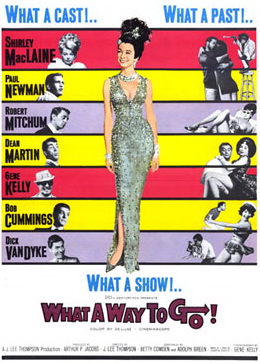
Vinnie’s Pick: What A Way to Go! (1964)
I must confess to bending the rules slightly with this entry. This is
undoubtedly a film that belongs to Shirley MacLaine. Like a housecat who
graciously lets people live in their homes, Shirley allows several leading men
to share the screen with her, and each time she makes them feel comfortable,
like they're the only man in the world. Gene Kelly is the last of them,
but it could be argued that his appearance is the grandest and most over the
top.
Shirley plays Louisa May Foster, a shy, unassuming girl who through no fault
of her own, appears to be cursed. For every time she attempts to marry for
love, her husbands seem to become bestowed with uncontrollable success.
Everything goes their way, they become engrossed in their work, and it ends with
them dying in progressively outlandish fashions, leaving her alone, and each
time, exponentially wealthier. The film begins with her attempting to give
all her money to the IRS in the form of a single check for 250 million dollars.
She is met with doubt, and is sent to a psychiatrist (Bob Cummings) to whom she
bares her tale of woe.
Starting with her childhood in Crawleyville, named after the town's richest family,
she is pressed by her mother (Margaret Dumont!) to marry the Crawley's indolent
son, Leonard (played by the indolent Dean Martin). She instead turns her eye to
Edgar Hopper (Dick Van Dyke), owner of a barely open general store, who lives
his life by the tenets of Thoreau. They marry, and out of spite Crawley proceeds
to make their life hell, mocking their meager existence. Hopper snaps, and
becomes a marketing dynamo, turning his general store into the most successful
business in town, driving the Crawleys into bankruptcy. The strain is too
much for him, and he dies from a massive (and ironic) coronary, his last words
being "a little hard work never hurt anybody!"
Louisa is now a wealthy woman, and travels to Paris to start anew.
There she meets Larry Flint - not that one, a struggling artist played by Paul
Newman. He lives the stereotypical life of an artist, in a loft surrounded
by other eccentric creators, including a chimpanzee who's currently more
productive than any of them. Larry's medium is a mechanical painting
device of his own invention that converts sound to brush strokes. Louisa, happy to find another
man who abhors wealth, marries him, and they live the simple life in their
paint-stained loft. But she whammies him as well, and when she suggests
he play beautiful music for the machine to interpret, it paints a masterpiece.
He builds an assembly line of them, and is making money hand over waldo, leaving
her alone again, first figuratively, and later literally when the machines turn
on him and turn him into their living (for a while) canvas.
Her third try, she goes the opposite direction - Rod Anderson (Robert Mitchum)
is even more staggeringly wealthy than she, and they hit it off immediately.
During a wild montage of parties and truly spectacular costumes (all created by
the equally spectacular Edith Head), Rod is amazed to learn that athough he's
been totally ignoring his business, he's actually made MORE money.
However, Louisa convinces him to sell everything and live his dream - to move
back to a farm like the one he grew up on. They do so, and are blissfully
happy...until one morning, Rod accidentally tries to milk their prize bull,
Melrose. The moment is understated and only implied, but is truly
hilarious - his last words, "Melrose, forGIVE me!", are preceded by a strained
and surprised bovine bellow, and followed by him being kicked out the back of
the barn.
Her next paramour comes in the form of Pinky Benson (Yes folks, you've been
patient - it's Gene Kelly) an earnest but happy where he is song and dance man
who performs in a local tavern called the Cauliflower Ear. His act is pure
schmaltz - he wears a clown getup, and does a fast hoofer nonsense number in the
style of fifties performer Pinky Lee. He's barely noticed by the audience, which
is just fine by the owner - a status quo that's lasted fourteen years.
Once again, Louisa thinks she's found a man who wants no more out of life than
he's already got, and they wed. And it all goes very well. Until...
One of the recurring motifs in the film is Louisa's complimentary comparison
of each of her marriages to a different kind of classic film. Her early time
with Hopper was like a melodramatic silent film where love conquered all, her
time in France like a French impressionistic picture, and the high-rent world of
Rod like a series of lavish entrances in a "Lush Budgett" glamour film.
Her time with Pinky / Kelly, predictably enough, is portrayed as an over the top
musical production. Kelly, at 52 by the time of this film, is still
staggeringly light on his feet, and Shirley more than keeps up with him.
Heading out for his birthday party after a performance, Louisa suggests he
save time by not applying his makeup, and do the act in his street clothes.
He feels a bit shy without his costume, and he sings his number softly, and at
half speed. Rather than his clownish (naturally) buck and wing, he does a
gentle soft-shoe number. As the raucous restaurant slowly grows silent to pay
attention to him, Louisa realizes she's done it a again. Pinky is
discovered before they can finish a whip-pan, and Louisa is morosely lounging
around a massive Hollywood mansion as Pinky works on a number of films at once.
Far from the soft-spoken hoofer she married, Kelly now plays Pinky in full-on
parody mode, with a brassy voice and the traditional "My public" mode of the
triple-threat mogul.
At his latest premiere, they arrive in an all-pink Rolls, Louisa's head
buried in a pink wig, and wrapped head to toe in pink mink. The film,
naturally, is a smash. The surging crowd of fans are out of control, and
his producers suggest he leave out the back entrance. Just as they're
about to leave, he realizes he can't do it to his fans, and pops out from the
alley to surprise them. BAD move. They thunder toward him, their
advance deftly mixed with shots (and sound effects) of stampeding elephants.
He is literally trampled to death by his adoring public.
As the dream sequences get progressively longer, so too her time spent with
each husband, which means that Kelly gets the most time on screen. He gets
to play a good spectrum, from the shy tavern performer, to the lovestruck
husband to the bombastic movie icon. MacLaine is adorable throughout the
film, eternally desperate for love, spending most of her time swathed in the
most astounding finery, alternately covering her entirely, and leaving so little
to the imagination you wonder how brother Warren didn't storm onto the set and
slap all the cameramen. Her high pitched voice sounds like if she were in a comic book, it'd have little musical notes in her word balloons, like Melody from Josie and the Pussycats did.
I deliberately tried to keep my summaries of the rest of her paramours brief,
as this is a Gene Kelly tribute. But let me assure you, I left out a LOT
of detail, and it's all worth a look. The film's been making the rounds on
cable, and is pretty easy to catch up with. And well worth doing, as well.