It’s been
said that our late loved ones are always with us, watching over us in the
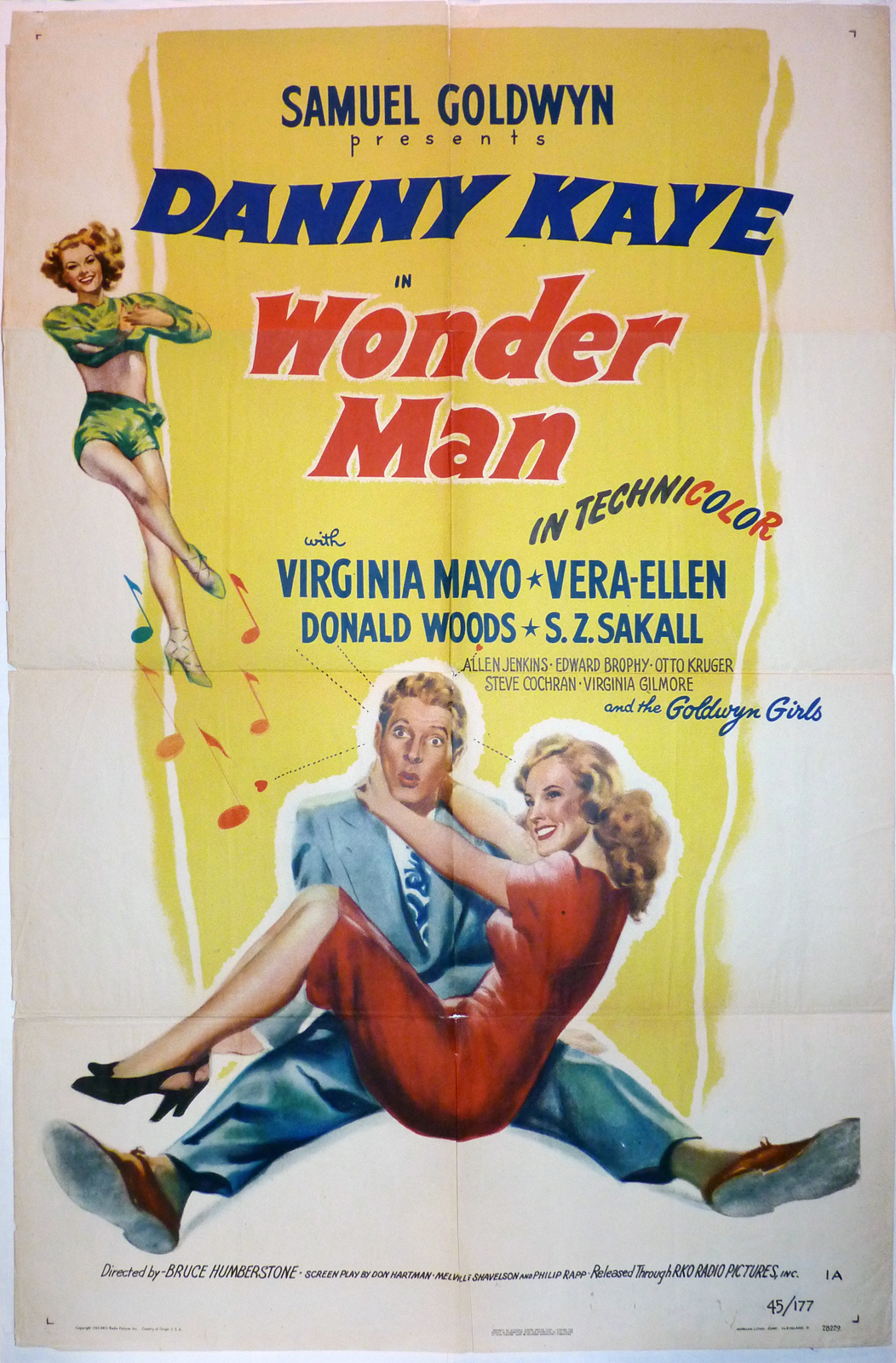
hereafter—but Danny Kaye takes the concept and runs with it in 1945’s supernatural RKO/Samuel
Goldwyn comedy
Wonder Man
(WM)!
If you thought Danny was hilarious on his own, wait’ll you see him in
the dual roles of famous nightclub star Buzzy Bellew and his brother Edwin
Dingle! As the Doublemint gum commercials, say, it’s double your pleasure,
double your fun!

Directed by
H. Bruce Humberstone
(I Wake up Screaming, Sun Valley Serenade; several
Charlie Chan
films, among others),
WM’s screenwriters included
Up in
Arms’ Don Hartman; Melville Shavelson from Kaye’s 1946 boxing romp
The
Kid From Brooklyn; Philip Rapp, creator of Fanny Brice’s Baby Snooks; Arthur
Sheekman, gag writer for The Marx Brothers; and Jack Jevne, Eric Hatch, and
Eddie Moran from
Topper and
Way Out West. If these fellas didn’t
know their comic ghosts, I don’t know who would! They say that too many cooks
spoil the broth, but in this case,
WM turned out to be a
musical-comedy smorgasboard and a hip, hilarious, tuneful romp indeed!
From Borscht
Belt tummler to Broadway star to multitalented movie star, Danny’s secret
weapon was Sylvia Fine, Danny’s brilliantly talented lyricist, composer,
manager, and his wife from 1940 until Danny’s death in 1987. Sylvia was truly the woman behind the man. With her brilliant
lyrics and wordplay, and Danny’s unbeatable talent and energy, they were an
amazing power couple!
 |
Sylvia & Danny:
They're so fine! |
Danny’s first
film, the 1944 service comedy
Up in Arms, was a box-office hit. But with
the theatrical release of
WM in June 1945, Danny
really knocked it out of the
park—Brooklyn’s Prospect Park, that is! As I’ve said in other
TotED
blog posts, as a native New Yorker, I enjoy watching movies where the action is
set in any of New York City’s five boroughs. I don’t even mind that
WM
was actually filmed at the Samuel Goldwyn Studios in California and not NYC,
since the cast, writers, and sets all have that New York feeling (not to be
confused with
that Barton Fink feeling).
Even better, the cast includes
Huntz Hall, one of our favorite Bowery Boys, as a young sailer who unwittingly gets entangled in
the wacky, ghostly hijinks.
We viewers
first meet Buzzy Bellew (Kaye) as the star attraction at New York City’s posh
Pelican Club (what the world needs now are more affordable swanky nightclubs!
But I digress….). The brash and brassy Buzzy is as likable as he is zany and
hyper, likable, bursting with energy. To borrow a line from Steve Martin
back in his stand-up comedy days, Buzzy is a wild and crazy guy (in the most
entertaining ways, of course)!
 |
| Enough bad news! Where's the sports page? |
Buzzy and his
Pelican Club co-star, singer/dancer Midge Mallon (dynamite dancer and former
Radio City Music Hall Rockette Vera-Ellen in her movie debut, followed by
The
Kid from Brooklyn; On the Town;
White Christmas, and so much more!)
have been a couple for a long time. Although it’s clear that Buzzy and Midge
are both into each other, somehow the cute, talented couple never quite manage
to actually get hitched at any of their attempted weddings. But Midge is a good
sport about it, perhaps because Buzzy is always funny, sweet, and apologetic—
or
maybe because their Pelican Club colleague Monte Rossen (Donald Woods from
Watch on the Rhine; True Grit; The Beast from 20,000 Fathoms, and more), is
a decent, patient joe who’s willing to wait until Midge finally comes to her
senses and realizes the devoted Monte is a better bet when it comes to building
a life together.
 |
*POP* goes the marriage proposal!
Buzzy and Midge are betrothed at last! |
Ah, but
Buzzy’s serious this time, giving Midge a jack-in-the-box attached to a diamond
ring! Vera-Ellen is adorable as Midge, and she and Danny have delightful
chemistry. And what a dancer she was! Ironically, according to the
TCM Web site, even though Vera-Ellen had a
perfectly swell singing voice, her numbers were dubbed! I guess it was like
when Audrey Hepburn’s singing voice was dubbed by Marni Nixon for
Breakfast
at Tiffany’s and
My Fair Lady: they could sing, but apparently not
quite well enough for the movies. Go figure!
People can’t
help loving Buzzy—except for notorious mobster, counterfeiter, and killer
Ten-Grand Jackson (Steve Cochran, also making his film debut here)! See, DA
O’Brien (Otto Kruger of
Murder, My Sweet;
Saboteur; High Noon) and the Assistant DA (Richard Lane, best known to Boston Blackie fans as Inspector Farraday) needs Buzzy to testify in the murder trial,
one of
whose victims
include one Choo-Choo Laverne, a fan dancer who was in the wrong
place at the wrong time. Our antic, overly optimistic entertainer is too
overconfident to let New York’s Finest provide him with police protection—not a
smart move for a high-profile witness in a murder case, especially when
Ten-Grand has just been
released on bail!
 |
| What's this? Inspector Farraday in league with Jules Amthor?! |
|
|
|
|
|
Alas, Buzzy
realizes too late that he should’ve taken advantage of that police protection,
or at least taken the time to read those
ominous newspaper headlines
splashed all over the news. Instead, Buzzy makes a fatal splash as
Ten-Grand’s strong-arm boys Chimp (Allen Jenkins
of Ball of Fire, but this time in funny-yet-sinister-villain
mode, as he was in
Lady on a Train) and
Torso (Edward Brophy, ditto, as he was in
The Thin Man and
All Through the Night)
send Buzzy to sleep with the fishes in Prospect Park’s lake. You have to hand it
to the writers for being able to make cold-blooded murder funny without being
depressing!
 |
| Onstage, Buzzy and Midge are on a Bali high! |
Enter Buzzy’s
twin brother Edwin Dingle (also played by Danny, natch), a quiet, bookish
librarian and researcher. Edwin and Buster (Buzzy’s real name) haven’t been in touch since young Buster ran away to try his hand at show business, rechristening himself as Buzzy
Bellew. Well, the Dingle boys are about to have a family reunion to catch up
with each other, avenge Buzzy’s death, and put Ten-Grand Jackson behind bars for
good—but that doesn’t mean ectoplasmic Buzzy won’t liven things up with merry,
macabre hijinks along the way! This isn’t
Hamlet, you know! What’s more,
romance is blooming between Edwin and his charming co-worker Ellen Shanley
(Virginia Mayo, my favorite among Danny’s leading ladies since I saw her in
The Secret Life of Walter Mitty). Keep your
eyes peeled for Natalie Schaefer—yes,
Gilligan’s Island’s Lovey Howell
herself!—appearing briefly and amusingly as a pesky patron of the local library
who’s both bewildered and fascinated by Edwin’s ambidextrous abilities. But
Edwin’s date with Ellen
takes a hilariously crackpot turn when Buzzy’s
ghostly music gets Edwin all
farshimmelt on the way to pick up potato
salad for their dinner date, and…well, you may never look at deli food with a
straight face again, especially with the hilariously frustrated S.Z. “Cuddles”
Sakall as the deli proprietor! Another highlight: Danny’s madcap sneezy
rendition of the classic Russian song “Otchi Chornniya,” and the climactic opera
that collapses into a side-splitting free-for-all! Hey, wouldn’t
WM
and
A Night at the Opera be a swell double-feature?
 |
| I love a man who can cook and wear an apron with
confidence! |
Fun Fact:
In addition to
WM, Steve Cochran and Virginia Mayo also co-starred
in such Oscar-nominated and Oscar-winning classics as
White
Heat and
and
The Best Years of our Lives. Cochran also
co-starred in many of Chester Morris’
aforementioned Boston Blackie movies (a favorite
here at Team Bartilucci HQ). I love the charming chemistry between Kaye and
Mayo!
WM was
Virginia Mayo's first leading lady role with Danny; before that
, she had a brief uncredited role in
Up in Arms.
 |
"You can lose your mind/
When brothers are two of a kind!" |
 |
Exasperated S.Z. Sakall is his usual "Cuddles"-some self!
|
WM
did very well indeed come Oscar time, winning for the Best Special Effects for
John Fulton’s cinematography and A.W. Johns’ sound effects. Leo Robin and David
Rose’s number for Vera-Ellen, “So in Love,” got an Oscar nomination for Best
Music, Original Song, as well as Best Music Scoring for a Musical Picture, under
Ray Heindorf’s direction. But I can’t complain about Heindorf losing, considering the Best Music
Scoring Oscar that year went to another of my all-time favorites, Miklós Rózsa
for Alfred Hitchcock’s
Spellbound!
According to the
TCM Web site, at one point in
WM, Buzzy impishly slips his torso (no, not Edward Brophy’s
character!) on a bust at Prospect Park, quipping, “What is this, trick
photography?” Definitely not “palpably inadequate!”
WM is one
of Danny Kaye’s very best movies!
 |
| Dead or alive, Buzzy sure knows how to make an entrance! Hiya, Bro! |
 |
| Sailor Huntz Hall & pals are gobsmacked at Edwin's supernatural powers, courtesy of Buzzy! |
 |
| All right, opera singer dame, give someone else a turn! |
 |
| Aw, don't you just love a happy ending? |

 Directed by
H. Bruce Humberstone (I Wake up Screaming, Sun Valley Serenade; several Charlie Chan
films, among others), WM’s screenwriters included Up in
Arms’ Don Hartman; Melville Shavelson from Kaye’s 1946 boxing romp The
Kid From Brooklyn; Philip Rapp, creator of Fanny Brice’s Baby Snooks; Arthur
Sheekman, gag writer for The Marx Brothers; and Jack Jevne, Eric Hatch, and
Eddie Moran from Topper and Way Out West. If these fellas didn’t
know their comic ghosts, I don’t know who would! They say that too many cooks
spoil the broth, but in this case, WM turned out to be a
musical-comedy smorgasboard and a hip, hilarious, tuneful romp indeed!
Directed by
H. Bruce Humberstone (I Wake up Screaming, Sun Valley Serenade; several Charlie Chan
films, among others), WM’s screenwriters included Up in
Arms’ Don Hartman; Melville Shavelson from Kaye’s 1946 boxing romp The
Kid From Brooklyn; Philip Rapp, creator of Fanny Brice’s Baby Snooks; Arthur
Sheekman, gag writer for The Marx Brothers; and Jack Jevne, Eric Hatch, and
Eddie Moran from Topper and Way Out West. If these fellas didn’t
know their comic ghosts, I don’t know who would! They say that too many cooks
spoil the broth, but in this case, WM turned out to be a
musical-comedy smorgasboard and a hip, hilarious, tuneful romp indeed!


