Sunday, December 1, 2013

The Morely, The Merrier! A Thanksgiving Weekend Double- Feature Saluting Robert Morely

British character actor Robert Morley (1908—1992) was one of cinema’s wittiest character actors—but if it had been up to his family, he would have ended up in the diplomatic service instead!  Luckily for us Morley fans, he was much more interested in acting instead.  His accolades included a Best Supporting Actor Oscar nomination for his comical turn in Marie Antoinette (1938), and classic movies including The African Queen; Topkapi; Beat the Devil; Around the World in 80 Days; Theatre of Blood; and so much more!  We of Team Bartilucci are spotlighting two of our favorites for our Robert Morley double-feature—enjoy!


Dorian's Pick: Who is Killing the Great Chefs of Europe? (1978)

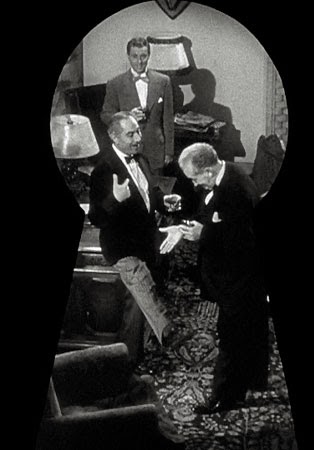
Good to see you, Mr. Hitchcock! 
Oops, so sorry, Mr. Vandeveer, my mistake!
Ah, here come the holidays!  With Thanksgiving, Hanukkah, Christmas, Kwanza, and any number of festive food-centric holidays descending upon us, Who is Killing the Great Chefs of Europe? (let’s save time and call it Great Chefs for short, shall we?) is a delicious way to kick off the first of half of our Robert Morley double-feature.  Before there were Julia Child, The Food Network, and The Cooking Channel, there were Nan and Ivan Lyons’ witty 1976 whodunit novel Someone is Killing the Great Chefs of Europe (1976). I read the novel when it was on best-seller lists, and it certainly had its moments of wit, sex, and clever violence.  Still, it seemed to me that the authors were so determined to cram in as much plot as possible that, for me, I’m afraid I eventually found it more exhausting than entertaining.  Nevertheless, the Lyonses wrote a 1995 sequel, Someone is Killing the Great Chefs of America, so brava to them, I say!

Happily, I found Ted Kotcheff’s 1978 film adaptation, Who is Killing the Great Chefs of Europe? (from Lorimar/Warner Bros.  Best of all, the script was from one of Team Bartilucci’s favorite screenwriters, Peter Stone (Charade; Arabesque; Mirage), a funny, suspenseful, romantic romp, with plenty of wit and fabulous food to boot! (Fun Fact:  director Kotcheff also co-starred in the 2003 fact-based drama Shattered Glass.) Just hearing Henry Mancini’s majestic yet playful score had me smiling!  Even when the characters are trading witty bon mots, there’s always a subtle, almost candlelit touch of sexy romance in the air, courtesy of Director of Photography John Alcott (The Shining; A Clockwork Orange; Barry Lyndon). 
And dig this international cast:

*Jacqueline Bisset — Her first name is pronounced “Jacque-lean,” and her last name rhymes with “Kiss It.” After debuting as “Miss Goodthighs” in the James Bond spoof Casino Royale, Bisset was on her way with such hits as Airport; Two For the Road; Rich and Famous; Murder on the Orient Express; The Deep.  I liked Ms. Bisset’s fashions by Oscar-winning costume designer Donfeld (not for Great Chefs, though.)  I admit Bisset's wardrobe might not work for every gal, but I rather liked Bisset’s rakish woolen coat and her Civil War outerwear; if it doesn’t bother Civil War re-enactors, I’m OK with it!  Fun Fact: Bisset is Oscar-winner Angelina Jolie’s Godmother!

*George Segal  — Ship of Fools; Who’s Afraid of Virginia Woolf; The Hot Rock; A Touch of Class; TV’s Just Shoot Me, and The Goldbergs.  Segal and Bisset had a delightful Tracy & Hepburn vibe in Great Chefs that I really enjoyed, especially with Stone’s aforementioned sparkling dialogue!

Robby's making plans for Nigel to turn that 
sweet little health food joint into 
Ranger Pete's Texas Burgers, complete with 
slaugherhouse! Another coup for 
American Fast Foods!
When we first meet Epicurious  publisher and gourmand Maximilian Vandeveer (Morley), we see that Max is a mountain of a man, huffing and puffing and scaring innocent pedestrians as they try not to be steamrollered by Max’s formidable girth. Dr. Deere (John Le Mesurier from I’m All Right, Jack; The Pink Panther; The Italian Job ).  Max is always accompanied by his assistant, Meacham (Madge Ryan of A Clockwork Orange), Max's assistant. As usual, Max is being a wiseacre, calling Dr. Deere “Doctor Darling” and such other wry barbs, but this time, Dr. Deere has worrisome news for Max:

Dr. Deere: “Would you care to remove your overcoat?”
Max: “Why? Is your diagnosis going to take us through a change of seasons?”
Dr. Deere: “Mr. Vandeveer, you are not a well man.”
Max: “That’s why I came to you instead of my florist.”

Dr. Deere cuts to the chase:  “Mr. Vandeveer , you are suffering from gout, enlarged liver, duodenal ulcer, spastic colon, heart murmur, and severe hardening of the arteries.  You are suffering from these maladies because you are calamitously fat. Unless you drastically alter your eating habits, you are most certainly going to die.”

Max: “Dr. Sweetheart, deprived of everything I adore, what makes you think I want to live?  Come along, Beecham!” 

Beecham looks like a woman thinking, 
a la Bugs Bunny, "Oh, brother! There goes 
me bread and butter! I gotta do something!

Why did the chickens cross the road? So Robby
could pitch an omelet franchise!
Of course, here in the 21st century, Max’s health can be improved with less-draconian methods than they had in 1978, but since that’s when Great Chefs was made, feel free to consider it a period piece if you like! (Or watch The Biggest Loser, if that’s your cup of Spirulina or whatever.) 


Enter Robby Ross (Segal), head honcho of food conglomerate American Fast Foods.  At the moment, Robby’s in London, donning a cowboy hat and freaking out the patrons of the health-food restaurant The Potted Shed when he announces they’re starting a new franchise right next door: “Ranger Pete’s Texas Burgers!  A hundred percent pure meat!”  It’ll apparently do their own butchering on the premise. As Robby says: “You won’t hear that hammer go *smack* or nothin’!”   Robby cheerfully tells the hapless waiter (Nigel Havers of Empire of the Sun; Chariots of Fire).  Oh that Robby—what a sneakypuss!  The diners sure are running away faster than chariots of fire, for sure! 
Nowadays there are far less draconian ways to get healthy, but after all, this was 1978; think of this as a period piece if you like!  (Or watch The Biggest Loser, if you like that sort of thing.)  Robby’s ex-wife is Natasha O’Brien (Bisset), renowned for her fabulous desserts, not to mention she’s gorgeous. I wonder if she exercises like mad to keep her girlish figure?  Interestingly, I couldn’t help noticing Natasha is frequently described as “an American cook,” and yet she has an obvious British accent.  Did Natasha grow up among British emigres?  Was she naturalized in the U.S.?  Just curious!. But I digress…


Royal Food Fight at the Palace! 
Louis Kohner vs. Auguste Grandvilliers! 
Place your bets!
 It’s an exciting time for Natasha, as the renowned  food magazine Epicurious  has anointed Natasha to be one of the talented cooks whose work comprises “The World’s Most Fabulous Meal” for none other than Queen Elizabeth herself! 
 *Louis Kohner (Jean-Pierre Cassel) for his baked pigeon  in crust;
*Jean-Claude Moulineau (Phillippe Noiret of Coup de torchon) for his pressed duck.
*Fausto Zoppi (Stefano Satta Flores)
*And of course, our gal Nat makes the dessert, Le Bombe Richelieu!


Who says too many cooks spoil the broth?
Not Nat & Louis!
Mmm, this is one Bombe we wouldn't ban!
At snack time, Natasha and Louis have
their own version of "special sauce"!


Then there’s Auguste  Grandvilliers (Jean Rochefort of Tell No One), who’s furious that he was not on the list!  As Max explains, “This is for The World’s Most Fabulous Meal, not The Most Underrated Meal.”  Ouch! 


Oops! Guess happiness isn't a warm gun!

The excitement of playing the Palace takes a terrifying turn when Natasha wakes up from her sexy roll in the hay with Louis to discover he’s been baked to death!  Robby quickly comes to console her, but now the London police are giving Robby and Nat the Hairy Eyeball, and they soon realize other cooks on the Epicurious list are turning up dead, too!  It’s enough to spoil your appetite, if it weren’t for that delightful cast, witty dialogue, and lovely European locations!  Whodunit?  Watch it and enjoy this smart, sexy romp for yourself!

So many great lines, too! Here's one of my favorites:
Natasha, noticing she and Robby only have one bed (before they kiss and make up):
“How come the only bed in this entire hotel comes with you in it?"

Robby: “There’s a convention in town.”
Natasha: “The Optimists, no doubt!”
Yikes! Poor  Louis' been overdone, bigtime!
In Venice, two's company and three's a crowd!
Rub-a-dub-dub, Nat & Rob in a tub!

No one will be seated during the duck-press killing; it's too gruesome!

Mother of gastronomy, is this the end of Max?

"I knew that divorce was too good to last!"


 Vinnie Picks at the plate - They say that Hitchcock used to film murder scenes the way others shoot love scenes, and vice versa. Well, this film shot food like others shot naked women. This may well have been where we got the term "Food Porn." Kotcheff hangs lovingly over the most opulent banquets ever seen on the screen to date.

I've always had trouble enjoying George Segal -- his acting is a bit broad for me. He always seems to be opening his mouth just a tad too wide, waving his hands just a bit too much. He's doing a very good job on ABC's The Goldbergs as the Grandpa; he seems to have pulled it back just a hair. But his not-quite-manic delivery works well here, as he's supposed to be a loud brassy American who sticks out like a sore thumb in the hallowed banquet halls and restaurants of Europe. The audience, like the cast, should have no idea what Jacky Bisset saw in the boor.

The final sequence in Television Centre is delightful, as Segal blunders his way through studio after studio looking for the cooking show. It's a sequence that's been done plenty of times, from Blazing Saddles to Pee-Wee's Big Adventure, but that's because it's such fertile comedic soil.


Vinnie's Pick: Hot Millions (1969)

Peter Ustinov has graced the posts of this blog more than a few times, and rightly so.  He was an astounding character actor, equally at home in drama as comedy, though usually providing the lighter characters in the dramatic turns.  Hot Millions is one of his lesser known films, And That's Terrible.  Like The Wife's selection, it's available from Warner Archive, which is allowing fans of more obscure films to finally own them, as well as opening them up to a new audience.  He co-wrote the script with Ira Wallach, and it was nominated for an Oscar for best original screenplay, one of his many award nominations, and two Oscar wins. 
We meet Marcus Pendleton (Ustinov) on his last day in prison, ending his turn for embezzlement of the National Conservative Party (Asked why he chose that target, he calmly replies "I'm a Liberal"). He finishes up the warden's tax return for him, ensuring him that they're bona fide, and is wished well, with the caveat that in this new electronic age, computers are making it harder for embezzlers to succeed. (In a subtle callback later in the film, he passes a newsstand displaying the headline that the warden was arrested for tax fraud).

Robert Morely serves as means to an end
in the film, giving Marcus Pendleton
his "In" to the world of business
Marcus realizes quickly that the warden has a point, and makes the logical move - to become a computer programmer, thus being the person in charge of writing all the security that makes it so hard for embezzlers.  So after a quick visit to a haberdashers for a City-worthy suit, he pops into a posh club for the upper class to troll for information.  Posing as a recruiter for an American company, TaCanCo, he's given the name of Cesar Smith (Robert Morely).  Smith is loath to take a new job, and Marcus is more than happy to convince him to follow his life's dream of traveling to South America to write a books about moths.  He's barely on the plane before Marcus assumes his identity and snaps up the job of lead computer program designer.  Executive Carlton J. Klemper (Karl Malden) acts from his gut, even though his V.P.  Willard Gnatpole (Bob Newhart) advises checking the naff Smith's credentials.  But when Smith shows Gnatpole up by suggesting a new method of coding practice that eliminates a bug he's been working on, he earns Klemper's nod and Gnatpole's ire.

Smith/Pendleton is shows the company's mainframe, and its security system is pointed out, a blue light that blocks all unauthorized access. He gets a secretary, who turns out to be Patty Terwilliger, who has a flat in the same boarding house as him, and who has suffered through a steady stream of jobs that she loses under calamitous circumstances.  She's confused as to why the man she knows as Marcus Pendleton is working here as Cesar Smith - he hastily explains he's working under his mother's name because of reasons.  They genially conspire to keep each other secret - she agrees not to talk about his name, and he agrees not to mention that she's not all that wonderful a secretary.

Smith immediately begins a campaign against that blue light, spending many a long night trying to hack his way around it.  He's ready to give up before he learns that the charwomen regularly disable it with a bang of their bucket against the back of the machine, as the inside of the computer is perfect for keeping tea warm.  Once that shackle has been freed, he begins his main plan, setting up phantom companies and authorizing payments to them. 

A perfect rendition of the old joke "So dumb she can't
change a typewriter ribbon without taking her dress off"
All the while, his friendship with Patty becomes more genial, as they begin to spend more time together.  The rest of the staff (especially Mr. Gnatpole) notices that she's not a very good secretary, and assume that she must be good in the sack.  Gnatpole begins a campaign of his own, to become close with Patty, one that she doesn't rebuff - she doesn't even grasp that he's trying.  There's a spectacular and dialogue-free scene when he offers to drive her home - as they drive, he keeps seeing signs like "Yield" and Make Way", and she sees signs reading "Stop" and "Do Not Enter"

Marcus' life goes very well, both professionally and personally - he's amassed a fortune in ill-gotten-gains, and has fallen in love with and married Patty.  When she reveals that she's "in the club" as she so delightfully puts it, he realizes it's time to cut and run.  Marcus and Patty emigrate to Rio and seem quite happy, and Klemper and Gnatpole are nearly breaking their arms pointing fingers at each other. It's about then that the REAL Cesar Smith, returned from South America, pops by TaCanCo when he learns that he's apparently been working there for some time.  He discovers Marcus' plan quickly, admiring it for its elegance.  They're ready to give up their money as lost, except they ge a telegram from "Smith", advising them as to where he is, and inviting them down to talk.  Cesar Romero has a delightful cameo as a Brazilian customs agent who almost kills Klemper with sarcasm when, discovering that he's brought instant coffee with him to Brazil (Coals to Newcastle, indeed), says to him, "To confiscate this is not enough; throw it away", making him not just toss it in the bin, but open it and shake the contents out. 

Not to divulge the ending, but nobody goes to jail, and nobody is sad, except for Mr. Gnatpole, mainly because nobody else is.

Bob Newhart is the unavowed modern
master of the Slow Burn.
Ustinov is a comedic master - you can't break concentration for a moment lest you miss one of his mumbled asides that will shatter you.  Malden plays a very model of a modern business-minded American, and Bob Newhart once again knocks it out of the park in the role of Small Angry Man that he does better than no other.  Maggie Smith has never turned in a bad performance, and this film is no exception.  Her Cockney accent gets full acceptance here, playing Patty as the classic flibbertigibbet.

Maggie Smith was great friends with Kenneth Williams, star of the "Carry On" films.  In this vintage clip she talks about him and their relationship.  In a clip tacked on to the end, Kenny shares a tale from years before in a department store.


Dorian checks over the books - We're big Peter Ustinov fans here at Team Bartilucci HQ, and Vinnie was the one who turned me on to Hot Millions, which in turn also turned me on to both Ustinov and Maggie Smith, thanks in part to our longtime pal John Wirenius. With Hot Millions' droll wit and the rest of the wonderful cast, we were hooked, thanks to "gateway drugs" like Topkapi, Grendel Grendel Grendel, and so much more!

Saturday, November 16, 2013

A Lon Chaney Double-Feature - Hope and Merrye-ment

My Favorite Brunette: There’s Always Hope!

This post is being revamped and republished for the Lon Chaney Blogathon, hosted by Movies Silently and The Last Drive-In, from November 15 through November 18, 2013. Have a thrilling time! We hope you'll enjoy this father-and-son double-feature!


So many of my favorite films have been restored to their original high-quality prints, such as Vertigo, Rear Window, and Touch of Evil, so I was thrilled when The Shout! Factory put out the 5-movie set The Bob Hope Collection, with my favorite Bob movie, the 1947 comedy-thriller My Favorite Brunette (MFB), written by Edmund Beloin & Jack Rose, and directed by Elliott Nugent (the 1939 version of The Cat and the Canary; Never Say Die; The Male Animal).  For my money, this comic gem is the best of Bob Hope’s three movies in the “Favorite” series. The first one, My Favorite Blonde (1942), teamed Hope with Madeleine Carroll in a zany yet suspenseful adventure reminiscent of her Alfred Hitchcock thrillers The 39 Steps (1935) and Secret Agent (1936). The last of the trilogy was My Favorite Spy (1951), in which Hope teamed up for similarly funny, frantic shenanigans with the beautiful and brainy Hedy Lamarr. Although I enjoyed all three “Favorites,” I was drawn most strongly to MFB because it affectionately spoofs one of my favorite genres, private eye mysteries.

I see a fabulous babe in your future!


I guess Mrs. Fong's baby isn't a vegetarian!
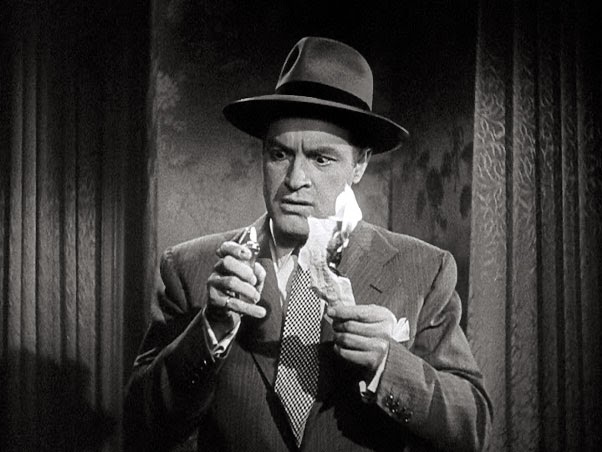
We meet our hero Ronnie Jackson (Hope), a successful San Francisco baby photographer, on Death Row—this is comedy?!  Oh yes it is, smarty, because there’s a gaggle of reporters interviewing our hero as he gets a chance to tell his side of the murder frame-up he’s embroiled in. In the true 1940s-style detective voiceover/flashback, Ronnie admits, “I wanted to be a detective, too. It only took brains, courage and a gun—and I had the gun!”


Carlotta Montay has a hush-hush case for our hero!

In flashbacks (this is a film noir spoof, after all, and a darn nifty one!), we find out that before Ronnie found himself embroiled in suspense, romance, and zany shenanigans, he was a successful baby photographer in San Francisco’s Trafalgar Building.  The tenant across the hall is cool, tough private detective Sam McCloud (and wait’ll you see the Paramount star doing a swell cameo as McCloud!).

"All my life, I wanted to be like Humphrey Bogart,
Dick Powell, or even Alan Ladd!
Sam’s just gone out of town on a case.  Before Ronnie can say “mistaken identity,” his dreams of playing shamus come all too true all too soon, when a beautiful, mysterious damsel-in-distress hurries into what’s really Sam McCloud’s office.  She is, as Ronnie describes her in voiceover, a “dark-eyed-dreamboat up to her gorgeous lips in trouble.”  Meet Ronnie’s new client, the lovely and desperate Carlotta Montay (played by the ever-delightful Dorothy Lamour, who went from getting rocked by the 1937 version of The Hurricane, to becoming part of a comedy movie trio with Bob, Bing Crosby, and “Dottie,” as the fellas nicknamed her in their first of their many “Road” comedies, starting with Road To Singapore (1940). Soon the cowardly yet determined Ronnie is up to his ski-nose in trouble as he and his comely client are chased by a gang of cutthroats with designs on Carlotta's uncle's uranium—that's right, uranium, just like in Alfred Hitchcock’s  Notorious!). And what a dastardly bunch they are:

*Jack LaRue* as sinister Tony, from No Orchids for Miss Blandish; Cornered; and of course, Road to Utopia with Hope, Crosby, and Lamour!

*John Hoyt* as Dr. Lundau.  We of Team Bartilucci have affectionately dubbed Hoyt as one of the most angular people on the planet.  Fun Fact from the IMDb: In his early years of performing, he put together a nightclub act doing impressions of famous celebrities. His impersonation of Noel Coward was so good that he was hired for the original Broadway comedy The Man Who Came to Dinner in 1939, in which he played Beverley Carlton, a role obviously based on Coward himself. (The 1942 film version was swell, too!)

*Charles Dingle*
as Major Simon Montague, from The Song of Bernadette; The Little Foxes; Duel in the Sun; George Washington Slept Here.

*Peter Lorre,* saving my favorite villain for last!  Lorre’s long career includes the chilling shocker  M; The Maltese Falcon; Casablanca; All Through the Night; *, practically stealing the show as Kismet, the most fearsome of evil Simon Montague’s henchman.  I especially get a kick out of Kismet’s running gag about practicing his citizenship exam while keeping his knife skills sharp; now that’s what I call multitasking!  

But there are good funny folks here, too:
*Jean Wong*
Despite not being listed in the film’s credits, Jean Wong practically stole the show for us here at Team Bartilucci HQ as Mrs. Fong, the mother of a toddler (Roland Soo Hoo) who’s so loathe to smile for Ronnie during his attempts to make the little tyke smile, our hero quips, “This kid's gonna grow up to be a sponsor!”  Jean also appeared in The Lady from Shanghai (1947); The Night Has A Thousand Eyes (1948); and The King and I (1956).

* Lon Chaney Jr.* Our star!   The son of Lon Cheney touched my heart with his moving  performance as Lenny in the film version of Of Mice and Men (1939), and did a swell job in the classic horror thrillers The Wolf Man (1941) and The Mummy’s Tomb (1942), among many others.  In MFB, Lon Jr. turns out to have a flair for sending up his classic movie roles, especially from Of Mice and Men, and by golly, I found him downright endearing!   Lon Jr. had more comic talent than people gave him credit for.  The scene with the bars on the doors especially cracked me up!


OUCH!  Ronnie gets knocked down,
but gets back up again...and again!
MFB deftly spoofs hard-boiled private eye thrillers of the era with a barrage of uproarious one-liners and set-pieces. Hope and Lamour's usual comic/romantic chemistry is at its finest. According to the IMDb, the 1940s was a very prolific period for Bob Hope, having made 21 movies during that decade, including Hope and Lamour’s series of “Road” movies; The Paleface with Jane Russell, and My Favorite Blonde (1942) with Madeleine Carroll (who was also married to Sterling Hayden for a time)


Dude, that old guy and that righteous babe came from San Dimas,
where Bill and Ted had those excellent adventures! Awesome!


Fun Facts: According to the IMDb, Elliott Nugent’s grandson, Jonathon Elliott,   had memories to share:  “My grandfather, Elliott Nugent, directed this movie and wrote about it in his autobiography Events Leading up to the Comedy.  Paramount star Alan Ladd got the cool cameo as private eye Sam McCloud on the strength of having directed him in the 1949 version of The Great Gatsby. 

Bob Hope and Bing Crosby had always a long-standing arrangement to do cameos in each other's movies.  In this case, Bing had already done a cameo in Bob's most recent movie, so it wasn't Bing’s turn.  (The IMDb didn’t specifiy which film, but I’m guessing it’s our film, My Favorite Brunette). Nevertheless, Bob was so eager to convince Bing to do this cameo that Bob offered to pay Bing $5,000—which Bing donated to charity, bless him!  Crosby walked onto the set, skipped makeup (he was already made up from another movie he was shooting on the lot anyway), stopped at wardrobe to don a prison guard shirt, and did his bit in one take, leaving the soundstage in just five minutes.  The result: a Hollywood record for the most money per minute paid to an actor!”

My Favorite Lines from My Favorite Brunette:
Ronnie in San Quentin, hearing there’s no word from the Governor about the gas chamber: “No word, huh?  I’ll know who to vote for next time!”

Ronnie faces the gas chamber for reporters, his hands getting shaky:
“It’s not so hard to kick the bucket.  It’s not so tough to walk that last mile.  It’s just hard to light a cigarette, that’s all.”

Female Reporter (Garry Owen): “Was it a woman?”
Ronnie: “It’s always a woman.  And you should have seen this woman.  Skin like smooth satin; beautiful blue eyes; dark silken hair; the kind of a gal who’d make you want to give her your last shirt.  (Pauses to look at his shirt.)  I borrowed this one from the Warden.”

Bob Hope: “You see, I wanted to be a detective too. It only took brains, courage and a gun—and I had the gun!”.

Bob Hope: “I was cut out for this kind of life. All my life I've wanted to be a hard- boiled detective like Humphrey Bogart, or Dick Powell ... or even Alan Ladd!” (Cue Alan Ladd!)


Ronnie arrives at Seacliff Lodge (not realizing it’s an asylum): “What a joint.  Must’ve been something left over from Wuthering Heights.  You know, the kind of a house that looks like you could hunt quail in the hallways?  I didn’t know it then, but I was gonna be the quail.”

Bob Hope (to Peter Lorre): “Nice cheerful place. What time do they bring the mummies out?”

Bob Hope: “It always looked so easy in those Tarzan pictures!”

Ronnie, coming to after Lorre knocked him out: “When I came to, I was playing Post Office with the floor. I had a lump on my head the size of my head.  Inside, Toscanini was conducting the Anvil Chorus with real blacksmiths.  I looked at the bottle of Old Pile Driver  and decided to stick to double malts.”

Bob Hope to Dorothy Lamour: "I don't know how much more of this I can take.  You've had me in hot water so long I feel like a tea bag.”

Ronnie and Carlotta at swanky café:  “The Poule D’Or, where they eat mink for breakfast.”


Carlotta's wheelchair-bound Uncle Stefan makes an
unexpected recovery!  Ronnie's keyhole camera will surely save
Carlotta, her uncle, and the day--if they hurry!


This car chase is making me hungry! Got any Grey Poupon?
Time to open the mailman? Whew, it's just the bad guys messing with us!
In the great tradition of Danny Kaye in The Secret Life of Walter Mitty,
Bob Hope as Ronnie finally gets a hot clue!
Is Carlotta giving Ronnie a private screening?
Whatever Carlotta wants, Carlotta gets!


Never bring a psychiatric patient to a knife fight,
especially if Kismet's involved!
!
Better luck getting the girl next time, Harry! :-)


Spider Baby:
"Just because something isn't good doesn't mean it's bad!"


Very rarely do you come along a film that you can truly describe as seminal.  Psycho was certainly the spiritual father to the slasher genre, and both it and Texas Chainsaw Massacre can be traced back to the real-life madman Ed Gein, but if you had to point to the far larger source of Chainsaw's DNA, it is the mad little film Spider Baby.  From it spawned the deep dark trope well of the Family of Crazies.  Sometimes alluring young ladies, sometimes mutated monsters like in The Hills Have Eyes, but they were first introduced to cinema by way of the Merrye clan.

By this point in his career, Lon Chaney Jr. had either settled into (or been forced into, depending on who you listen to) a steady stream of sad shadows of the classic horror roles, or self-parodies of his great dramatic turn as Lenny in Of Mice and Men, the latter category including the role he played in The Wife's selection above.  So it's rather nice that one of his last films ends up being one of his best performances, filled with compassion and kindness, something by that point, I expect most people forgot he could play.


Most kids play "Doctor" - the Merryes play
"Civil War Doctor"!
"Merrye Syndrome" is a malady specific to the family of the same name - members of the family grow and progress normally until early puberty, after which they begin to regress mentally, not just to childhood, but allegedly to earlier stages of evolution.  Chaney plays Bruno, chauffer and caregiver to the last of the family - young Virginia (Jill Banner) and Elizabeth (Beverly Washburn) and their brother Ralph (Sid Haig).  Ralph has already lost the ability to speak, and never walks when he can crawl, and the girls have grown into young loveliness, while their personalities have remained that of tomboys, with an affinity for insects and violence.

Bruno, following the wishes of their late (?) father, cares for them like he was their own, trying to keep them under control, and away from the prying eyes of neighbors.  But the occasional visitor can causes problems, like when a deliveryman (Mantan Moreland) gets caught in Virginia's "Spider web", who she kills with a series of "stings" with a pair of butcher knives.  Bruno dutifully cleans up after the trio when the unforeseen happens, and calmly tries to remind them how to behave.

But the delivery bring bad news - a lawyer reports that a distant member of the family wishes to take custody of the Merrye trio, and with them, control of the sizable holdings of the family.  Bruno must hastily clean his charges up and make the home look presentable, in the hopes there's no need to take the children away.

It...doesn't work out.

Bruno (Lon Chaney Jr.) cautions the girls to be on their best
behavior - no poison in the vinaigrette, and vivisection
is right out!
Chaney pulls off a solid performance as he cares for the young maniacs.  His final act of protection for the family is both tragic and hilarious, and at the same time, purposefully  hilarious.  He was already suffering from illness and a weakness for the drink by this point, and while it showed on him physically, he gave the role his all, nicely balancing over the top delivery and melodrama. 

As for the Sisters Merrye, Jill Banner died at only 35 in 1982, after only a handful of roles, including several parts on Dragnet, and Snow White in house favorite The President's Analyst.  Beverly Washburn was a child star, and is still working today. She'll be turning seventy this November 25th. 

Quinn Redeker, the family's distant relative, had a 25-year run on The Young and the Restless, after a nearly ten-year stint on The Days of our Lives.  He was also nominated for an Oscar as one of the writers of The Deer Hunter. And I'll lay odds that every personal appearance he makes, some yukkapuck makes him sign a copy of this damn movie.

Sid Haig's mute performance as Bruno is deliciously unsettling from the moment he crawls out of the back of the family's vintage automobile.  When he shows up in a Little Lord Fauntleroy suit halfway through the film, all dolled up to impress the relatives, it only makes him seem odder, especially considering the things he does to them while wearing that suit.  Considering how well he's now known for the film, most of his work was as more general character parts as hoods and unsavory swarthy individuals.  He got to play one of King Tut's minions on Batman, and in the late seventies, I first saw him as Dragos, the bad guy from one of Filmation's forays into live-action, Jason of Star Command.  It's only in recent years has Sid returned to the horror genre, mostly via the work of Rob Zombie, whose House of 1000 Corpses is so spiritually related to Spider Baby as to be as inbred as the Merrye clan itself. 

The film is almost required viewing for fans of horror history, and a delight for fans of dark comedy.  The recent high-quality DVD release is out of print, but not impossible to find, and well worth the search.

Say hi to Uncle Ned for me.

Friday, November 8, 2013

Sam Levene — What a Character!

This post is for the 2013 edition of the What a Character! Blogathon, co-hosted by Aurora of Once Upon a Screen; Kellee of Outspoken & Freckled; and Paula of Paula's Cinema Club; enjoy!


I became a Sam Levene fan backwards.  You see, the first film in which I saw Sam onscreen (if I may so address him without seeming too bold) was in one of his last movies, Jonathan Demme’s 1979 Hitchcockian thriller Last Embrace  For me, Sam Levene stole the show as Sam Urdell, the crotchety but likable head of a secret Jewish society who helps troubled secret agent hero Roy Scheider before he becomes the next victim!.  Here’s my one of my favorite lines:

“This was the prime whorehouse of the East Side. A moment of reverence, please: fifty years ago, this was the very place I lost my cherry.”

Lawman Sam as New York's Finest, Lt. Mike Brent,
in The Mad Miss Manton (1938)
Stranger on a train? Nope, it's good-guy Sam Levene in Last Embrace (1979)
Our man Sam was born in Russia on August 28, 1905, and his family settled in New York City. The world of fashion led Sam to the Broadway stage and screen stardom. In 1925, Sam was working as a dress cutter for his brother Joe, who wanted to be a salesman. Joe agreed on one condition:  Sam had to improve his “poise.” Sam agreed, and auditioned for the legendary Charles Jehlinger at the American Academy of Dramatic Arts.  Sam got the scholarship, and he was on his way!
Sam in slow-burn mode as Lt. Abrams in After the Thin Man (1936)

Sam made his Broadway debut in 1927 with five lines in the play Wall Street.  From there, Sam carved out a long, great career spanning 50 years on Broadway, film, and TV. He came to Hollywood in 1936 to reprise his stage role as a gambler in the comedy Three Men on a Horse, alongside other beloved Team Bartilucci character actors Frank McHugh, Allen Jenkins, and Joan Blondell. 
Sam’s next couple of roles brought him to the right side of the law in After the Thin Man (1936), with William Powell and Myrna Loy as those lovable married sleuths Nick and Nora Charles.  Sam supported the stars as Lt. Abrams of San Francisco’s Finest, slow-burning his way to helping Nick and Nora solve a murder involving Nora’s wrongly-accused cousin Selma Landis (Elissa Landi) from ending up in the hot seat!  Sam’s Lt. Abrams also returned for Another Thin Man (1939) and Shadow of the Thin Man (1941). Sam continued his funny-side-up trend as the comical henchman Creeper in Whistling in Brooklyn (1943) from the Whistling in the Dark comedy-thrillers with Red Skelton, including co-star Anthony Caruso, who would later co-star in John Huston’s 1950 film noir The Asphalt Jungle and The Godfather, among others.

One of Sam's most poignant performances: the ill-fated Samuels
in the searing drama Crossfire (1947)

In 1950, Sam created the role of Nathan Detroit in the original Broadway production of Guys and Dolls.  Granted, to paraphrase Danny Kaye in The Secret Life of Walter Mitty (1947), Sam was working under a slight disadvantage:  he had no singing talent!  Nevertheless, Sam’s solo number, “Sue Me,”  which had been deliberately written in only one octave for Sam’s benefit, turned out to be one of the show's big hits!  When he had to sing in an ensemble number, such as “The Oldest Established,” he mimed the words.  Of course, when the 1955 film version was cast, movie stars took over: Frank Sinatra as Nathan Detroit, and Marlon Brando as Sky Masterson.  Many critics noted that Sinatra wouldn’t use the character's ethnic New York accent when he sang.  Moreover, many felt Sam should have been allowed to reprise his “Jewish Wry” approach to the role, openly wishing that Levene were cast as Nathan Detroit instead (me too!)  


Guys and Dolls and Let It Ride were among
Sam's many  Broadway triumphs!
But on the bright side, Sam got plenty of accolades of his own, including a Tony Award nomination in 1961 for Best Actor in a Play for The Devil's Advocate, as well as starring in the original Broadway production of Neil Simon's The Sunshine Boys, playing Al Lewis to Jack Albertson's Willie Clark. However, the role in the 1975 movie version of The Sunshine Boys was originally was earmarked for Jack Benny, who was replaced by his friend George Burns after Benny’s death. Burns won an Oscar playing the role—“another big one that got away from Levene,” notes the IMDb’s Jon C.Hopwood.
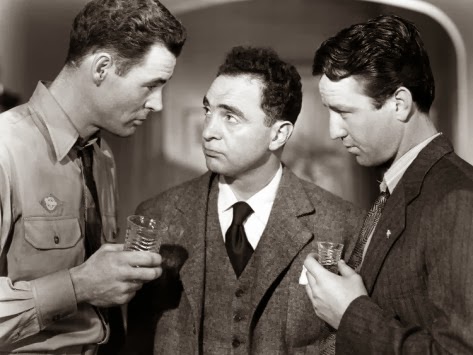
Sam was no stranger to film noir, and he once again showed his talent in Robert Siodmak’s Hemingway-inspired The Killers (1946) as retired police officer Lt. Sam Lubinsky, and the following year, Jules Dassin’s searing prison break thriller Brute Force (1947); and Sweet Smell of Success (1957).  But of all of Sam’s memorable performances, I was especially moved by Sam’s performance as Samuels, the tragic, hapless victim of Robert Ryan’s murderous bigotry.  Talk about being in the wrong place at the wrong time with the worst possible person!  Poor Samuels; oh, how I longed to be able to smash Robert Ryan’s Montgomery over the head with the nearest chair!

Fun Facts:  In 1950, Sam starred in the film With These Hands (1950)  about the International Ladies' Garment Workers Union. At the opening of the film, David Dubinsky, the President of the ILGWU, told him "I know you," and Sam said, "Yes, I'm in the film with Arlene Francis." Dubinsky replied, "No, you were a cutter, just like me."
Smoke 'em if you got 'em!  Red Skelton matches wits  with Sam
as henchman Creeper in Whistling in Brooklyn (1943)!

In David Denby’s New York Magazine review of Woody Allen’s Everyone Says I Love You (1996), he mentioned Sam Levene playing Nathan Detroit in the original Guys & Dolls. Denby stated: “Levene couldn’t sing a note, but his gruff, toneless outbursts could break your heart.” Levene was not cautious, and that made all the difference.”
Sam died of a heart attack on December 28, 1980. He was 75 years old, but his body of work will always be remembered, having made 49 films total during his Hollywood career. His last film role was in the courtroom drama ...And Justice for All (1979)  He’ll never be forgotten.  Sam Levene—what a character indeed!