Showing posts with label Mel Brooks. Show all posts

Friday, August 26, 2011

High Anxiety, You Win…Me Over! My Multimedia Review

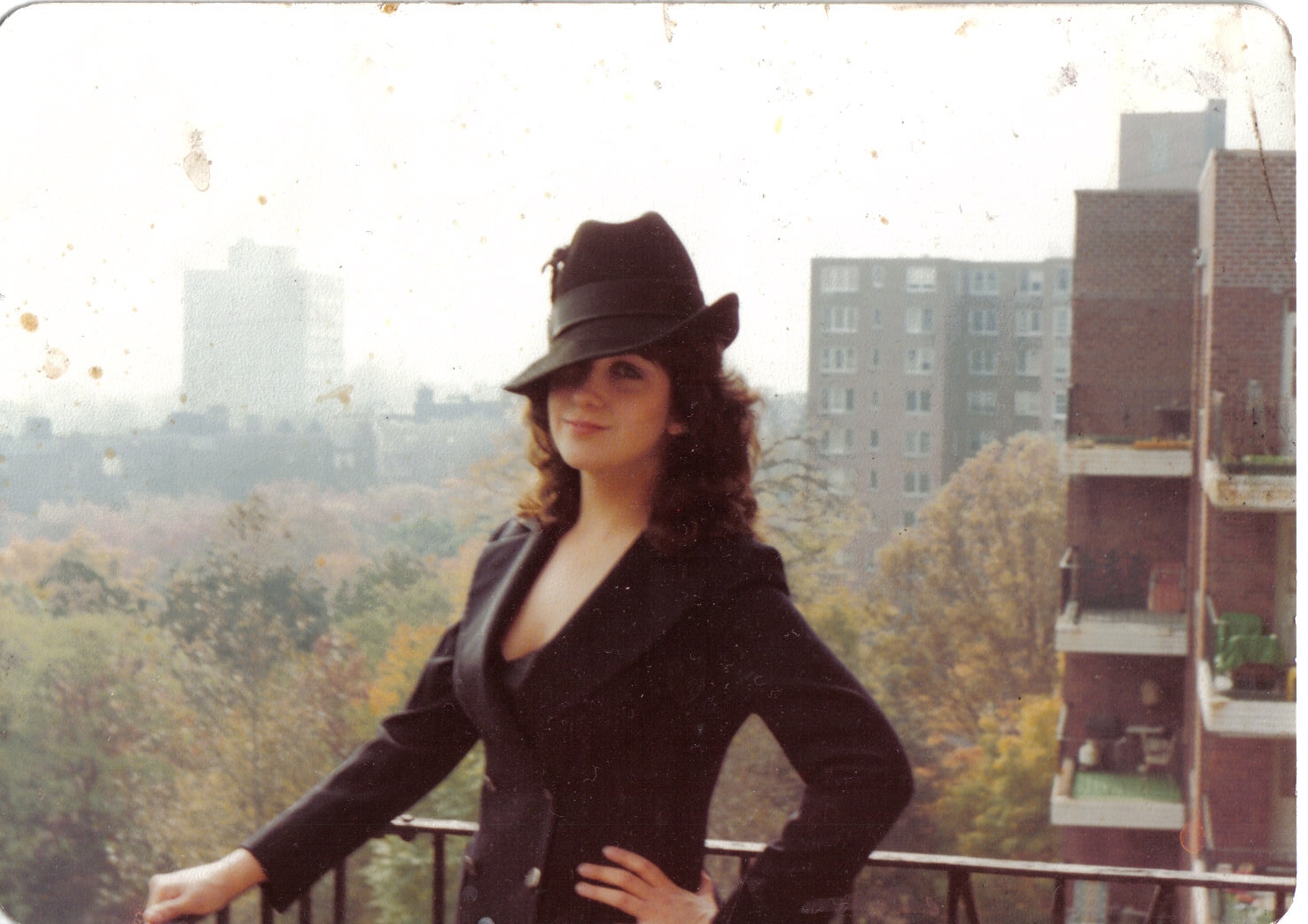
For those of you who’ve asked about my DorianTB avatar photo since this mug of mine began turning up on Facebook and in this blog, the answer is directly related to this week’s blog post about Mel Brooks’ smart, affectionate, deliriously funny 1977 Alfred Hitchcock spoof High Anxiety! You see, during my senior year at Fordham University in 1985, our beloved Theater professor Sister Francesca Thompson, the coolest and most sophisticated nun ever, assigned our class to lip-synch to a recording of our choice; the more inventive the performance, the better. I decided to salute two of my favorites with one stone, so to speak.
I wore a black fedora from my dear mom's vast hat wardrobe, a black tuxedo-style blazer, and black slacks—that is, until I innocently strode up to my pal and classmate Kypro (“Kyp” for short), nonchalantly removed my slacks, and asked him to keep an eye on them during my number. Considering that Kyp looked rather like a young 1980s version of Victor Mature, the look on his face was especially priceless, bless him! I went up to the front of the classroom, looking as much like Judy Garland in Summer Stock as I could. (Luckily, I had a cute figure then, if I do say so myself!) I opened my mouth to lip-synch—and out came the boisterous voice of Mel Brooks singing “High Anxiety” from the soundtrack album! If I do say so myself, I brought down the house, getting an A+, and it was a heck of a lot of fun, as well as a confidence boost for a shy kid like me (don’t let my gregarious writing style fool you!).
Off to Sr. Francesca's Theater class, 1985
High Anxiety (HA even the initials are funny!) is great fun even if you're not already an Alfred Hitchcock fan — but if you are, you'll love it all the more as you nail specific spoofs of and references to Hitchcock’s classic suspense films. The key is that Brooks’ best movie genre parodies would still be solid genre films if you took out all the jokes and sight gags. That’s why his biggest hits are so good and have been so dearly loved, such as 1974’s Blazing Saddles and Young Frankenstein. HA is a comedy piƱata stuffed with outrageous yet affectionate spoofs of Hitchcock’s best films—a far cry from many other genre parodies who try to do what Brooks and his writers do when they’re at their best, except that all too many of the wannabes’ attempts come off as puerile and mean-spirited.

I should explain to those who might be new to Mel Brooks’ work (so many young movie fans to inspire!) that aside from Brooks’ solo screenplays for his 1968 Oscar-winner The Producers, and 1970’s The Twelve Chairs, his best scripts have often been collaborations between himself and other writers, as they did with Your Show of Shows. Of course, there’s wit in Hitchcock’s thrillers, too. The difference is that Hitchcock’s humor was sleek and sly, while Brooks and his co-writers Ron Clark, Rudy DeLuca, and future Oscar-winner Barry Levinson are boisterously cheeky; as Brooks himself might say, “they kid because they love.”
Flying the friendly skies? Richard begs to differ!
Herrmann-like  traveling music from John Morris!
Madeline Kahn as Victoria Brisbane - so cute!
Montague & Diesel unwind after a day of evildoing
The plot plays delightfully like Hitchcock’s Greatest Hits, or as our friend and fellow blogger Nathanael Hood of Forgotten Classics of Yesteryear said in his own superb in-depth High Anxiety blog post from 2009: “The Master of Comedy takes on The Master of Suspense!...I find that this film is more than just a collection of satirical set pieces. It shows an endearing love of Hitchcock. Not only are his movies parodied; Hitchcock’s camera movements are mimicked, his musical scores quoted, and even the actors’ performances are modeled after prominent characters from his movies. Many of the references are subtle. So subtle that they can be missed, or even outright ignored by audiences.” The story is a delightful blend of every Hitchcock trope as seen through a funhouse mirror. Our hero, Nobel Prize-winner Dr. Richard H. Thorndyke (Brooks), arrives as the new head man of the Psycho-Neurotic Institute for the Very, Very Nervous; it’s like Green Manors in Spellbound (1945). Of course, the P-NIftV,VN is goofier than Green Manors ever was, with patients like Charlie Callas as the man who thinks he’s a cocker spaniel, and who Richard is led to believe is Arthur Brisbane, Industrialist. (The real Brisbane is played by the dapper, gentlemanly F/X expert Albert Whitlock, who worked on several Hitchcock movies.)

Meanwhile, poor Richard is fighting a vertigo-like malady, the titular High Anxiety. “If left unchecked, it can cost you your life!” declares his old friend and mentor Professor Lillolman (Howard Morris)—whereupon Lillolman and Richard are startled by an ominous musical sting, courtesy of the Los Angeles Symphony Orchestra’s touring bus! Soon Richard becomes the man who knew too much as he falls in love with Brisbane’s beautiful, soignee daughter Victoria (Madeline Kahn), or as Richard and others say, “You’re the cocker’s daughter?” Before you can say “Que sera sera,” Richard’s making like Frank Sinatra crooning the title song for Vicki in the hotel’s Art Deco-ish piano bar (for me, that’s HA’s highlight), and getting framed by evil P-NIftV,VN personnel Nurse Diesel (Cloris Leachman) and her love slave Dr. Montague (Harvey Korman) for a murder he didn’t commit, running hither and yon to clear himself through all kinds of picturesque locations while the Hitchcock gags (and even a few that aren’t Hitchcock-centric but are still funny anyway) fly thick and fast and fabulous—and so much more!

Don't you feel less neurotic already?
While I’ve always thought Brooks’ former co-star and co-writer Gene Wilder would've been perfect casting as acrophobic psychiatrist Dr. Richard H. Thorndyke (click here for the psychiatrist panel and the HA musical number to find out what “H” is short for), Brooks is nevertheless as irresistible as he is irrepressible, with Kahn a fine match for him as the flakiest mysterious blonde this side of Kim Novak. When you’ve seen as many Mel Brooks comedies as Vinnie and I have, you notice the genuine emotions behind the laughter. Sure enough, HA’s approach is as affectionate as it is hilarious. Not to overstate the case, but there’s palpable tenderness in the almost father-son relationship between Richard and Professor Lillolman, as well as the budding romance between Richard and Victoria. Ah, but there’s plenty of funny packed between the tender moments and Hitchcockian suspense! For example...


Dick Van Patten is caught in a web of evil, beyond the shadow of a doubt!

Could Vicki Brisbane be the future Mrs. Dr. Victoria Harpo Thorndyke?
It's not heights little Richard was afraid of, it's parentsor Pablum!
  • Professor Lillolman, who reminds me of Spellbound Oscar-nominee Michael Chekhov, is mistakenly addressed as “Professor Little-Old-Man.”
  • As Victoria, Kahns a knockout in her Vertigo gray suit and picture hat and Notorious-style black gown (not to mention her Louis Vuitton jumpsuit and matching car!). Vicki’s ditzy moments crack me up, too, like her hotel room scene while Richards in a phone booth trying not to be strangled by Diesel and Montague’s henchman “Braces” (co-writer Rudy DeLuca). First she tries to pretend she’s not turned on by what she thinks is an obscene phone call, then she tosses away her Vuitton teddy bear and backpedals like mad when she realizes it’s Richard: “I knew it was you! I laughed. Did you laugh?”
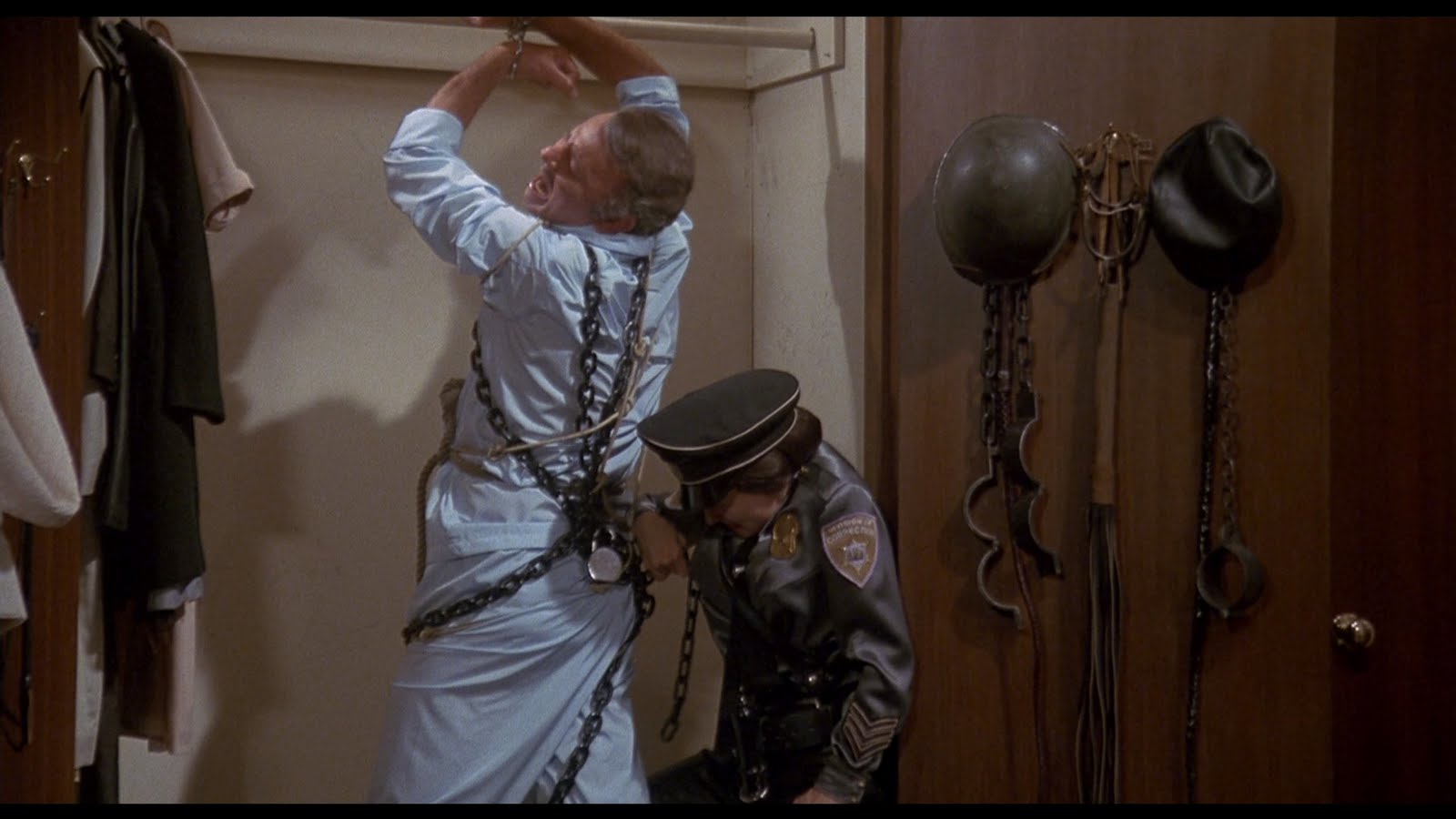
  • As Dr. Montague, Harvey Korman dresses like Charles Gray in the 1968 Hammer thriller/period piece The Devil Rides Out. As Nurse Diesel, Cloris Leachman looks like a scarily hilarious cross between Rebecca’s Mrs. Danvers and Ilsa, She-Wolf of the S.S.! They play uproariously outrageous bondage-and-discipline games when they’re not keeping rich patients prisoner. Dominatrix Nurse Diesel: “I know you better than you know yourself. You live for bondage and discipline!” Submissive Dr. Montague: “Too much bondage! Not enough discipline!”
  • Like any self-respecting Hitchcock-style hero, Richard has what The New York Times reviewer described as “an elegant flaw,” namely his High Anxiety. The Times went on to say, “He has the cowardly man’s restless glance as he keeps track of the terrain and of all the ways to make a quick exit.” My kind of guy! I’m also tickled that Richard’s name is clearly a nice tip of the hat to debonair but beleaguered hero Roger O. Thornhill from North by Northwest. Those who’ve been following TotED for a while may recall that North by Northwest is not only my favorite Hitchcock film, it’s my absolute favorite film of all time, period. 
Now when I love a movie, I go out of my way to learn everything I can about it, including buying novelizations of that film if there is one. High Anxiety was no exception. The author of the High Anxiety paperback was Robert H. Pilpel, who wrote a great many articles for Harper’s Magazine, as well as a number of his own books, including the 1979 historical novel To the Honor of the Fleet; Between Eternities; Churchill in America, and a title that particularly intrigued me, Understanding your Therapist, or Why is This Taking So Long? I wouldn’t be surprised to find out that last title got Pilpel the High Anxiety novelization gig! Pilpel has a real gift for humorous writing with a sting in the tail, blending comedy, suspense, and romance nicely. For example, here’s our height-hating hero’s first-person account of his feelings as his airline prepares to land:
Omigod, we’re losing altitude! No, the ground is gaining altitude! “Ladies and gentlemen, the Captain has turned on the No Smoking sign. Please extinguish all smoking materials. Make sure your seat belts are fastened and your seats in the full upright position for our arrival in Los Angeles.” Omigod! Too fast, too fast! We’re dropping like a stone….Oh, Lord, why does the landing gear coming down always sound like the landing gear breaking off?
And here’s Richard insisting on meeting Arthur Brisbane, and Montague reluctantly phoning Nurse Diesel to set up a meet-and-greet:
“Hello? Nurse Diesel? Dr. Montague here. Dr. Thorndyke would like to visit Arthur Brisbane this afternoon…Good…Oo-yay oh-knay ut-way oo-tay oo-day. Et it gay?”

He hung up with a little flourish of his wrist, as if Pig Latin were the most natural language for a licensed psychiatrist to use in speaking with a psychiatric nurse.
Richard sees the ultra-modern (for the late 1970s) Hyatt Regency Hotel for the first time:
Convention headquarters in San Francisco was a large modernistic hotel almost twenty stories high, built around a central glass-roofed courtyard. By some fiendish miracle of advanced architecture, the hotel was constructed so that each floor facing the courtyard juts out into thin air a little farther than the floor just below it. As you stand in the lobby, therefore, you are treated to the impression that the whole building is about to cave in on you. If you leave the lobby and venture upward, on the other hand, you are treated to the impression that gravity will soon bring you and the whole impudent pile of overhangs crashing ignominiously to the ground. The net impression you are treated to is that you should get the hell out of there before the building makes you dead, and that impression becomes a certainty when you see the fishbowl elevators whizzing up and down at the junctions of the walls like to many glass-enclosed coffins. It was doing my High Anxiety no good.
A beautiful stranger (who turns out to be Vicki Brisbane) bursts into Richard’s hotel room:
“Get away from me,” she snapped. “Don’t move. Be quiet. They’ll hear you. Close the drapes.”

It occurred to me that I was dealing with a beautiful victim of paranoia—a beautiful armed victim—so I went to do as she’d asked.

“Get down!” she said vehemently. “They’ll see you.”

Paranoid. Definitely. I crouched down and closed the drapes.

“Close the other one,” she commanded.

Paranoid and pushy. I obediently started across the room.

“Keep down,” she ordered.

She was so obviously scared and so much more obviously pretty that I really didn’t mind being bossed around by her. Her gun impressed me, too…Suddenly there was the sound of the doorknob turning…. Quick,” she said. “Make believe you know me.” And with that, she pulled me to her and kissed me as no paranoid had ever kissed me before.
Our trapped hero Braces himself for mortal combat!
Braces starts strangling Richard in the phone booth as he calls Vicki:
Vicki jumped to the wrong conclusion. Listen, fella. I don’t go for this kind of thing.”

I managed to get one hand between my throat and the wire, but almost immediately the strangling pressure of the cord trapped it, and I could feel my wrist bone being forced into my Adam’s apple. I gasped and huffed like a man with terminal asthma, which in a way was what I was.

“Who is this?” Victoria asked. “Listen, you’re crazy if you think I’m going to stay on this phone and listen to heavy breathing.”

It wasn’t working. I was making a lot of noise, but no air was coming in. Red spots started dancing in front of my eyes.

“Listen,” Victoria went on, “maybe other girls get turned on with these kinky phone calls, but I couldn’t care less. How did you get my unlisted phone number? Did someone I know give it to you?...Listen, mister, I’m not going to listen to any more of this. I’ve had just about enough!...What are you wearing?”

It was horrible. I was being strangled to death while listening to the girl I loved mistake me for a pervert. It made me wild with terror and despair. It made me want to wail and sob. The only sound I could squeeze out, however, was a squeaky “Jeeeeee…Jeeeeee….”

“Jeans?” said Victoria. “You’re wearing jeans? I bet they’re tight.”
So if you loved the movie, read the book! I’ve seen it available online. 

And if you haven't yet read all of Nate Hood's excellent High Anxiety blog post, here's a link:

http://forgottenclassicsofyesteryear.blogspot.com/2009/10/high-anxiety.html

Friday, May 20, 2011

Brooks Alumn-O-Rama: FATSO and THE FRISCO KID, by Team Bartilucci

My husband Vinnie and I have our Team Bartilucci blogging caps on again! One of the many reasons he and I and our families have always loved Mel Brooks’ movies is that Mel and most if not all of the writers, directors, and actors he worked with came from ethnic families and grew up in multicultural New York. Vinnie and I did, too; I grew up mostly in the Bronx and also lived in Manhattan for many years, while Vin grew up in Elmont, Long Island. Our combined ethnic heritage includes Italy, Ireland, and Scotland, as well as France and, I’m told, possibly Spain. We’re a regular U.N.!


The two movies we’ll be covering this week feature regulars from Brooks’ movies. While only the first was produced by Mel’s company, Brooksfilms, you’ll see plenty of familiar faces in the casts of both movies. Enjoy!

Dorians Pick: Fatso (1980)

This comedy-drama—or dramedy, as they say nowadays—was Oscar-winning actress Anne Bancroft’s only foray into writing and directing that we know of, but it was fantastico!  Having grown up in New York City in a food-loving family that was Italian-American on Dad’s side and Irish-American on Mom’s side, our clan identifies so closely with Fatso’s characters that it almost feels like a documentary to us!  Heck, I still remember the movie poster from its original theatrical release: a mournful-looking Dom DeLuise standing against a long list of foods under the bold heading “Do Not Eat:” Weight-loss solutions have come a long way since then, but human nature and emotional family members haven’t changed all that much—and that’s one of the things that has always endeared Fatso to our family and friends.

DeLuise is best known as a hilarious member of Mel Brooks’s stock company of zanies, but it was great to see him at last in a leading man role—a romantic leading man, at that! He plays our hero Dominick DiNapoli, an overweight 40-year-old bachelor living in NYC’s Little Italy. His happy life revolves around his boisterous Italian-American family, all living together in apartments in their two-family walk-up. Dom’s sister Antoinette (Bancroft) lives in one apartment with her husband and kids, while Dom shares his apartment with his “baby” brother Frankie, a.k.a. "Junior" (Ron Carey, who’d been best known and loved in our household as chauffeur/sidekick Brophy in Brooks’ hilarious Hitchcock spoof High Anxiety. What a shame that all three leads are no longer with us, though I’m glad we have Fatso and other fine films of theirs to remember them by. But I digress…)  Dom’s countless cousins include his big-hearted and just plain big cousin Sal (Manny Medina), who loves food, glorious food, as much as Dom. Having been doted on and overfed by his worried, well-meaning mom (tragically, Dom’s two  previous baby brothers died before the age of 2), Dom’s life has revolved around eating, drinking, and being merry more often than not. But when 39-year-old Sal dies of a massive heart attack, the grieving Antoinette and Junior frantically beseech Dom to tackle his own weight problem before he follows in Sal’s footsteps to the graveyard (pitch-dark humor abounds at the funeral).

Dom’s misadventures on the road to weight management begin with the support group Chubby Checkers, recommended by neighborhood friend Mrs. Goodman (played by Estelle Reiner, the “I’ll have what she’s having” scene-stealer from her director son Rob Reiner’s modern classic …When Harry Met Sally).  Dom tries to stick to the nigh-draconian diet, in which the diet doctor pretty much recommends that he eat and drink only the basic food groups and none of the rich dinners and desserts he adores, since this takes place in 1980! It reminded me of a wisecrack Joan Rivers made in one of her early books, Having A Baby Can Be A Scream: “If it tastes good, spit it out.” Antoinette and Junior try to help Dom stick to his weight-loss plan. Alas, their well-intentioned but overzealous haranguing only makes poor Dom feel worse about himself.

Then he meets the new shopkeeper in town, a voluptuous, sweet-natured blonde named Lydia Bollowenski (Candice Azzara). It’s clear that down-to-earth, huggable, adorable Lydia is perfect for Dom, and as Dom works up the courage to ask her out, they slowly but surely fall in love. Although Fatso was rated PG, Dom and Lydia’s romantic scenes together are still pretty darn romantic and sensual. I bet Dom DeLuise never got so much kissing and clinches in all of his movies combined, bless his heart!
Our family’s favorite scene is when Dom tries to head off a midnight binge with the help of two Chubby Checkers members. Of course, the trouble with controlling eating is that unlike alcohol or drugs, we all need food to survive. So when the subject inevitably turns to food, the situation soon erupts into the most spectacular binge of all time for all concerned! It always cracks us up when Dom and his partners-in-weight-management rhapsodize dreamily about the many ways to enjoy a jelly doughnut, turning the innocent phrase “Get the honey, Junior” into a threat/chant.

By turns zany, warm-hearted, and bittersweet, Fatso may be too shrill for some tastes, but my family and I loved it from beginning to end, and still do!  Born Anna Maria Italiano, triple-threat Bancroft’s Bronx roots show throughout. The volatile yet endearing characters and the loving details about their lives ring true, kind of like Martin Scorsese on laughing gas. While many of the film’s ideas about the best approaches to battling the bulge are dated now, it was surprisingly ahead of its time in portraying emotional eating and its tragicomic aspects, making it all the more devious that Bancroft and Director of Photography Brianne Murphy filmed the tempting, luscious-looking foodstuffs in an inviting, sensual fashion reminiscent of the 1978 comedy-thriller Who is Killing the Great Chefs of Europe?  Can you imagine what Fatso would have been like if The Food Network had existed back then? Yikes! It would be utter food porn!

Bancroft and her cast sprinkle many nice little character touches throughout, like the way Dom stirs a huge pot of sauce during Sal’s wake at Antoinette’s apartment, weeping while at the same time sampling the sauce and adding his own seasonings. I also love the romantic moments and easy conversations between Dom and Lydia. Having waged my own “battle of the bulge” during much of my adult life (and succeeding thanks to the new-and-improved Weight Watchers Points Plus program, not to put the whammy on it!), I could absolutely identify with Fatso. It’s like a lively Sunday dinner with my Grandma Josie and/or our other food-loving drama queen relatives and Italian-American pals in our old Bronx neighborhood—and I mean that as the highest of compliments. Fatso sometimes shows up on The Fox Movie Channel (letterboxed!) and HBO Comedy, but I wish some enterprising company would release it on DVD or Blu-Ray sometime!

Vinnie tosses some spice in the sauce on Fatso:The dialogue in the film is solid and authentic, with moments of brilliance.  The phrase "You ate the 'ony'!" cannot be sufficiently explained; it must be experienced. Later, Dom laments to Lydia that he's failed twice now on his diet, and she replies, "Christ fell THREE times...and he was Christ!" And at the climax of the film, Dom speaks to Lydia on the phone; all we hear is the word "yes," 17 times.  He runs the gamut of emotions in that conversation, and it's a wonderful moment. 

Vinnie's Pick: The Frisco Kid (1979)
A Jewish cowboy. Sounds groan-worthy doesn't it?  That was how The Frisco Kid was pitched to the public, and pretty much what most people know about it.  But if you take the time to sit down and watch it, it's a solid comedy with two very good actors as its tentpoles.
Gene Wilder plays Avram Belinsky, a Polish rabbi (who just barely came out 38th in a class of 39) who is selected to travel to America, specifically to San Francisco (which, according to the chief Rabbi, is "near New York") to head a new temple.  To say that his trip is not smooth is an understatement.  After the ship to California leaves early without him, he arranges passage in a wagon train with two brothers who eventually roll him for his cash and throw him out of the wagon.  He finds a group of Amish farmers, mistaking their black clothes for Jewish garb.  The farmers help him to a train, which, while Avram is in the washroom, is robbed by Tommy Lillard (Harrison Ford)  He and Tommy meet up again officially later in Avram's journey, and Tommy quickly realizes this poor schmuck won't make it ten miles without his help.

They forge a friendship which is tested by, among other things, a harsh winter, Indians, peyote poisoning, Tommy's revelation to Avram as a bank robber, and Avram's continued refusal to ride on the Sabbath, even though they're being chased by  a posse. Further west they meet up with the trio who stole Avram's money, one of whom is wearing the decorative breastplate from the torah as a necklace.  A short and embarrassing fight later, Avram has his money back, and three new enemies.  They follow the pair to a beach and attempt to gun them down, but Tommy shoots the brothers' crony, and Avram fires a gun for the first time, killing one of the brothers. 

After they arrive in San Francisco, Avram has a crisis of faith, and decides he cannot be a Rabbi anymore. Not because he killed a man -- it was in the act of saving a life, and in such extreme circumstances, many acts are considered permissible -- but because when he had the choice to come and help Tommy or save the Torah from the campfire, he ran to save the Torah. He is shattered that "I chose a piece of paper over the life of my best friend."  The hesitation is short-lived as the members of the congregation find him at the restaurant he and Tommy are eating at...and so does remaining robber-brother Matt Diggs (character actor William Smith). The final gunfight ends with no further blood being spilled, and Avram takes his place as the head of the temple, a wiser man than when he left Poland.
While there are the requisite ethnic jokes peppered throughout the script (Clyde Kusatsu has a short part that would NEVER be allowed in a film today), the film flies high on the wings of its leading men.  Wilder takes what could be a schticky trope of a character and fills him with a quiet strength, playing him not as comically naive, but honest and trusting, both in his fellow man and his God.  This was one of Harrison Ford's first starring roles after Star Wars, and he gets to play Tommy with bombast and bluster, taking the limelight that Wilder courteously vacates with his subdued turn. Wilder spends a great deal of time succeeding through that quiet strength and a lot of passive-aggressive "I'm not ASKING you to do anything", and Ford responds with wonderful slow burns.  The film is deftly directed by Robert Aldrich (Whatever Happened to Baby Jane?, et al) as a traditional Western with no glib Brooksian anachronisms. Ford was called stiff in his performance; I saw it more that he was playing a traditional Western bushwhacker. Similarly, William Smith gets to give a classic Western "You killed my brother" performance, and he nails it.  Don't blink, or you'll miss score composer Frank DeVol ("Happy" Kyne himself) as the piano player in the Red Dog saloon.
Apparently, John Wayne was originally courted for Harrison Ford's role.  I think that would have changed the balance of the film entirely.  While Wayne could certainly do comedy (surely we've gone on about The Quiet Man before, haven't we?), it would have absolutely become a John Wayne Movie, and Wilder and his character would have taken a back seat, or at least would have given up the seat with the cushion. 

Fans of Quincy, M.E. will recognize Val Bisoglio as, of all things, an Indian chief who shares with Wilder the single greatest descriptions of God, especially the Jewish interpretation of Him, ever put to screen.  Suffering from a drought and holding a rain dance, the chief asks Avram why "his god" won't just make it rain.

Chief Gray Cloud: What does he do?
Avram: He... He can do anything!
Chief Gray Cloud: Then why can't he make rain?
Avram: Because he doesn't make rain. He gives us strength when we're suffering. He gives us compassion when all that we feel is hatred. He gives us courage when we're searching around blindly like little mice in the darkness... but He does not make rain!
[a flash of thunder, followed by a downpour]
Avram:
Of course... sometimes, just like that, he'll change His mind.
One of the subtle themes through the film is that Avram becomes friends with and receives assistance from all sorts of people, including Indians, Amish and a Christian monastery (with Vincent Schiavelli as a monk who has taken a vow of silence).   Everyone gets along, regardless of creed.  Nice touch. It's a charming little film, far from the spoof masterpieces of Brooks.  Like Fatso, it's a film about people.

Dorian kibbitzes on The Frisco Kid:

The Frisco Kid was as funny as I expected, with Gene Wilder and Harrison Ford’s odd couple team-up working very well. I especially liked the surprising subtlety and nuance that Wilder brought to his endearing performance as the gentle rabbi. His Wild West adventure teaches him how to be the best rabbi he can be—and triumph over bad guys without going against his own teachings!

Thursday, March 24, 2011

THE PRODUCERS Meet…THE PRODUCERS!

My smart, funny hubby Vinnie and I have our Team Bartilucci caps on for this week’s double dose of The Producers. We adore writer/director Mel Brooks’ madcap satire in all its forms: the original Oscar-winning 1968 movie; the Tony-winning 2001 Broadway musical; and the movie version of the musical! How’s that for blanketing the field?
Dorian: “Money is honey…He who hesitates is poor!”
I know more people who can quote lines from The Producers than lines from Shakespeare’s works; make of that what you will! J People seem to either absolutely adore or utterly despise The Producers. But most folks I know agree with Vin and me that this nutzoid farce has "Love Power," to quote the late, great Dick Shawn as the ever-groovy, scene-stealing LSD, a.k.a. Lorenzo St. DuBois. Outrageously impudent yet surprisingly tender at times, it’s no surprise that writer/director Mel Brooks' zany tale of schemers trying to produce “the worst play ever written” and profit from it won Brooks his Best Original Screenplay Oscar and became a comedy classic. Need I say it’s also one of our family’s longtime favorites?
All singing! All dancing! All outrageous!
Two coffees, black, hold the bullets!
Meet our rascally protagonist Max Bialystock (Zero Mostel), who’s had an epic string of bad luck in recent years: “You know who I used to be? Max Bialystock, King of Broadway, six shows running at once! Lunch at Delmonico’s. $200 suits. (Max gestures at his stick pin.) You see this? This once held a pearl as big as your eye. Look at me now. Look at me now! I’m wearing a cardboard belt!” Even Max’s comb-over has seen better days. It’s been years since Max has produced a hit Broadway show, and he’s been reduced to using his powers of persuasion — and wheedling, and bellowing, and conning — to “launch… (himself) into Little Old Lady Land” to seduce money out of his rich elderly female backers, giving them “one last thrill on their way to the cemetery.” Afterwards, he collects checks made out to “Cash” (“That’s a funny name for a play.”) from the unsuspecting old dears. The most aggressively horny of them all is Estelle Winwood as “Hold Me Touch Me,” who loves to play games where she both insults and sexes up Max as her chauffeur, naughty stableboy, etc. I used to wonder if Winwood was born old, God bless her; I’ve never seen her as a young woman in any of her many films! She lived to the truly ripe old age of 101, stealing the show in all of her movies that I’ve seen, including this one.

Enter one Leo Bloom (Gene Wilder), a meek young accountant sent to do the books for Max’s most recent Broadway flop. It innocently occurs to the studious, honest Leo that “under the right circumstances, a producer could make more money with a flop than he could with a hit” by raising $1 million, putting on a $60,000 Broadway flop, and keeping the rest when the play theoretically closes on opening night. Of course, if the play was a hit instead, the producer would go to the hoosegow, since there’s no way he could pay back all the backers. A light bulb goes on over Max’s head. After Max badgers, er, persuades Leo to be his partner, the book-cooking begins, the hunt for a surefire flop play commences, and the wacky shenanigans escalate! Max and Leo find their worst play candidate, Springtime for Hitler, written by addlepated Nazi playwright Franz Liebkind, played by the recently departed Kenneth Mars, a longtime Team Bartilucci fave. Thrilled, Franz waxes rhapsodic about his beloved Fuhrer: “Hitler, there was a painter. He could paint an entire apartment in one afternoon! Two coats!”  But that’s only the beginning of our heroes’ audacious, hilarious odyssey, as they hire flamboyantly gay transvestite director Roger De Bris (Christopher Hewett, best known as TV’s Mr. Belvedere when I was a youngster), the aforementioned LSD, Swedish-speaking sexpot secretary Ulla (Lee Meredith), and one of the craziest chorus lines in movie history. No wonder this screamingly funny, no-holds-barred comedy helped to put former Your Show of Shows writer Brooks on the map as a filmmaker.

The great Zero Mostel steals every scene in his uproarious, larger-than-life portrayal of Max. I’ve heard that Mostel could be a handful to work with, but it sure pays off in all his stage and screen performances. The Producers is no exception. Alas, Mostel wasn’t nominated for an Oscar, but Gene Wilder was nominated for Best Supporting Actor; his perfect balance of hysteria and sweetness played off blustery, wily Mostel beautifully. In particular, I’ve always liked the father-and-son vibe Mostel and Wilder develop over the course of the movie—including antic father-and-son-style arguments.
Anyone trying to make a comedy depending on controversy and questionable taste for its laughs should watch The Producers  first and see how a master does it! In fact, before the Broadway musical version of The Producers revitalized Mel Brooks’s career, I was thinking that maybe Brooks and Wilder should take the time to watch it again themselves. At that point in their careers, they seemed to need a refresher course in how to be funny after the duds they’d begun churning out. At their peak as writers and comedic actors, Wilder always seemed to be able to temper Brooks' mania for poo-poo humor, and Brooks always seemed able to help Wilder to better balance out his trademark hysteria/sweetness. In her 1968 New York Times review, film critic Renata Adler wrote that Wilder “played (Leo) as though he were Dustin Hoffman being played by Danny Kaye.” Her assessment is both on-target and ironic, considering Dustin Hoffman was originally cast as Liebkind, until he was offered the role of Benjamin Braddock in The Graduate. Brooks gave Hoffman his blessing, Mars moved into position, and movie history was made all around!
Much as my family and I also loved the Broadway and film editions of the musical version co-written by Brooks and Thomas Meehan, and starring the incomparable Nathan Lane and Matthew Broderick (even though I felt that Broderick wasn't quite as good as Leo Bloom as Lane was as Max Bialystock. That said, together they have great buddy chemistry), the original is still the champ!

Vinnie: “Broadway!  Oh joy of joys! Oh dream of dreams!”
Upon first rumors of a Broadway adaptation of The Producers, the eyes of The Wife and I filled with a mania usually only seen in children approaching Christmas.  We riffed madly on what the show might contain: We guessed right on songs called “Where Did We Go Right?” and “Little Old Lady Land” (okay, the song was titled “Along Came Bialy,” but it was absolutely about Little Old Lady Land) and “Where Did We Go Right?”, while my guess of “Everything Goes Better with Dancing” was wrong. Nathan Lane as Max Bialystock was our only guess/choice, and when Mel Brooks showed up on Letterman with a contract for Nathan, we breathed a sigh of relief. Soon afterwards, we were strolling along NYC’s Theater Row during a picturesque Manhattan winter with our friend Jason, who casually remarked that tickets had gone on sale for the show, a moment we’d been watching for carefully. Suddenly time seemed to stretch and slow, and the snowflakes hung frozen in the air as Jason tried to recall which theater it was.  We dragged him through Times Square like we were Regina Lampert and Peter Joshua (et al) at the Paris Stamp Market in Charade, screaming, “Think, Jean-Louis, THINK!”  He eventually remembered the theater (The St. James) and we grabbed two seats for the first show they had, which was for the fourth night after opening.  Oh how we laughed.
Ulla -- Ulllll-la-la!

Four hundred years later (or so it seemed) we were in our seats in the mezzanine, and the air was filled with a shared joviality. The show had already been declared a hit, but these first few shows were filled with Mel Brooks fans who had, like ourselves, bought our ticket sight unseen, based purely on our love for the man, the film and his entire catalog.  A party of people across the aisle from us were decked out in tuxedos and Viking helmets, like the ones seen on the boys in the cut (and presumed lost) scene where they take the Siegfried Oath in the original film. The show went through a few changes. With the musical now set in the 1950s instead of the late ’60s, Lorenzo St. DuBois and his classic protest ballad “Love Power” was gone entirely, and Franz Liebkind’s part grew in kind when it’s he who is originally cast as the Fuhrer with the classic line, “That’s our Hitler!”  Pretty much everybody’s part got bigger – Ulla graduated to full female lead, complete with romantic subplot. Roger DeBris and Carmen Giya got a big bump up, with Roger eventually having to play Hitler, with riotous results.  Lots of new songs, all written by Mel on the only musical instrument he knows – the tape recorder.  He made the songs up and sang them into a waiting microphone, and the musical staff transcribed and arranged them. Thomas Meehan clearly took the Gene Wilder role and kept Mel from going too crazy – there’s clearly a lot more “Later Mel”-isms in the show (“I can assure you, even though we’re sitting down, we’re giving you a standing ovation”), but it’s kept well in check.  Plus, the boys (and Ulla) get a traditional Broadway Happy Ending, crammed in at the end after the rehearsal of “Prisoners of Love”, with the show opening on Broadway and Max and his new partner taking their place as
Kings of the Great White Way. While Lane and Broderick are the best-known actors in the parts of Max and Leo for the musical, there are a few folks who have taken the roles who I would have killed to see.  A limited performance in L.A. featured Jason Alexander and Martin Short – indeed, Short was Mel’s first choice for the role of Leo.  In Britain, Lee Evans played Leo with Lane as Max again. Lane and Evans teamed in Gore Verbinski’s first major live-action film, Mouse Hunt, and while his career in the U.S. was limited, Evans is a national treasure in England.  Reece Shearsmith of The League of Gentlemen played Leo later in the run as well.  And in a run in Manchester, U.K. standup comic Peter Kay played Roger DeBris.
Anyway, back in America

At the premiere party of the musical, which went on to win a well-deserved 12 Tony Awards including Best Musical, Harvey Weinstein said to Mel, “We gotta make a movie of this!”  Mel replied, “We MADE a movie of it; it was called ‘The Producers’!” So there was little doubt there would be a film of the musical…of the film. Lane and Broderick were back, as were Gary Beach and Roger Bart as DeBris and Carmen
.  Nathan Lane was perfection as usual, using his magnificent mix of equal parts Zero Mostel and Lou Costello.  But Matthew Broderick’s performance, both in the musical and the film, always fell a bit flat for me.  He never reached the level of panic that Wilder did (which I imagine Lee Evans and Martin Short did in their turns), and comes off more uncomfortable than hysterical.  Uma Thurman hung her performance on a passable accent, but ultimately, she seems better cast for action roles than comedy. Will Ferrell has yet to give a poor performance, and his manic Liebkind is no exception. Cameos from Andrea Martin as one of the little old ladies and one of the Queer Eye boys, Jai Rodriguez, as one of DeBris’ in-house staff (Jai graduated to playing Carmen later in the Broadway run) are a nice treat as well.  Don’t blink or you’ll miss Brad Oscar, Broadway’s Franz, as a cab driver. Speaking of Oscars, check out the newspaper the usherettes read in the first number; the Funny Boy review byline is “Addison DeWitt,” the role for which George Sanders won his All About Eve Oscar.


Susan Stroman directed the Broadway production and was chosen to direct the film, but as has happened many times with adaptations of musicals, it felt very much like a filmed stage show, not really taking advantage of the larger stage.  Somehow, the scenes that DID venture outside, the performances of “We Can Do It” and “Along Came Bialy,” still felt flat and staged. Like so many before, the film is merely a good approximation of the stage musical.


A little bit of trivia is revealed by Stroman on the DVD commentary: at the close of the film as the camera pulls back to reveal the many marquees of Broadway, we see a bit of the Lunt-Fontanne theater’s marquee on the left; specifically, the letters “ANNE”. That’s a tribute to Mel’s wife Anne Bancroft, who had died shortly after the opening of the musical, last appearing in the Producers-centric episode of Curb your Enthusiasm.


To her dying day, The Wife’s Mom swore she had seen The Producers “in its first run on Broadway.” We tried endlessly to tell her it had started as a film, and she was patently mistaken, but no number of IMDb listings would change her mind. (We suspect that she’d innocently mistaken it for one of Mostel’s other Broadway hits.) It’s nice to know that we got to see it — I can only hope it was as good as the production she remembered. 


Friday, February 18, 2011

For Love of Chair: IT'S IN THE BAG! Has a Sit-Down with THE TWELVE CHAIRS


This week we of Team Bartilucci salute two relatively modern versions of The Twelve Chairs, based on the classic 1928 Russian novel by Ilf & Petrov. As you’ll see, each version puts its own zany twist on the story. Pull up a chair of your own and enjoy! J

Vinnie’s Pick: It’s In The Bag! (1945)There are a number of comedians all but forgotten by modern culture, like the Ritz Brothers or the legendary Bert Williams, first black man to headline the Ziegfeld Follies.  In the world of radio, Fred Allen was once a powerhouse, but today, only fans of the entertainment of the era know him.  He’s responsible for the oft-repeated quip about television being called a medium because “it’s neither rare nor well-done”* His radio show inspired the work of Stan Freberg, Johnny Carson, and if they were honest about it, damn near every comedian to come along since.

His forays into film were few, and his only starring role was It’s In The Bag!, the topic of today’s treatise. Allen plays Fred Floogle, a man of no fixed vector of success, barely scraping by with his flea circus.  When he discovers he’s the only heir to an unknown uncle’s twelve million dollar estate, he thinks he’s made it, and starts a spending spree worthy of Monty Brewster. Alas, Fred discovers his uncle had been wiped out, leaving assets totaling a pool table (rack and balls included) and five chairs.  He quickly sells off the chairs to an auction house…a bit too quickly. A phonograph record from his uncle reveals that he was swindled out of his fortune by persons unrevealed. Evidence of the crime, as well as three hundred thousand dollars in cash has been secreted…in one of the five chairs.

So begins a mad dash across town for the chairs, events including a sizable cameo by Allen’s on-air (and only kayfabe) foe, Jack Benny; Miss Pansy Nussbaum, a beloved character from his radio show; and eventually the hideout of gangster Bill Bendix (played by…William Bendix!).

The sequence in a wildly overpacked movie theater is a classic – Dave Willock and Walter Tetley (best known to modern cartoon fans as the narrator of the Wacky Races and the voice of Mr. Peabody’s boy, Sherman, respectively) appear as ushers who run Floogle and his wife from pillar to post in a quest for a pair of seats, finding none. A nightclub scene features Allen singing (a term used here to describe the sounds coming from his mouth, in absence of a more illustrative term) with Don Ameche, Rudy Vallee and Victor Moore. Other guest stars include Robert Benchley, Jerry Colonna, Sydney Toler and John Carradine, not to mention a small army of character actors.

A screwball comedy that still holds up today, It’s In The Bag is available via Netflix Instant Streaming.

*At least that’s how Ernie Kovacs quoted it on one of his specials; another version goes: “It’s a medium because when it’s well-done, it’s rare.”  I like Ernie’s version.

Dorian’s Pick: The Twelve Chairs (1970)
After writer/director/uberfunnyman Mel Brooks won his well-deserved Oscar in 1968 for his original screenplay for The Producers, his next film was the 1970 farce The Twelve Chairs, based on Ilf & Petrov’s 1928 novel. That’s right, Fred Allen didn’t create It’s in the Bag; he was just one of several talented people who’ve adapted it over the years. Alfred Hitchcock fans, take note: Mrs. Hitchcock, writer/editor Alma Reville, was one of It’s in the Bag’s screenwriters. How fitting, then, that the world of The Twelve Chairs skillfully blends sorrow and treachery with comedy like Hitchcock did! Of course, I wouldn’t go so far as to claim the world is “a foul sty (full of) swine” like Joseph Cotton did as Uncle Charlie in Shadow of a Doubt (1943); life and The Twelve Chairs all have plenty of joy, satirical moments, and outright hilarity, too. When The Twelve Chairs came out in theaters, New York Times film critic Vincent Canby grumbled, “One of these days someone is going to put together a smash-hit television special called The Greedy, Fraudulent World as Seen by Mel Brooks.” In my opinion, Canby missed the point. A gleefully unapologetic comedy with a sting in the tail like The Twelve Chairs stirs me to slightly paraphrase Steve Martin: comedy isn’t always pretty. Brooks’ best work has always had a knack for showing us, through a funhouse mirror, the best and worst of people and the world we all live in. 

The film’s frantic shenanigans take place in 1927 Soviet Russia, where former nobleman Ippolit Vorobyaninov (Ron Moody, two years after his Oliver! Oscar nomination) has been reduced to a desk clerk under the new regime. When he hears his mother-in-law is on her deathbed, he rushes over so fast he doesn’t even let go of his rubber stamp (leading to the one of the film’s darkest, funniest sight gags). She confesses that when the Revolution kicked in and the Bolsheviks invaded, she’d hurriedly hidden the family jewels—real jewels, you naughty-minded people—inside the upholstery of one of the titular chairs from the Vorobyaninov clan’s dining room set. Of course, those chairs have since gone all over Russia one way or another, so Vorobyaninov has his work cut out for him. Enter suave, street-smart con man Ostap Bender (Frank Langella, before Dracula made him an even brighter star of stage and screen in the late 1970s), smoothly insinuating himself into a partnership with Vorobyaninov to find the chairs. And boy, does Vorobyaninov needs the help; the remains of his entitled attitude haven’t prepared him to live by his wits or use the fine art of finesse! Our fortune hunters are also up against Father Fyodor (Dom DeLuise), who took advantage of the Confession booth to glean info about those valuable chairs. Luckily, the not-so-good Father is as stupid and bumbling as he is greedy—and uproarious!
Even with the bittersweetness of life in the then-new Soviet Union, The Twelve Chairs is frequently laugh-out-loud hilarious. The theme song alone cracks me up, with lyrics like “Hope for the best, expect the worst/You could be Tolstoy, or Fannie Hurst.” One of our family’s favorite running jokes is “I am Cousin—CHAIR!” Moody and Langella are as memorable a comedy team here as Zero Mostel and Gene Wilder were in The Producers; now there’s a crossover story I’d like to see (of course, it would have to be science fiction since the stories are centuries apart; details, details! J). I must say Langella was quite the hottie. (Heck, Langella still cuts a dashing figure today!) The ending has bite to it, to be sure, but that doesn’t kill the mirth of the preceding 90 minutes. Besides, I’m intrigued by the idea of friendship trumping pride, even if it involves Dostoyevsky and faking epilepsy. According to Wikipedia, there’s another novel about the adventures of rakish Ostap Bender. I may have to look that up sometime!