Showing posts with label Raymond Chandler. Show all posts

Friday, March 9, 2012

MURDER, MY SWEET: Tough Guys Don’t Sing


The hard-boiled 1944 mystery Murder, My Sweet (MMS) forever changed the career of its star Dick Powell (not to be confused with William Powell from my recent After the Thin Man post). Arkansas native Powell began his career as a singer with Charlie Davis’s orchestra before Hollywood grabbed him, eventually steering Powell’s career path from juvenile crooners in such musicals as 42nd Street, Dames, Gold Diggers of 1933, and Flirtation Walk (read Classic Filmboy’s post about it here!) to hard-boiled detectives, ex-cons trying to resume their lives only to find themselves in deeper trouble, and other noble tough guys in such suspense thrillers as Cornered (1945), Johnny O’Clock (1947), Cry Danger, and The Tall Target (both 1951). (Dick Powell did some nifty comedies, too, but that’s a blog post for another time.)

Although Howard Hawks’ film version of The Big Sleep (1946) is still my favorite adaptation of author Raymond Chandler’s novels about the tough yet noble L.A. private detective Philip Marlowe, MMS is a darn close second. How close? Thisclose! I like Powell’s portrayal of Marlowe as a noble and essentially decent man, insouciant yet soulful, and nobody’s fool. In certain ways, it seems to me that in Humphrey Bogart’s portrayal of Marlowe in The Big Sleep, he has a better shot at getting the best of the bad guys, as well as getting the girls (especially in a Hawks film!), though his heart eventually belonged to Lauren Bacall’s Vivian Rutledge. In MMS, by contrast, Powell’s Marlowe comes across to me as a likable, determined underdog who keeps on pitching without losing his wry sense of humor.
Dick Powell witnesses film history as Claire Trevor
performs film noir's first facepalm!
When I think about Powell’s metamorphosis from crooner to tough guy, I’m reminded of Mel Brooks’ The Producers, of all thingsspecifically the scene where Christopher Hewett, as director/choreographer Roger DeBris, complains about the creative rut he’s been in: “Dopey showgirls in gooey gowns! Two-three-KICK-turn, turn-turn-KICK-turn! It’s enough to make you puke.” Well, Powell was equally eager to change his image! Come to think of it, after MMS, he had another hit in Cornered (1945) as a Canadian Royal Air Force veteran, foiling hidden Nazis and avenging the death of his French war bride. But I digress….

Despite the doubts voiced by Powell’s fiancĂ©e June Allyson, he was determined to go out for hard-boiled roles. No doubt Powell also realized that at the age of 40, he was a tad long in the tooth to play a juvenile anything. But Powell jumped right in, looking for the right role. For starters, he seemed to be the only leading man in Hollywood eager to tackle the role of antihero Walter Neff in Double Indemnity, bless him! But Double Indemnity was a Paramount production, and Powell was under contract to RKO, so Powell had to wait until MMS to repurpose himself as a big-screen tough guy. It was well worth the wait, as Powell turned out to be one of the finest actors to play Philip Marlowe. Even June Allyson approved of the finished product! (Powell and Allyson wed and had a long, happy marriage until his death in 1963 from complications of the cancer the entire cast eventually suffered after filming The Conquerer. But that, too, is a story for another time.) For more about the fascinating life and times of Dick Powell, click this link to Laura’s Miscellaneous Musings and her awesome birthday salute from last November!


Marlowe goes “grouse-hunting,”
and finds out it’s Moose season!
Director Edward Dmytryk (The Falcon Strikes Back, The Caine Mutiny, Mirage, and more) and Director of Photography Harry J. Wild (Oscar-nominee Army Girl, His Kind of Woman, Gentlemen Prefer Blondes) truly captures the moody visuals and emotions. The opening credits are noir all the way, with cops sweating our man Marlowe — not that Marlowe can see them, since his eyes are heavily bandaged, for reasons that will become clear later. Is this what they mean by blind justice? Well, at least with the bandages, Marlowe won’t get smoke in his eyes. The story is told primarily in flashback, but the script by screenwriter John Paxton (who, in addition to MMS, wrote Cornered; Fourteen Hours; The Wild One; Crack-Up; How to Murder a Rich Uncle; and On the Beach) is tight, suspenseful, and brimming with great dialogue that does Chandler’s source material proud.


Guilt’s written all over Lindsay Marriott’s face—and coat!
Marlowe starts out with two clients. The first one is a mountain of a man, Moose Malloy (wrestler-turned-actor Mike Mazurki), fresh out of jail and determined to find his long-missing girl Velma Valento. There’s been an awful lot of water under that bridge since Moose was in the jug, but he’s a persistent guy, to say the least. Marlowe’s second client is Lindsay Marriott (Douglas Walton, whose films included The Count of Monte Cristo; the 1935 version of Mutiny on the Bounty; The Picture of Dorian Gray—no relation!—and Bride of Frankenstein, playing Percy Shelley!). A foppish fellow, Marriott hires Marlowe to accompany him to a woodsy “petting spot” (complete with a deer for petting, but the critter scrams when danger rears its head) in order to get a valuable trinket belonging to an unspecified lady friend. Instead, Marlowe is knocked unconscious by an unknown party, in classic film noir style:

“I caught the blackjack right behind my ear. A black pool opened up at my feet. I dived in. It had no bottom. I felt pretty good—like an amputated leg.

Our man Marlowe wakes up to find Marriott beaten to death in the car, and a young woman shining a flashlight in his face, asking if he’s all right. Clearly the pretty young interrogator was expecting someone else, because she hightails it outta there but quick! Marlowe wants to get to the bottom of this: “I’d like to know who, besides me, might have killed Marriott. He gave me one hundred dollars to take care of him and I didn’t. I’m just a small businessman in a very messy business, but I like to follow through on a sale.” Soon Marlowe is up to his eyeballs in violence and suspense, wrapped in a case involving:
  • A missing jade necklace valuable enough to kill for;
  • Kidnapping Marlowe, including drugging him to keep him quiet or make him talk, as needed;
  • Lewin Lockridge Grayle (Miles Mander in a poignant performance), the rich, elderly jade expert who really owns the missing jade necklace;
  • Jules Amthor (Otto Kruger), a distinguished-looking gent who airily admits, “I am in a very sensitive profession, Mr. Marlowe. I am a quack. Which is to say, I’m ahead of my time in the field of psychic treatment.”
  • Romance with two very different women: the wholesomely lovely Ann Grayle (Anne Shirley), and Helen Grayle (Claire Trevor), the hot “big league blonde” stepmother who Ann loathes and Grayle loves practically to the point of obsession.
The coaster is clear!
Every performance is perfect, for my money. Mike Mazurki was one of film noir’s most memorable tough guys, and he and Powell play off against each other well. Ironically, the filmmakers made the already-tall Mazurki look even more intimidating, thanks to the magic of forced perspective. But don’t let Mazurki’s fearsome looks fool you; he was a Manhattan College grad and a witty conversationalist. Compassionate, too: in the 1960s, Mazurki founded the “Cauliflower Alley Club,” a non-profit organization that awarded scholarships and financial assistance to retired or injured wrestlers and their families.

In their TCM Web site articles, Frank Miller & Felicia Feaster noted that Powell wasn’t the only actor to chafe against typecasting in MMS: “Anne Shirley and Claire Trevor both conspired to do a little acting-against-type of their own, and petitioned for the proverbial good girl Anne to play the scheming fatale and for Claire, used to playing molls and floozies, to play the ‘good and dull’ (as Anne put it) nice girl. But to no avail: conventional typecasting was followed and the actresses delivered expected versions of their usual screen personas…As a consolation prize, Shirley demanded that her heiress character at least get to wear a mink coat, a bit of glamour missing from her usual run of working-class characters.” Personally, I thought Shirley and Trevor were perfect in their roles—a classic case of “If it ain’t broke, don’t fix it.” What’s wrong with playing to your strengths?

The great supporting cast includes Otto Kruger (Saboteur, Hitler’s Children, Wonder Man) as smooth, sinister quack Jules Amthor, who also has a racket in which pretty boys like the late Mr. Marriott take pretty women like Helen Grayle dancing and driving only to become hold-up victims, not taking lives. But Marriott’s death changes things, as our man Marlowe later explains to Police Lieutenant Randall (Don Douglas):
“Amthor’s a tough cookie. He works some kind of complicated (psychological) routine on gals with broken-down libidos. I think Marriott was his contact man…The jewelry Marriott was supposed to be buying back was a jade necklace belonging to one of Amthor’s patients, worth about one hundred thousand dollars. Marriott might have been crossing up Amthor, I don’t know. Anyway, he fumbled the ball…Amthor figured I must’ve picked it up. He figured wrong; I disappointed him. I didn’t have the jewelry, and I didn’t talk. But he has a little rest home where you learn to talk. It’s operated by a guy who calls himself Dr. Sonderborg. He’s a whiz with a hypo. He’s at 23rd and Descanso.”
I bet Marlowe wishes he was in that romantic Spellbound door-opening scene instead of
Dr. Sonderborg's House of Horrors! Where’s Ingrid Bergman when you need her?
The nightmare montage in which Marlowe is drugged and tormented is worth the price of admission in itself, with truly compelling imagery courtesy of F/X whiz Vernon L. Walker and Douglas Travers. Interestingly, some of MMS imagery brings to mind Alfred Hitchcock’s Spellbound, which came out sometime around that same year. However, I believe MMS came out first, and I’d go so far as to say it’s markedly more sinister (appropriately so), though I love both films.


At Florian’s, they don’t care what Semisonic sings;
it ain’t closing time until Moose says so!
Chandler’s original 1940 novel was actually titled Farewell, My Lovely, and that was its title in its initial theatrical release in New England and Minneapolis. But to those audiences, Farewell, My Lovely sounded like just another one of those sappy musicals that Powell was trying to leave behind. So it was farewell to the lovely original title, and a hearty hello to the gripping new title. In addition to Powell’s tough new screen image, the resulting smash hit revitalized Powell’s career big-time as he eventually added producer and director to his formidable list of accomplishments.

This particular Chandler tale was filmed three times over the years, and its first version wasn’t even a Philip Marlowe movie! The novel was first adapted into an entry in the Falcon series in 1942, namely The Falcon Takes Over, starring Suave Hall of Famer George Sanders. They plugged the plot of Farewell... into one of Michael Arlen’s Falcon adventures, packing as many of the characters as possible into its 65-minute running time. Heck of a cast, too: Ward Bond as Moose Malloy; Team B. fave Hans Conreid as Lindsay Marriott; and Turhan Bey as Jules Amthor! I’ve only seen it in bits and pieces, and I’d love to catch up with the whole film sometime. MMS was the next version of Chandler’s story. I also loved the third version, Dick Richards’ 1975 remake of Farewell, My Lovely with the great Robert Mitchum at his world-weary, sleepy-eyed best, and Sylvia Miles was deservedly nominated for a Best Supporting Actress Oscar for her performance as Jessie Florian. (I saw it in our local bijou when I was 12; I forget whether I saw it with my mom or my older brother Peter, but to this day I’ve never forgotten the film itself!) Maybe I need to do another blog post sometime comparing all the different versions of the film!

 I dress up, I dress down...
Chandler had sold the MMS movie rights to RKO years before, and he considered it the best film version of his work—high praise indeed, considering the ornery Chandler had been difficult to work with in later years while adapting scripts with Billy Wilder for Witness for the Prosecution and Alfred Hitchcock for Strangers on a Train. Anyway, getting back to Chandler’s good side, he was delighted to note that MMS’ success had helped to make him a best-selling author, even outselling the hard-boiled mysteries of competitor Dashiell Hammett. In fact, Powell played Marlowe again in 1954, this time for a TV adaptation of The Long Goodbye for the anthology series Climax!
 
Many of Powell’s noir films were written and/or produced by New Jersey native Adrian Scott, including the Oscar-nominated drama Crossfire; the aforementioned Cornered; Mr. Lucky; The Boy with Green Hair; and Deadline at Dawn. For a while, it was something of a family affair when Scott married MMS co-star Anne Shirley shortly before MMS was released. Unfortunately, both Scott and Dmytryk were blacklisted as two of the Hollywood 10, which didn’t do the marriage any good. Indeed, Shirley eventually left Scott with a “Dear John” letter. That said, Shirley ended up having a long, happy marriage to screenwriter Charles Lederer, whose many scripts included The Thing from Another World (1951) and Kiss of Death. Although Scott’s blacklisting kept him from working under his own name in Hollywood at that time, he still wrote as a front for the British television series The Adventures of Robin Hood with his second wife, Joan LaCour.

I'll show RKO I can too play slinky film noir dames!
Native New Yorker Anne Shirley had been born Dawn Evelyeen Paris in Manhattan. Little Dawn’s father died while she was still a baby. Money was tight, but Dawn’s photogenic cuteness soon became her family’s bread and butter. At the age of 16 months, the little tyke was working as a photographer's model under various names, particularly “Dawn O’Day.” As she grew into a lovely, wholesome-looking young lady of five-foot-two, auditions began for the 1934 film version of author Lucy Maud Montgomery’s beloved novel Anne of Green Gables (also one of my dear late mom’s favorites). Dawn won the title of spunky, spirited Anne over hundreds of young aspirants, and she officially became Anne Shirley—literally, when she changed her name to that of the beloved character she played. Hey, it worked for future Oscar-winner Gig Young (formerly Byron Barr) in The Gay Sisters (1942)! A few years later, Shirley earned a Best Supporting Actress Oscar nomination for the role of Barbara Stanwyck’s daughter in the classic 1937 tear-jerker Stella Dallas. Shirley’s many other roles included Anne of Windy Poplars, the 1940 sequel to Anne of Green Gables; and The Devil and Daniel Webster, which won an Best Score Oscar for one of my favorite movie music composers, Bernard Herrmann, under the title All That Money Can Buy.

Moose thinks the price of cab rides is un-fare!
Anne Shirley wasn’t the only native New Yorker in the MMS cast: Claire Trevor came from the Bensonhurst section of Brooklyn. Her star rose after her Oscar-nominated performance in Dead End (1937) and John Ford’s Stagecoach (1939).  According to Dawn Sample of Noir and Chick Flicks, Trevor’s Bad Girl With A Heart Of Gold roles eventually earned her the title “Queen of Film Noir,” playing even more dangerous dames in films like Born to Kill (1947). Trevor had been working for years at 20th Century-Fox, but in Robert Osborne’s intro to a TCM broadcast of MMS, he revealed that at the time Trevor was cast in MMS, she was freelancing, making only one or two films a year, including Johnny Angel (1945) and Crack-Up (1946). Trevor was only 5-foot-1 in her stocking feet (again with petite people!), but her powerhouse presence made her bigger than life during her long, award-winning career, which also included her Best Supporting Actress Oscar for Key Largo (1948) and her Emmy for the Producers’ Showcase telecast of Dodsworth (1956), as well as another Oscar nomination, this time for The High and the Mighty (1954). Anyone here know if any enterprising casting directors ever put Trevor, Alan Ladd, and/or Veronica Lake in the same movie? Now there’s a flick I’d like to see! But I digress…

In addition to being Dick Powell’s wildly successful transition from All Singing! All Dancing! All Comedy! movie roles, MMS also happened to be the first-ever movie in which Chandler’s iconic Marlowe was portrayed on the silver screen! In fact, according to the TCM Web site, MMS came out even before The Big Sleep, and it’s considered to be the most faithful to both the plot and the spirit of Chandler’s original novel. I wouldn’t be surprised if the success of MMS got my man Howard Hawks thinking “Hey, we could totally do a flick like that!” or words to that effect.

Aw, so romantic! Does that mean love really is blind?

Friday, December 23, 2011

THE BIG SLEEP-OVER! Retooling a Good Bogart Film Into a Great One

This review is part of the Humphrey Bogart blogathon hosted by Meredith. The Blogathon runs from December 23rd through December 25th, 2011. By all means, please leave comments for one and all! :-) 

Thanks to talented blogger Meredith of Forever Classics and her terrific blogathon saluting the one and only Humphrey Bogart (December 25, 1899 – January 14, 1957), we have back-to-back Raymond Chandler film adaptation posts here at TotED:  last week’s Lady in the Lake, and now my entry in the Humphrey Bogart Blogathon, in honor of what would have been the great man’s 112th birthday: The Big Sleep (TBS) 

Raymond Chandler by Rick Geary
Ah, Howard Hawks! Was there any genre he couldn’t tackle with what seemed to be the greatest of ease? And with all due respect to Dick Powell, Robert Montgomery, Robert Mitchum, and James Garner (I haven’t had a chance to catch up with George Montgomery in The Brasher Doubloon yet), was there ever a more perfect cinematic portrayal of Raymond Chandler’s private investigator hero Philip Marlowe than Humphrey Bogart in TBS? Or a more perfect leading lady for him than Lauren Bacall, playing Vivian Sternwood, who in 1945 happily became Mrs. Bogart for the rest of Bogie’s life? Admittedly, the kind of perfection I mean has nothing to do with such trifles as linear, crystal-clear plotting. (Clarity? We don’t need no stinkin’ clarity!) No, the elements that made the 1946 film version of TBS such a perfect entertainment include Hawks’ zesty direction; the film’s great cast, including those sleek, smart, sassy Hawks women, almost all of whom try to seduce him to one degree or another (I want to be a Howard Hawks kind of woman when I grow up!); and the tangy, moody yet cheeky atmosphere that Hawks and his screenwriters William Faulkner, Leigh Brackett (as far as I’m concerned, she’s a Hawks kind of woman, too), and Jules Furthman created with sharp dialogue, humor, and suspense. The memorable characters Marlowe meets along the way range from colorful lowlifes to people of integrity staring down corruption and destruction. In my opinion, TBS is one of the most perfect thrillers about decidedly imperfect people in big trouble! 

"Build a greenhouse, reduce your carbon footprint," they said. 
 I shoulda called Nero Wolfe;
he knows orchids!


Marlowe knows reading is
fun, manly, and sexy! 
TBS opens with the famous greenhouse scene, where Marlowe meets his wealthy new client, General Sternwood (Charles Waldron), an elderly, ailing, wheelchair-bound widower who describes himself thus: “You are looking, sir, at a very dull survival of a very gaudy life.” General Sternwood wants Marlowe to help him keep an eye on Carmen Sternwood (Martha Vickers), the youngest and wildest of the two beautiful young Sternwood sisters, who’s being blackmailed over gambling debts. While Marlowe is at it, the General also wants him to see if he can find his friend Sean Regan, who Marlowe knew back in their rum-running days in Mexico: “I (Marlowe) was on the other side. We used to swap shots between drinks, or drinks between shots, whichever you like.” Sternwood has come to regard Sean as the son he never had. Sean, usually the family enforcer, always took care of anyone who tried to make trouble for the Sternwoods. However, Sean apparently drove off about a month ago and hasn’t been seen or heard from since. It’s clear that Sternwood misses him terribly, which touched my heart and got my suspicions aroused. Marlowe agrees to take the case.

Oh, baby! What guy wouldn't want
to try weaning Carmen Sternwood?
Carmen is the kind of sexy, spoiled flirt who can’t say no, and won’t take no for an answer, either. She’s not shy about approaching men; in fact, Carmen gets to the point pronto when she meets Marlowe, deliberately falling into his arms—lucky for her that Marlowe’s a good catcher! Still, Marlowe makes it clear she’s not his baby as he tells butler Norris (Charles D. Brown, who makes a great straight-faced foil for Marlowe), “You ought to wean her. She’s old enough.” Between Carmen’s bedroom eyes and her gambling debts, is it any wonder she keeps getting herself into more hot water than a tea bag factory? But this time, Carmen gets in a jam it won’t be easy to get out of: Marlowe tails her to the home of book dealer and blackmailer Arthur Gwynn Geiger (the uncredited Theodore Von Eltz), only to find Geiger murdered and Carmen in a dazed, giggling stupor. Even worse, the Asian statue in Geiger’s house has a hidden film camera inside, and somebody’s already made off with the photographic evidence. Soon Marlowe is up to his fedora in colorful and dangerous characters, including gambler/gangster Eddie Mars (John Ridgely), whose wife supposedly ran off with the missing Sean. By all accounts, Mrs. Mars isn’t the kind of wife a guy wants to lose, so what’s up with that? (Fun Fact: According to the TCM Web site, Eddie’s henchmen Sid and Pete were named for Bogart’s frequent co-stars and off-screen pals Sydney Greenstreet and Peter Lorre.)
“So, shamus, how’re the Falcons doing this season?”

The strong, spirited, beautiful women in any Hawks film are always worth watching. TBS provides a veritable smorgasbord of fabulous females, all rushing in and out of the story like it was Grand Central Terminal at rush hour! One of my favorites was a young, pre-Oscar (for Written on the Wind) Dorothy Malone, proving guys do make passes at girls who wear glasses, especially when they let their hair down. Then there’s the uncredited but nevertheless captivating Sonia Darrin as Agnes Lowzier, another sulky, gorgeous, dangerous dame who may not get tons of screen time, but what she gets is, as Spencer Tracy would say, “cherce.” Agnes’ fool for love, Harry Jones, is played by Elisha Cook Jr. and he almost steals the show when he puts himself on the line for Agnes. The sacrifice that “Jonesy” makes on Agnes’ behalf really made me feel for the little guy. 

That does it! No more sleepovers
for you, young lady!
I’ve always liked General Sternwood, and how he calls a spade a spade (not to be confused with Dashiell Hammett’s detective Sam Spade, another iconic Bogart character). Indeed, I like the way Sternwood and Marlowe get along immediately, with their “insubordination” in common. Like so many parents, Sternwood has trouble keeping his two gorgeous young daughters out of trouble; as Marlowe says, “Both pretty, and both pretty wild.” Still, I’d say that even with her penchant for gambling, Vivian is the soul of sensibility and practicality compared to out-of-control Carmen. This isn’t the first time she’s been blackmailed, either; oy, some kids never learn! To further complicate matters, Marlowe and Vivian are starting to fall for each other. Even so, the clever, loyal Vivian makes it clear to Marlowe that she’ll stop at nothing to protect her sister and father as, separately and together, they work to solve this dizzy, violent, but gleefully entertaining mystery.
That's some bad hat, Baby! No wonder Bacall 
shed the chapeau in the retakes!
Between Vivian and Mrs. Mars, Marlowe's fit to be tied!
Like The Boy Scouts, Marlowe is always prepared!
Love is like an itching on Viv’s knee, and baby, she can’t scratch it!
Here's looking at you, Baby!
"Baby, you're the greatest!"
If you’re a stickler for clear, linear plotting, don’t look for it in TBS, or any other Chandler novel  based on one. Chandler’s strengths are in his witty, sardonic dialogue, his memorable characters, and the moody atmosphere he weaves with words. The ever-versatile Hawks evokes this atmosphere with his great cast and production values, including Max Steiner’s score combining suspense and playfulness, working beautifully with the delightfully insolent banter between Bogart and Bacall. In both TBS and Lady in the Lake (indeed, in almost all Chandler/Marlowe movies to one degree or another), at some point Marlowe gets fed up with the leading lady playing it cagey, and he almost always takes her to task, whereupon she hotly responds with a line like, “People don’t talk to me like that!” I always think of these scenes as “The Taming of the Hottie,” because here as in other Chandler/Marlowe movies, Marlowe and the heroine each give as good as they get. It’s especially fun in TBS with the evenly-matched Marlowe and Vivian. Hawks’ leading ladies always have (or quickly develop) spunk to go with their sexiness and strength! Hawks’ films had a reputation of being fun to make, and TBS was no exception. According to Lauren Bacall in her memoir By Myself, Hawks and company got a memo from studio head Jack Warner: “Word has reached me that you are having fun on the set. This must stop.” No word on whether or not anyone did so (my money’s on “no”)!
Vivian sure can sling those obligatos on "And Her Tears Flowed Like Wine"!
Although TBS was actually completed and in the can by March 1945, Warner Bros. sat on it for about a year and a half. Robert Gitt, the Preservation Officer at UCLA Film and Television Archives, explains it all in the DVD’s Special Features. For starters, World War 2 was ending around that time, and movie studios were scrambling to get their remaining war movies into theaters before they started to feel dated; as a result, Warner Bros figured their detective thriller could wait for the nonce. But even more importantly, despite Lauren Bacall’s star-making role in To Have and Have Not, the movie that had brought her and Bogart together, her star was plummeting after her dreadful reviews as an upper-class Brit in the 1945 film adaptation of Graham Greene’s novel Confidential Agent. In The New York Times, Bosley Crowther didn’t sugarcoat poor miscast Bacall’s performance: The noise she makes in this picture is that of a bubble going ‘poof!’” Ouch!
 
Happily, a knight in executive’s shining armor saved the film and Bacall’s career: Charles K. Feldman, the producer who also brought us 1967’s wild-and-crazy comedy version of Casino Royale. Feldman was Howard Hawks’ production partner, and his confidential advice really turned things around for TBS. In addition to shuffling some scenes and eliminating others, Feldman implemented other suggestions which really made the magic happen for the new-and-improved 1946 version:
  1. 1.) Bacall wore a none-too-flattering veil in the 1945 version. What was the costume department thinking? Moviegoers wanted see Bacall’s beautiful kisser, so they ditched that veil and reshot the scene.
  2. 2.) Hawks shot more scenes between Bogart and Bacall, encouraging their sexy, insolent attitudes. To borrow a line from the TBS trailer, audiences loved seeing That Man Bogart and That Woman Bacall that way!
  3. 3.) Mrs. Eddie Mars was played by Pat Clark in the 1945 version, but apparently she wasn’t available for re-shoots in 1946. Clark’s footage was scrapped for scrappier Peggy Knudson.
Personally, my perfect version of The Big Sleep would be the 1946 version as is, except that I’d love to put in the D.A. scene from the 1945 version (it’s in the double-sided version of the TBS DVD) to clarify at least that part of the plot! In any case, TBS may not always make sense, but it brims with so much suspense, desire, wit, and riveting personalities that I didn’t mind a bit!

Enjoy the following Big Sleep links from YouTube:


Why, Miss Malone, you’re beautiful!

The Big Sleep, Bogart and Bacall and the prank phone call:

Lauren Bacall sings “And Her Tears Flowed Like Wine”
http://youtu.be/z11dA7srESo


For more information about the fascinating making of The Big Sleep, check out the TCM Web site:


Happy Birthday and Merry Christmas to birthday boy Bogart, and Happy Holidays of all kinds to all of you and all you care about from all of us here at Team Bartilucci H.Q.!

Friday, July 8, 2011

Discretion is the Garner Part of Valor

This week, we of Team Bartilucci are saluting one of our favorite actors, James Garner. We mentioned his playful suavitude as one of our Suave Hall of Famers last October in our "Flico Suave" blog post. But by golly, the former James Bumgarner deserves a post all his own, so here it is!


Dorian's Pick - Marlowe (1969): Out of the Past, Into the '60s
Before the good people of Warner Archive recently made Marlowe (1969) available on DVD, I think the last time I saw it was on the 4:30 Movie when I was a kid in the Bronx! But before we talk about James Garner’s performance as author Raymond Chandler’s iconic private detective Philip Marlowe, I think it’s important to provide some background. Marlowe has been played in the movies (and on TV and radio, too, but let’s stick to the movies for this post) by a remarkable variety of actors, with performances ranging from the sublime to the ridiculous. For me, I’m afraid Elliott Gould in The Long Goodbye wins in the “ridiculous” category. In Robert Altman’s version, Gould looks and acts like he’s auditioning for Columbo. Yes, I know the Gould/Altman version has its fans, and I’ve liked Gould in other roles, but I just don’t think he’s a good fit as Philip Marlowe. Years earlier, in 1947, George Montgomery had tried his hand at playing Marlowe in The Brasher Doubloon. I’ve never had an opportunity to see the film, alas, but judging from the trailer and the bits and pieces of the film I've seen on YouTube, young Montgomery was trying to look older behind a dapper mustache. Eventually, Montgomery quit show business to run a wildly successful furniture business. Does anybody here know if there's a legal DVD of The Brasher Doubloon available anywhere? But I digress….

Happily, the sublime Marlowes outshine and outweigh the lesser ones. My own favorites include Humphrey Bogart in Howard Hawks’s 1946 film version of Chandler’s first novel, The Big Sleep; Robert Montgomery directing himself in MGM’s offbeat but compelling 1947 adaptation of Lady in the Lake (I’ll admit that one’s an acquired taste, and by golly, I’ve acquired it!); and three different but thoroughly entertaining versions of Chandler’s 1940 novel, Farewell, My Lovely. The first film version actually used the plot for one of George Sanders’s Falcon movies, The Falcon Takes Over (1942). Instead of Chandler’s Los Angeles, The Falcon Takes Over is set in my beloved New York City, with Ward Bond as Moose Malloy and Team Bartilucci fave Hans Conried as Lindsay Marriott. Edward Dmytryk’s Murder, My Sweet (1944) was a far more faithful adaptation despite the title change; the producers were afraid that the title Farewell, My Lovely sounded too much like a musical. But by any title, Murder, My Sweet helped Dick Powell shatter his image as a crooner, establishing him as a big-screen tough guy forevermore. Dick Richards’s 1975 version restored the original Farewell, My Lovely title, and Robert Mitchum commands the screen as another one of my favorite Marlowes. Mitchum was terrific in Michael Winner’s 1978 version of The Big Sleep, too, although I wasn’t crazy about many other aspects of the film, especially its transplant from 1946 Los Angeles to 1978 England, and its overreliance on blood and violence to keep audiences awake.

Electric Company: Sparks fly between Marlowe and Dolores 
This leads us to Marlowe star James Garner at last! Vinnie and I have been die-hard Garner fans since we were kids. When we were growing up, we watched him on TV in his long-running TV series The Rockford Files, not to mention vintage reruns of Maverick and films like The Great Escape (1963), The Americanization of Emily (1964), 36 Hours (1965), The Thrill of it All (1963), and so many other terrific films of many genres. Garner is always a likable onscreen presence, with a touch of the antihero about him and more acting range than people give him credit for. Garner is another one of those actors who makes it look easy, rather like a laid-back American Cary Grant. He has a wry, breezy style (I get a kick out of his catchphrase “I’m a trained detective”), but he’s also tough, sardonic, and introspective when he needs to be. He even matches Marlowe’s description in the novels; what’s not to like?

Marlowe certainly has a promising pedigree, with a terrific cast and multi-award-winning screenwriter Stirling Silliphant (In the Heat of the Night, Charly, The Towering Inferno) adapting Marlowe’s script from Chandler’s 1949 novel The Little Sister. Indeed, the theme song was actually titled “Little Sister,” with music by Peter Matz and lyrics by Norman Gimbel, sung by the then-popular band Orpheus, who’d had a big hit with “Can’t Find the Time.” Lang Thompson’s absorbing article on the TCM Web site describes Orpheus as “a psychedelic pop band,” but for me, “Little Sister” and the other Orpheus songs I found on YouTube evoked The Lettermen’s greatest hits more than, say, The Strawberry Alarm Clock’s “Incense and Peppermints.”


The opening credits show a young man taking surreptitious photos of a sexy couple getting wet and wild in what’s obviously supposed to be a private pool. The woman turns out to be popular sitcom star Mavis Wald (Gayle Hunnicutt), who should perhaps use some of her sitcom earnings for better security, or at least better friends. You see, Mavis’s pool buddy turns out to be notorious mob boss Sonny Steelgrave* (played by H.M. Wynant, whose many TV and movie appearances include roles on 77 Sunset Strip, Alfred Hitchcock Presents, Maverick, and the genre spoofs of Team Bartilucci favorite Larry Blamire, of The Lost Skeleton of Cadavra fame). Can you say “blackmail”? I knew you could!


Party line-up with camera shop guy,
Marlowe, & his girl Friday, er, Julie
We first see Marlowe when he comes to question one Haven Clausen (love these names!) about Orrin Quest (Roger Newman), the missing person our hero is trying to find. The investigation comes to a literal dead end when Marlowe discovers Clausen with an ice pick in the back of his neck. Cut to our exasperated hero Marlowe and his memorably-named young client, Orrin’s sister Orfamay (Sharon Farrell, who moved on to even greater success in the long-running TV soap opera The Young and the Restless). To borrow a line from Clifton Webb in Laura, Orfamay seems to have “come from an incredibly rustic community where good manners are unknown,” not to mention common sense and emotional stability. Orfamay accuses Marlowe of not trying hard enough to find the long-missing Orrin, who’s apparently gone underground with the hippie/flower-child types, this being set in 1969. Maybe Orrin ran off to be an Orpheus roadie? In any case, Orfamay runs hot and cold under the best of circumstances, tearfully angry at Marlowe one minute and trying to seduce him the next, which might have interesting possibilities if she didn’t dress like a little kid wearing her granny’s dresses, among her other oddball qualities. As gallant as he is world-weary, Marlowe returns Orfamay’s retainer, but over the course of the film, she keeps popping up with her hot-and-cold routine. Look, Toots, Marlowe gave you back your retainer; quit pestering the poor guy and find another P.I. already!


Whodunit? Take your pick!
But even a pesky, emotionally unstable client is better than a dead one. That ice-pick killer is shaping up to be a serial killer, and the latest victim is one of Marlowe’s clients, Grant Hicks (Jackie Coogan). Marlowe calls from the boarding house, trying to get info about Hicks’s murder by feigning a folksy Southern drawl: “I’m a former tenant in Clausen’s roomin’ house. I was just checkin’ out when he tried to call you. That was before somebody mistook him for an ice block.”

Future Emmy-winner Paul Bogart directed; ironic, considering that Humphrey Bogart (no relation) was, in my opinion, the best movie Marlowe (no offense intended to the beloved star we’re saluting this week). Entertaining and well-cast though it is overall, Marlowe could have used a tweak or two. Silliphant’s script works hard to balance out the old and new elements, but the movie sometimes felt a bit unstuck in time to me. True, Quentin Tarantino has been doing that in his films since the 1990s, but Marlowe sometimes feels like its Chandler-esque elements are being shoehorned in. The characters’ first names sound very 1940s even though the setting is 1969 L.A., which might well have been intended as a tribute to Chandler’s original material. And I know the hairstyle Hunnicutt wears in the scene in Mavis’s apartment was probably cutting-edge in the late 1960s, but I wish she had cut it off instead. It makes the otherwise beautiful Hunnicutt look like she has ultra-long sideburns! Does the fact that Chandler’s 1949 novel was updated for the 1969 movie version make this a period piece for us 21st-century viewers? That said, when the ’40s elements work, they work quite well indeed, like placing Marlowe’s office in L.A.’s landmark Bradbury Building.

When Marlowe’s client gets knocked off, there’s hell toupee!
In addition to Garner, Hunnicutt, Farrell, and Coogan, Marlowe’s great cast sparkles with past and future award-winning TV and film stars, including Carroll O’Connor as Lt. Christy French, before the groundbreaking sitcom All in the Family put him on the map as bigoted loudmouth Archie Bunker; Rita Moreno, who later had a recurring role on The Rockford Files with Garner, as well as winning an Oscar (for West Side Story), a Tony (for The Ritz), a Grammy, and and Emmys, ALMAs, BAFTAS, and so many more, bless her! No wonder Moreno is listed in the Guinness Book of World Records! And let's not forget superb supporting actors William Daniels (not to be confused with the film’s Director of Photography, Oscar-winner William H. Daniels!); Jackie Coogan as the ill-fated Grant Hicks; and Kenneth Tobey (The Thing from Another World, among others) as Sgt. Fred Beifus.

Warning: Drugged cigarettes can be hazardous
to a private eye's health!
The plot has shades of old Hollywood, including a nice bit where Marlowe is in a TV station and finding himself more absorbed in a Greta Garbo film than in the live rehearsal going on. But with all due respect to Garner and company, it’s young Bruce Lee who steals the show as smiling, snappily-dressed henchman Winslow Wong, who basically beats up Marlowe’s office! Lee only has two scenes, but they’re the very best scenes, if you ask me. Good thing Marlowe doesn’t have any staff; someone could get hurt! Ah, the pros and cons of being an independent contractor!

Who needs HGTV? Leave your next office makeover to Winslow Wong!

*
“Sonny Steelgrave” was a character name also used by the late writer and TV producer Stephen J. Cannell, if I recall correctly. (Vinnie says: "She's right - he was a bad guy on the first season of Wiseguy, played by Ray Sharkey.")


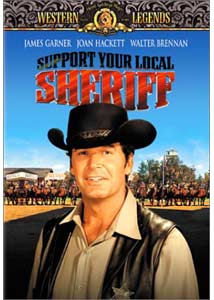
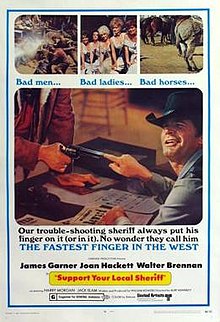
Vinnie's pick - Support your Local Sheriff (1968) : "We're All Behind Ya!"
Most of James Garner's greatest roles are virtuous men who know how to fight perfectly well, but choose to think, talk or bamboozle their way out of a situation, if not just plain run away, so they may live to to run another day. Jason McCullough, lead character of Support Your Local Sheriff, is a perfect example of this. He arrives in Calendar, Colorado a short time after gold is discovered in the open grave of one Millard Frymore. Everyone's so gold-mad that the few people in the service industries (and I don't mean Madame Orr's House) are able to charge eight dollars for a "tasty home-cooked meal" and twenty for an eight-hour shift on a cot, so Jason is forced to find work, and the position of Sheriff happens to be available. As opposed to the previous three holders of the position, Jason takes to it easily, using a combination of confidence, bluster, and a reputation that spreads like wildfire. Ten minutes on the job and he arrests Joe Danby (Bruce Dern) whom he saw kill a man in a gunfight earlier in the day. Now the brand new jail has no bars yet, but with the help of a few drops of red paint on the floor to pass as blood, Joe stays in his cell nice and tidy.

The town is filled with wacky characters played by beloved character actors, including Harry Morgan, Henry Jones and Jack Elam as Jason's deputy Jake. Joan Hackett plays the mayor's daughter Prudy, a tomboyish young lady who doesn't seem to know what to do with her hands when the Sheriff's around. Garner walks smoothly through the chaos unruffled, pulling his gun when he has to, but most of the time getting people to do what he wants by wits and generally confounding the hell out of everyone. When Pa Danby (Western legend Walter Brennan, parodying his role in My Darling Clementine) shows up to break Joe out of jail, Jason stops him by sticking his finger in Pa's gun barrel. After killing endless hired guns, he drives one out of town by throwing rocks at him.

When the Danbys assemble a small army to come after the Sheriff, he makes it clear that he plans to pack up and run. Expecting to be branded a coward, he's surprised when Prudy describes it as the most mature thing she's ever heard from a man. That so flusters Jason that he changes his mind and plans to stay and fight it out against the Danbys. The final gunfight is as good as in any classic western, but still packs in the laughs.

One of the coolest aspects of the character is how he really is a tremendous fighter and a better shot, but chooses to keep that under wraps, like a claw. When presenting himself for the position to the town council, they ask for his credentials. He replies with a simple "Oh, don't worry, you'll be glad you hired me". When they ask for some provenance, he takes a large washer, flings it up in the air and shoots through the center. The council is reticent to believe him, pastes a stamp over the hole, and asks him to repeat the stunt. He does, effortlessly. The change in tone from Harry Morgan is priceless.

James Garner produced the film through his company Cherokee, and like Humphrey Bogart's self-produced films through Santana, his films are tailor-made for him. He followed this up with Support Your Local Gunfighter, which did not feature the same characters, but did feature much of the same cast, giving the mistaken impression that it's a sequel. It doesn't hold up for me; for one thing, his character is more of a con-man in the film, and as I've mentioned, I prefer it when he plays a good guy, as opposed to my other favorite character type, the charlatan with a heart of gold.