Friday, July 15, 2011

DIAL and DIAL Again!

"Can’t a fellow look beyond a tennis net without being out for something?" Farley Granger in Strangers on a Train (1951)

This week's TotED post salutes Dial M for Murder, both seriously (Alfred Hitchcock's classic film version) and funny-side-up (Scott Fivelson's one-act play Dial L for Latch-Key)! (Mind the spoilers!)


Dial M for Murder (1954)


From Woman in White with Tony
To answer Granger's question: not in an Alfred Hitchcock movie! Former tennis champ Tony Wendice (Ray Milland) comes off all smooth and debonair, but unlike Farley Granger as Guy Haines, Tony’s not a nice Guy! In Frederick Knott’s smashing, diabolical 1952 stage thriller, Dial M for Murder (DMfM). Tony makes caring, husbandly noises around his beautiful, wealthy wife Margot (Grace Kelly), but in the wordless opening sequence, it becomes clear that she’s really just a meal ticket to Tony. No wonder she and her former boyfriend, American TV writer Mark Halliday (Robert Cummings, a Hitchcock alumnus as the hero of 1942's Saboteur) are picking up where they left off.  To be fair, Margot and Mark seem to feel a little guilty, wanting to do the right thing, but those crazy kids are stuck on each other. Tony feels stuck as well, clearly realizing his days of sponging off Margot are numbered. To borrow a line from Anthony Shaffer’s Sleuth, Tony is finding murder less burdensome than alimony. So Tony hatches a cunning plan, involving blackmailing a fellow blackguard from his college days, one Captain Lesgate…or is it C.A. Swann? (Either way, he's played by Anthony Dawson from Dr. No, among others.) Like Cary Grant’s character in Charade (1963), Swann seems to have aliases aplenty, not to mention a trail of debts and at least one dead body: “Poor Miss Wallace....” So Swann falls in with the plan, which involves keys under a staircase carpet and the split-second timing of a fatal phone call. But you know what they say about the best-laid plans….
...to Lady in Red with Mark!

A smash hit on London’s West End and Broadway in 1952, it didn’t take long for Hollywood to come a’knockin’. Warner Bros. was keen to get Alfred Hitchcock to direct the 1954 film adaptation, and Hitch signed on, although his heart wasn’t quite in it. In Adam Philips’ excellent review of DMfM in his blog Hitchcock and Me, he also pointed out that John Williams’ character, Chief Inspector Hubbard, “may have rubbed Hitchcock the wrong way, as competent police officers in Hitchcock’s pictures are few and far between.” But once Hitchcock met his new leading lady, Grace Kelly, an actress-director dream team was born! Hitchcock and Kelly collaborated on three movies before she traded Hollywood royalty for Monaco royalty, the other two films being Rear Window (1954) and To Catch a Thief (1955). But the team-up with Kelly wasn’t the only “first” here for Hitchcock: it was also the first—and only—time Hitchcock used the original 3-D format. With that particular 3-D process being a big fad at the time, producers attempted to woo TV audiences back into theaters, complete with the original 3-D glasses, annoying though they were. Warner Bros. insisted that Hitchcock capitalize on the 3-D fad. The stereoscopic technique was a clunky, cumbersome nuisance, but Hitchcock agreed to use it, only to have DMfM released in a “flat” version anyway! Vinnie and I actually got to see the 3-D version several years ago in my hometown, at New York City’s Film Forum. Despite the glasses’ shortcomings, we thought it was pretty darn cool, especially the scene where our gal Grace manages to grab the scissors and kill Swann in self-defense! Admittedly, sometimes it also had us snorting with laughter for the wrong reasons, like when the liquor bottles on the Wendices’ wet bar seemed to be jumping out at us moviegoers. It got me wondering what a 3-D version of The Lost Weekend starring DMfM star Ray Milland might have been like!

Have you seen your husband, baby, standing in the shadows?
Considering DMfM was filmed in color (WarnerColor, no less! Technicolor, Schmechnicolor!), it makes great use of shadows and angles, especially when the camera slowly maneuvers upward. It’s almost as if God Himself is sternly looking down on Tony and Swann plotting Margot’s murder, thinking, “You two are gonna get it! Taste my wrath, you evil jaspers!” I love the look on Swann’s face as Tony shares his juicy story of stealing Margot’s love letter and blackmailing her. They’re almost like yentas gossiping over coffee and cake—or, considering this is set in England, tea and scones. And all the while, Tony is matter-of-factly wiping down incriminating fingerprints, the shifty old slyboots!

Vinnie Can’t Resist Chiming In: There was a Hallmark Hall of Fame version of Dial M... done back in 1958 – the only returning cast member was the wonderful John Williams. He too is a recurring figure in Hitchcock’s work. In addition to Dial M... and To Catch a Thief, Williams appeared on Alfred Hitchcock Presents eight times, playing functionally the same police inspector character three times, one being the epic three-part "I Killed The Count." John Williams had a heck of a career before he started telling us about the themes from “A Stranger In Paradise’ we first found in The Polovtsian Dance No. 2 by Borodin.


As Tony Wendice, Ray Milland gives one of his most compelling performances; indeed, I’d go so far as to name Tony among my Top Five Hitchcock Villains. Look at the way he manipulates Margot into staying home doing his “boring clippings” instead of going to a movie as she’d originally planned. After Tony gets home to discover that would-be victim Margot fought back and ended up killing Swann in self-defense, you can almost see the calculating in Tony’s eyes as he figures out how to make this “ghastly accident” work in his favor, the meticulous son of a bitch! (I still wince every time I see Swann fall on his back, plunging the scissors in deeper!) Grace Kelly won my sympathy as she proved to be perhaps the quintessential Hitchcock Blonde. (It didn’t hurt that her entrance is accompanied by Dimitri Tiomkin’s lushly romantic music.) Having said that, for me, North by Northwest’s Eva Marie Saint was a darn close second! In any case, John Williams steals the show as Chief Inspector Hubbard. He’s almost like a more dapper Columbo in that he can seem slightly absentminded, but when things get serious, he turns out to be a sly fox after all. When he does, you find yourself glad to be on his side!

Guess who came to dinner? Hitchcock's cameo!
Robert Cummings always seems to be written off as a lightweight, but I nevertheless found myself liking him as Mark Halliday. (Wonder if his character was named after crime author Brett Halliday?) Maybe it’s because I’m predisposed to like affable mystery writers, having known a few. Also, it seemed to me that Mark truly loved Margot, and vice-versa. I’ve always liked that bit in the apartment where Mark looks at Margot while talking about how it’s hard to write a perfect murder because “things don’t always work out”— and we know darn well he’s not talking about crime stories. C’mon, cut the guy some slack! He did save his sweetie, albeit with a little help from Hubbard. I thought Tony would soil himself when Mark unwittingly suggests a way to save Margot that sounds an awful lot like Tony’s murder plot. I always feel like cheering when Hubbard turns out to be truly on our heroes’ team: “They talk about flat-footed policemen. May the saints preserve us from the gifted amateur!” And such a British ending: cocktails in the face of adversity!


Dial L for Latch-Key (2010)

When fellow blogger Adam Philips of Hitchcock and Me reviewed Scott Fivelson’s 2010 comedy Dial L for Latch-Key (DLfLK) this past April, I thought it sounded hilarious, and I would have loved to see the much-praised live stage production if it had been within a reasonable distance of my Pennsylvania home. Alas, it was only playing at the New End Theatre in London, England, and the airfare alone was too rich for my blood. But in June, I got the next best thing: an invitation from Rick Tannenbaum of Hen House Press (http://loveandpublishing.com) , inviting me to read and review the paperback edition of Fivelson’s one-act play.

I’m pleased to say DLfLK was great fun to read, and chock full of affectionate madcap spoofing of not only DMfM and Alfred Hitchcock’s favorite tropes, but also Hitchcock-inspired thrillers ranging from The Manchurian Candidate to Charade. I could see the play’s zany absurdist shenanigans in my mind as I read it. The plot starts off in a Dial M for Murder vein, then veers cheerfully off in the wildest directions. Even the props—like the trunk festooned with such travel decals as “Tower of London” and “Alcatraz”— are a hoot. So are the stage directions. For example:


(Enter RAYMOND, an impeccable sophisticate with an insufferably self-satisfied air. Tropical shirt. Perfectly pressed Bermuda shorts. High socks. Brand new tennis shoes. Slicked-back shoe-polish dark hair. In a buoyant mood.)

(Enter G and BOB…G is grace personified. Her golden blonde hair and radiant bearing doing all they can to raise her above her current circumstances, mink coat only partially concealing the old-movie-style striped prison uniform worn beneath it.)
(At her side, Bob, American, a handsome cipher. HIS overcoat draped over one arm. Bob is at all times reining in a boundless, featureless energy, happy to be anywhere he is. Because HE’S there. In a word, American.)

You could make a drinking game out of the references to Hitchcock-style elements! (I’m a teetotaler, so I’ll be the designated driver.) DLfLK is grand smart-alecky fun, with a broad, affectionate wink to the thrillers we grew up loving, whether we first saw them in actual theaters or on TV. Hen House Press is also producing a radio play of Dial L for Latch-Key for an NPR affiliate in New York, so keep your eyes and ears open for further developments. For more information on Dial L for Latch-Key, contact Rick Tannenbaum at Hen House Press via Twitter (@eHenHouse) or e-mail (oppknx@yahoo.com).

Inspector Hubbard combs every inch...


Is there no end to the hot smooching?

Saturday, July 9, 2011

SLEUTH: Doppler Jeopardy

This post, Sleuth: Doppler Jeopardy, is my entry for the Vivien Leigh and Laurence Olivier Blogathon, hosted by Kendra Bean.

(Warning: You may find Spoilers amongst the clues!)

In honor of our Fearless Leader Kendra's Vivien Leigh and Laurence Olivier Appreciation Blogathon, we of Team Bartilucci are proud to participate by saluting one of our absolute favorite films of all time: the 1972 film adaptation of Sir Anthony Shaffer's diabolically suspenseful, witty international stage smash Sleuth.

Dorian says: Vinnie was particularly keen to participate, having loved Sleuth even before I did, so props to my dear hubby for writing the lion's share of this post! Director Joseph L. Mankiewicz of the Oscar-winning All About Eve (among so many other smart, entertaining movies) was a top-notch choice to direct the film version. Cole Porter songs are sprinkled throughout John Addison's sprightly, playful Oscar-nominated score. Ken Adam's production design for Andrew Wyke's grand home, Cloak Manor, is mouth-watering; we want to live there when we grow up! Mankiewicz’s dark, twist-laden, cracking good comedy-thriller works on many levels, including as an indictment of the class system. Too bad Sir Laurence Olivier and Michael Caine couldn’t have won some kind of Team Oscar for their work in this one; you know, like the Screen Actors Guild Awards. In 2007, Sleuth was remade with Kenneth Branagh at the helm, with Caine now in the Olivier role and Jude Law in Caine’s original role.  A great remake is rare (the best ones that leap to mind are the 1941 Maltese Falcon and the 2001 Ocean’s Eleven), but the first half of the Sleuth remake was sleek and entertaining, until it suddenly took a bizarre wrong turn into gay-bashing and humiliation—not our idea of fun! In the meantime, you can still find copies of the out-of-print DVD edition of Sleuth on Netflix or even your local video store, so by all means seek it out!  Take it away, Vinnie!

Vinnie says: In a perfect world, a mystery should keep the audience guessing. With enough twists and turns, you shouldn't have a clue (pardon the choice of words) of the outcome, while still playing fair enough that a viewer might succeed, or could at least admit that he could have once the facts were laid out in the dénouement.

Sleuth has an unfair advantage. It's not a mystery. There is no murder (OK, there's one), so there's no need to play fair with the audience. There are only two men, one pompous and petty, the other angry as hell, in a long game of cat and mouse. The scenes play out so long that your confidence that things are as they are is stretched just past the point of confidence, and as soon is it is, they pull the rug out from under you.

Cloak Manor in the merry month of maze
Sir Laurence Olivier plays Andrew Wyke, endlessly award-winning author of the St. John Lord Merridew mysteries. Andrew is a classic upper-class British aristocrat, and has filled his home and his life with an obsession for games, puzzles and other things used by the insufferably intelligent to prove they are smarter than "ordinary people." He's dictating the end of his latest mystery as the film begins, safely hidden within his vast garden maze, which is of course rigged with cheats so he can win. He's met by Milo Tindle (Michael Caine), a hairdresser who's been having an affair with Andrew's wife Marguerite. Andrew is remarkably polite and accepting of the situation; indeed, he wants to arrange a scenario where everyone wins.

We’re not in Brother Lightfingers’ abbey, we’re in a hurry!
Andrew lays out the board simply: if Milo runs off with Marguerite, she'll need a divorce, and she will take Andrew for far more than he wishes or feels she deserves. However, if Milo plays the role of a burglar, steals a large cache of Marguerite's jewelry from the house safe, and fences them with a gentleman whose contact information Andrew will supply, Andrew will be able to get reimbursed for the loss from his insurance, Milo and the lovely Marguerite will end up with more money than they would from a divorce (especially since it'll be under the table and tax-free), and everybody can walk away whole and unravaged by the law. Milo agrees, and Andrew drags him about the house in a mad pantomime of a robbery, dressing him in a clown costume, walking him through the robbery and guiding him as to what bits of the house he should upset to make it look as if a scuffle has taken place. This last portion is where Milo chooses to stray from the script and get a tad more zealous in his disarraying activity.  (Dorian says: As writers ourselves, we can empathize with Andrew's dismay as Milo tossed his new manuscript all over Andrew's luxurious home! OK, back to Vinnie!)

The Day The Clown Cried—For Help!
Things take a turn for the hearse when Andrew points his gun at Milo and informs him that this has all been a plan for Milo to incriminate himself as a burglar, so that Andrew could legally shoot him in defense of his home. Dropping the friendly attitude he's had through the larcenous romp, he declares himself so far above Milo in station and intellect that he barely considers this to be murder. He fires the gun at the base of Milo's skull, Milo tumbles down the stairs of the living room in a crumpled heap, and Andrew calmly heads back downstairs to tidy up.

End scene.
Not bad, eh?

It was at this point in the stage play that Alan Bates left the theater after being offered the role of Milo, as he thought a character that dies midway through the story a la Psycho was beneath his position as an actor. In fairness, he's not the first to have jumped to that conclusion. (Though it does show that it's wise to sit through the entire play before making up your mind!)

Laura, er, Marguerite is the face in the misty light...
The narrative continues an unspecified period of time later. Andrew is puttering about his home, alone (as he always is — we never meet his wife Marguerite, save for her portrait, painted to resemble Joanne Woodward) when the doorbell rings. It's Inspector Doppler (Alec Cawthorne) who comes to ask about the mysterious disappearance of one Milo Tindle. At first feigning any knowledge of the man, when the Inspector presents a note in Andrew's handwriting, found in Milo's home, asking that they meet, Andrew is forced to put his cards on the table. Milo, he explains, was here, put through a series of escapades, and finally, Andrew shot him.

With a blank.

The entire affair was to put Milo through such terror and humiliation as to find out his true mettle, to see if he was "worthy" of his wife. Andrew decided he was, and when he awakened, Milo was allowed to leave, if not with his pride intact, at least his head.


Oh, you've got brown eyes, oh, you've got blue eyes....
The inspector is appalled to learn that someone could play such a ghastly trick on another person, and insists that he inspect the home. Andrew agrees happily, but when Doppler begins to find evidence of a far more serious act than a mere April Fool's trick (blood on the stairway, Milo's clothes balled up at the bottom of the wardrobe), he puts forth the theory that Andrew had, in fact, killed Mr. Tindle, albeit accidentally, and has disposed of the body to make the problem vanish. Andrew is dumbfounded and protests his innocence, insisting that his tale is true, and more than a little offended that this flatfoot wouldn't just take the word of a gentleman at face value and leave. As he begins to panic that he may be arrested for a crime that never even happened, let alone one he didn't commit, Doppler lowers the boom. He begins to remove makeup and padding, standing revealed as...Milo Tindle (Caine)! With the help of some stage makeup artist mates and a key he obtained from another acquaintance, he set up this charade to take Andrew to that point of fear for his life that Milo experienced. Andrew begins to regain his composure, and immediately starts shoring up the levees that his panic nearly burst. He knew it was Milo all along, was playing along to give him the fun of the game, a verbose version of "I let you win." (Dorian says: Surrrre you did, Andrew.... See how you like it, buster! Back to Vinnie!))

And that's when Milo reveals Act Two. While at the house to set up the evidence, he met Andrew's mistress, a young bit of stuff named Téa. They spoke, she had no problem believing that Andrew would play such a trick, Milo shags her rotten...and then strangles her. He then explains that he has contacted the police. They will be there within the hour to ask Andrew about, not Milo's disappearance, but Téa's. And Milo has planted three pieces of incriminating evidence about his palatial home to connect Andrew to the murder . He's sure the police will find them soon enough, but for Andrew to do so within this tight time frame, he'll need to play Milo's game.

Is it me, or is Andrew a little TOO into his toys?
The film ends with one dead body, police at the door, and the laughter of Laurence Olivier over some jaunty harpsichord music. And we haven't spoiled the ending at all.

While they give credits for several actors (including the aforementioned Alec Cawthorne, which is "a virtual anagram" of the words "or Michael Caine" if you manipulate a couple letters), it's a two-man play, and both Olivier and Caine were nominated for Oscars, among other major awards. Anthony Shaffer won a Tony and an Edgar, among other prizes. Sleuth rivals Deathtrap as the perfect comedy-thriller.

Kenneth Branagh remade Sleuth in 2007, with Caine graduating up to Sir Larry's role and Jude Law stepping into Milo Tindle's pricey Italian loafers. The first half of the film is very well done, with many technological upgrades to make Milo's attempted robbery all the more embarrassing, and the threat of murder after the act more realistic and less imperious. But alas, the last act descends into an overlong game of "Fag."

Perhaps it wasn't called that in your circles. Back in the days of childhood, before we Knew Better, boys would go to great lengths to get their friends to admit that at times, in the secret part of their heart, they'd thought that that guy was attractive, or that they'd wondered fleetingly wht it might be like to touch certain things or have certain things in their mouth. As soon as they would, the other assembled friends, who attoseconds before were swearing it was just between them, no one would mock anyone, lifted their fingers and pointed like Donald Sutherland at the end of the 1978 version of Invasion of the Body Snatchers and scream "FAAAAAAAAG!!!!!!!"

It's annoying, outdated, and shoehorned in from so far out in left field that it makes one want to wash. In short, it can't hold a candlepin to the original. The 1972 version of Sleuth holds up today, and can still surprise new viewers. It is worth missing a hand or two of cards and watching.

* * * * * * * * * * * * * * * * * * * * * * * * * * * * * * * * * * * * * * * * * * * * * * * * * * * * *
Wow, I think this may have been one of Team Bartilucci's most prolific writing weeks to date! After you've read (and enjoyed, we hope!) our Sleuth blog post, feel free to visit Tales of the Easily Distracted for our very recent post about James Garner, "Discretion is the Garner Part of Valor." 

Friday, July 8, 2011

Discretion is the Garner Part of Valor

This week, we of Team Bartilucci are saluting one of our favorite actors, James Garner. We mentioned his playful suavitude as one of our Suave Hall of Famers last October in our "Flico Suave" blog post. But by golly, the former James Bumgarner deserves a post all his own, so here it is!


Dorian's Pick - Marlowe (1969): Out of the Past, Into the '60s
Before the good people of Warner Archive recently made Marlowe (1969) available on DVD, I think the last time I saw it was on the 4:30 Movie when I was a kid in the Bronx! But before we talk about James Garner’s performance as author Raymond Chandler’s iconic private detective Philip Marlowe, I think it’s important to provide some background. Marlowe has been played in the movies (and on TV and radio, too, but let’s stick to the movies for this post) by a remarkable variety of actors, with performances ranging from the sublime to the ridiculous. For me, I’m afraid Elliott Gould in The Long Goodbye wins in the “ridiculous” category. In Robert Altman’s version, Gould looks and acts like he’s auditioning for Columbo. Yes, I know the Gould/Altman version has its fans, and I’ve liked Gould in other roles, but I just don’t think he’s a good fit as Philip Marlowe. Years earlier, in 1947, George Montgomery had tried his hand at playing Marlowe in The Brasher Doubloon. I’ve never had an opportunity to see the film, alas, but judging from the trailer and the bits and pieces of the film I've seen on YouTube, young Montgomery was trying to look older behind a dapper mustache. Eventually, Montgomery quit show business to run a wildly successful furniture business. Does anybody here know if there's a legal DVD of The Brasher Doubloon available anywhere? But I digress….

Happily, the sublime Marlowes outshine and outweigh the lesser ones. My own favorites include Humphrey Bogart in Howard Hawks’s 1946 film version of Chandler’s first novel, The Big Sleep; Robert Montgomery directing himself in MGM’s offbeat but compelling 1947 adaptation of Lady in the Lake (I’ll admit that one’s an acquired taste, and by golly, I’ve acquired it!); and three different but thoroughly entertaining versions of Chandler’s 1940 novel, Farewell, My Lovely. The first film version actually used the plot for one of George Sanders’s Falcon movies, The Falcon Takes Over (1942). Instead of Chandler’s Los Angeles, The Falcon Takes Over is set in my beloved New York City, with Ward Bond as Moose Malloy and Team Bartilucci fave Hans Conried as Lindsay Marriott. Edward Dmytryk’s Murder, My Sweet (1944) was a far more faithful adaptation despite the title change; the producers were afraid that the title Farewell, My Lovely sounded too much like a musical. But by any title, Murder, My Sweet helped Dick Powell shatter his image as a crooner, establishing him as a big-screen tough guy forevermore. Dick Richards’s 1975 version restored the original Farewell, My Lovely title, and Robert Mitchum commands the screen as another one of my favorite Marlowes. Mitchum was terrific in Michael Winner’s 1978 version of The Big Sleep, too, although I wasn’t crazy about many other aspects of the film, especially its transplant from 1946 Los Angeles to 1978 England, and its overreliance on blood and violence to keep audiences awake.

Electric Company: Sparks fly between Marlowe and Dolores 
This leads us to Marlowe star James Garner at last! Vinnie and I have been die-hard Garner fans since we were kids. When we were growing up, we watched him on TV in his long-running TV series The Rockford Files, not to mention vintage reruns of Maverick and films like The Great Escape (1963), The Americanization of Emily (1964), 36 Hours (1965), The Thrill of it All (1963), and so many other terrific films of many genres. Garner is always a likable onscreen presence, with a touch of the antihero about him and more acting range than people give him credit for. Garner is another one of those actors who makes it look easy, rather like a laid-back American Cary Grant. He has a wry, breezy style (I get a kick out of his catchphrase “I’m a trained detective”), but he’s also tough, sardonic, and introspective when he needs to be. He even matches Marlowe’s description in the novels; what’s not to like?

Marlowe certainly has a promising pedigree, with a terrific cast and multi-award-winning screenwriter Stirling Silliphant (In the Heat of the Night, Charly, The Towering Inferno) adapting Marlowe’s script from Chandler’s 1949 novel The Little Sister. Indeed, the theme song was actually titled “Little Sister,” with music by Peter Matz and lyrics by Norman Gimbel, sung by the then-popular band Orpheus, who’d had a big hit with “Can’t Find the Time.” Lang Thompson’s absorbing article on the TCM Web site describes Orpheus as “a psychedelic pop band,” but for me, “Little Sister” and the other Orpheus songs I found on YouTube evoked The Lettermen’s greatest hits more than, say, The Strawberry Alarm Clock’s “Incense and Peppermints.”


The opening credits show a young man taking surreptitious photos of a sexy couple getting wet and wild in what’s obviously supposed to be a private pool. The woman turns out to be popular sitcom star Mavis Wald (Gayle Hunnicutt), who should perhaps use some of her sitcom earnings for better security, or at least better friends. You see, Mavis’s pool buddy turns out to be notorious mob boss Sonny Steelgrave* (played by H.M. Wynant, whose many TV and movie appearances include roles on 77 Sunset Strip, Alfred Hitchcock Presents, Maverick, and the genre spoofs of Team Bartilucci favorite Larry Blamire, of The Lost Skeleton of Cadavra fame). Can you say “blackmail”? I knew you could!


Party line-up with camera shop guy,
Marlowe, & his girl Friday, er, Julie
We first see Marlowe when he comes to question one Haven Clausen (love these names!) about Orrin Quest (Roger Newman), the missing person our hero is trying to find. The investigation comes to a literal dead end when Marlowe discovers Clausen with an ice pick in the back of his neck. Cut to our exasperated hero Marlowe and his memorably-named young client, Orrin’s sister Orfamay (Sharon Farrell, who moved on to even greater success in the long-running TV soap opera The Young and the Restless). To borrow a line from Clifton Webb in Laura, Orfamay seems to have “come from an incredibly rustic community where good manners are unknown,” not to mention common sense and emotional stability. Orfamay accuses Marlowe of not trying hard enough to find the long-missing Orrin, who’s apparently gone underground with the hippie/flower-child types, this being set in 1969. Maybe Orrin ran off to be an Orpheus roadie? In any case, Orfamay runs hot and cold under the best of circumstances, tearfully angry at Marlowe one minute and trying to seduce him the next, which might have interesting possibilities if she didn’t dress like a little kid wearing her granny’s dresses, among her other oddball qualities. As gallant as he is world-weary, Marlowe returns Orfamay’s retainer, but over the course of the film, she keeps popping up with her hot-and-cold routine. Look, Toots, Marlowe gave you back your retainer; quit pestering the poor guy and find another P.I. already!


Whodunit? Take your pick!
But even a pesky, emotionally unstable client is better than a dead one. That ice-pick killer is shaping up to be a serial killer, and the latest victim is one of Marlowe’s clients, Grant Hicks (Jackie Coogan). Marlowe calls from the boarding house, trying to get info about Hicks’s murder by feigning a folksy Southern drawl: “I’m a former tenant in Clausen’s roomin’ house. I was just checkin’ out when he tried to call you. That was before somebody mistook him for an ice block.”

Future Emmy-winner Paul Bogart directed; ironic, considering that Humphrey Bogart (no relation) was, in my opinion, the best movie Marlowe (no offense intended to the beloved star we’re saluting this week). Entertaining and well-cast though it is overall, Marlowe could have used a tweak or two. Silliphant’s script works hard to balance out the old and new elements, but the movie sometimes felt a bit unstuck in time to me. True, Quentin Tarantino has been doing that in his films since the 1990s, but Marlowe sometimes feels like its Chandler-esque elements are being shoehorned in. The characters’ first names sound very 1940s even though the setting is 1969 L.A., which might well have been intended as a tribute to Chandler’s original material. And I know the hairstyle Hunnicutt wears in the scene in Mavis’s apartment was probably cutting-edge in the late 1960s, but I wish she had cut it off instead. It makes the otherwise beautiful Hunnicutt look like she has ultra-long sideburns! Does the fact that Chandler’s 1949 novel was updated for the 1969 movie version make this a period piece for us 21st-century viewers? That said, when the ’40s elements work, they work quite well indeed, like placing Marlowe’s office in L.A.’s landmark Bradbury Building.

When Marlowe’s client gets knocked off, there’s hell toupee!
In addition to Garner, Hunnicutt, Farrell, and Coogan, Marlowe’s great cast sparkles with past and future award-winning TV and film stars, including Carroll O’Connor as Lt. Christy French, before the groundbreaking sitcom All in the Family put him on the map as bigoted loudmouth Archie Bunker; Rita Moreno, who later had a recurring role on The Rockford Files with Garner, as well as winning an Oscar (for West Side Story), a Tony (for The Ritz), a Grammy, and and Emmys, ALMAs, BAFTAS, and so many more, bless her! No wonder Moreno is listed in the Guinness Book of World Records! And let's not forget superb supporting actors William Daniels (not to be confused with the film’s Director of Photography, Oscar-winner William H. Daniels!); Jackie Coogan as the ill-fated Grant Hicks; and Kenneth Tobey (The Thing from Another World, among others) as Sgt. Fred Beifus.

Warning: Drugged cigarettes can be hazardous
to a private eye's health!
The plot has shades of old Hollywood, including a nice bit where Marlowe is in a TV station and finding himself more absorbed in a Greta Garbo film than in the live rehearsal going on. But with all due respect to Garner and company, it’s young Bruce Lee who steals the show as smiling, snappily-dressed henchman Winslow Wong, who basically beats up Marlowe’s office! Lee only has two scenes, but they’re the very best scenes, if you ask me. Good thing Marlowe doesn’t have any staff; someone could get hurt! Ah, the pros and cons of being an independent contractor!

Who needs HGTV? Leave your next office makeover to Winslow Wong!

*
“Sonny Steelgrave” was a character name also used by the late writer and TV producer Stephen J. Cannell, if I recall correctly. (Vinnie says: "She's right - he was a bad guy on the first season of Wiseguy, played by Ray Sharkey.")


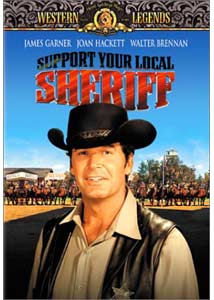
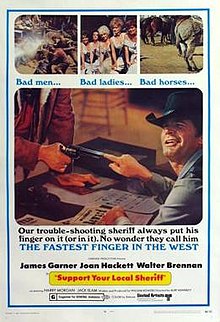
Vinnie's pick - Support your Local Sheriff (1968) : "We're All Behind Ya!"
Most of James Garner's greatest roles are virtuous men who know how to fight perfectly well, but choose to think, talk or bamboozle their way out of a situation, if not just plain run away, so they may live to to run another day. Jason McCullough, lead character of Support Your Local Sheriff, is a perfect example of this. He arrives in Calendar, Colorado a short time after gold is discovered in the open grave of one Millard Frymore. Everyone's so gold-mad that the few people in the service industries (and I don't mean Madame Orr's House) are able to charge eight dollars for a "tasty home-cooked meal" and twenty for an eight-hour shift on a cot, so Jason is forced to find work, and the position of Sheriff happens to be available. As opposed to the previous three holders of the position, Jason takes to it easily, using a combination of confidence, bluster, and a reputation that spreads like wildfire. Ten minutes on the job and he arrests Joe Danby (Bruce Dern) whom he saw kill a man in a gunfight earlier in the day. Now the brand new jail has no bars yet, but with the help of a few drops of red paint on the floor to pass as blood, Joe stays in his cell nice and tidy.

The town is filled with wacky characters played by beloved character actors, including Harry Morgan, Henry Jones and Jack Elam as Jason's deputy Jake. Joan Hackett plays the mayor's daughter Prudy, a tomboyish young lady who doesn't seem to know what to do with her hands when the Sheriff's around. Garner walks smoothly through the chaos unruffled, pulling his gun when he has to, but most of the time getting people to do what he wants by wits and generally confounding the hell out of everyone. When Pa Danby (Western legend Walter Brennan, parodying his role in My Darling Clementine) shows up to break Joe out of jail, Jason stops him by sticking his finger in Pa's gun barrel. After killing endless hired guns, he drives one out of town by throwing rocks at him.

When the Danbys assemble a small army to come after the Sheriff, he makes it clear that he plans to pack up and run. Expecting to be branded a coward, he's surprised when Prudy describes it as the most mature thing she's ever heard from a man. That so flusters Jason that he changes his mind and plans to stay and fight it out against the Danbys. The final gunfight is as good as in any classic western, but still packs in the laughs.

One of the coolest aspects of the character is how he really is a tremendous fighter and a better shot, but chooses to keep that under wraps, like a claw. When presenting himself for the position to the town council, they ask for his credentials. He replies with a simple "Oh, don't worry, you'll be glad you hired me". When they ask for some provenance, he takes a large washer, flings it up in the air and shoots through the center. The council is reticent to believe him, pastes a stamp over the hole, and asks him to repeat the stunt. He does, effortlessly. The change in tone from Harry Morgan is priceless.

James Garner produced the film through his company Cherokee, and like Humphrey Bogart's self-produced films through Santana, his films are tailor-made for him. He followed this up with Support Your Local Gunfighter, which did not feature the same characters, but did feature much of the same cast, giving the mistaken impression that it's a sequel. It doesn't hold up for me; for one thing, his character is more of a con-man in the film, and as I've mentioned, I prefer it when he plays a good guy, as opposed to my other favorite character type, the charlatan with a heart of gold.

Friday, July 1, 2011

DOUBLE INDEMNITY: The Secret Life of Walter Neff

When insouciant insurance salesman Walter Huff came over to the Nirdlinger house to renew Mr. N.’s insurance, he wasn’t in, but his wife was. This dame, Phyllis, was no perky housewife; for one thing, she greeted Walter wearing nothing but towels and a come-hither smile. Before you could say “accident insurance,” she was back with a honey of an anklet and Walter in the palm of her hand. So begins James M. Cain’s 1936 Liberty Magazine serial Double Indemnity (DI), in which Walter and Phyllis become adulterous lovers plotting to murder Nirdlinger and scam Walter’s insurance company. The Liberty serial eventually morphed into a best-selling 1943 novel. Even better, in Billy Wilder’s more-than-capable hands, it became a now-classic 1944 film noir, with the leads getting snappy new names: Walter Neff and Phyllis Dietrichson. In fact, with all due respect to Cain, Wilder’s film version improves on the novel in many ways (thank goodness; it’s hard to read a hard-boiled suspense story about a killer named “Nirdlinger” and keep a straight face!). DI became a cinema classic almost in spite of itself, considering that its dark tone and scandalous subject matter freaked out Hollywood so much that it took 9 years to get DI from the printed page to the big screen!

Dick Powell, who was eager to change his then-crooner image, seemed to be the only leading man in Hollywood who was eager to tackle the role of antihero Walter Neff. But Double Indemnity was a Paramount production, and Powell was under contract to RKO at the time, so he had to wait until Murder, My Sweet to repurpose himself as a big-screen tough guy (and one of the best actors to play Raymond Chandler’s private detective Philip Marlowe, in my opinion).  It was Fred MacMurray, then best known for his breezy light comedy roles, who finally had the guts to take the role of insurance salesman-turned-murderer Walter Neff — but even MacMurray needed convincing at first. None of the other in-demand male stars of the period wanted Barbara Stanwyck’s conniving, money-loving, hubby-offing temptress Phyllis Dietrichson to make a chump out of him on screen. Their loss! It was quite a revelation to me when I saw DI for the first time, watching it on TV in my teens. I’d first seen MacMurray’s work back when he was best known to my generation as a wholesome Disney movie star and the lovable dad of TV’s My Three Sons. When I saw him playing underhanded types in DI, The Caine Mutiny, and another Wilder classic, The Apartment, I was both gobsmacked and impressed with MacMurray’s range. As a result, I was all the more disappointed that MacMurray was never even nominated for an Oscar for any of his stellar performances.

Director/co-screenwriter Wilder’s flair with suspense and black humor works perfectly with Cain’s storytelling style; it even improves on the book (which I read years ago). MacMurray and Stanwyck are dynamite in this, one of the most gleefully, unapologetically black-hearted noirs ever made. Their dialogue, especially in the first half of the movie, contains many of my favorite movie lines of all time — and of course, if I start quoting them all, I’ll pretty much be transcribing most of the script! The chemistry between Stanwyck and MacMurray blazes like the Chicago Fire as the wily, spellbinding Phyllis draws Walter into her web. As Richard Schickel points out in one of the two-disc DVD set’s pair of excellent audio commentaries, Stanwyck’s Phyllis is always reacting in the moment; as a result, you’re never sure whether she means a word she says, making her all the more fascinating. (To paraphrase a line from one of Donald J. Sobol’s Encyclopedia Brown books: “I wouldn’t believe her if she swore she was lying!”) The words of Dashiell Hammett’s cynical Sam Spade to the equally slippery Brigid O’Shaughnessy in The Maltese Falcon could also apply to the quicksilver Phyllis: she’s good, awful good! Miklós Rózsa’s brassy yet brooding score accents the suspense perfectly. Edith Head’s costumes strike the right notes, too, despite Phyllis’s tacky fashion sense — but it works because Phyllis has a touch of trash about her that Walter seems to be drawn to, and Stanwyck is always mesmerizing no matter what.

Edward G. Robinson is DI’s crabby yet kind-hearted Voice of Reason in his portrayal of Barton Keyes, the Pacific All-Risk Insurance Company’s ace Claims Manager. As Keyes, Robinson is irresistible, with his zeal for detail, the “little man” in his gut giving him indigestion every time an insurance claim seems fishy, and his gruff affection for Walter. Heck, there’s almost more tenderness between Walter and Keyes than there is between Walter and Phyllis! If you ask me, the biggest crime in DI was the failure to nominate either of the male leads for an Oscar, especially scene-stealing Robinson, though at least the Academy was smart enough not to overlook the mesmerizing Stanwyck. For that matter, Robinson was never nominated for an Oscar for any of his superb performances. He was eventually given one of those special career Oscars, or as we like to call them here at Team Bartilucci H.Q., the “Yikes, He’s So Old He Could Croak Any Minute and He Still Hasn’t Gotten An Oscar? *D-OH!*” award.

Keyes, Keyes, he's our man! If he can't nail 'em, no one can!
DI boasts plenty of wonderful character bits, too; really, there isn’t a bum performance in the bunch! Our household’s DI faves include Fortunio Bonanova as Garlopis, whose phony insurance claim Keyes chews to bits “like a slice of rare roast beef;” and Porter Hall (from The Thin Man, among many others) as Jackson from Medford, Oregon, the jovial train traveler who innocently throws a wrench into the murder plot when he turns up on the train’s Observation Car while Walter pretends to be Phyllis’ injured, crutch-bound hubby. (Speaking of the crutches, is that opening credit sequence with the silhouetted, fedora’d figure on crutches one of the coolest credit sequences of all time, or what?) Any fans of The Thing from Another World who might be reading this shouldn’t blink when Walter lets Lola (the poignant Jean Heather) into his office at one point, or you’ll miss Douglas Spencer (with hair!) as Walter’s associate, Lou Schwartz, coming out at the same time.


Femme fatale Phyllis is so crooked,
even doors open the wrong way when she's around!
If you love the movie, you’ll go gaga over the DVD set’s nifty commentary tracks and extras. Among other things, we learn about the censorship issues in bringing Cain’s juicy, lurid tales to the big screen. For example, there were several European film versions of The Postman Always Rings Twice (including Luchino Visconti’s 1943 version, Ossessione, which works very well in its down-to-earth way) before Hollywood brought it to the big screen with John Garfield and Lana Turner in 1946. We’re also told about the different writing/working styles of Wilder and Raymond Chandler, who’d been hired to help adapt the story when Cain was under contract elsewhere, and Wilder’s then-collaborator Charles Brackett nixed the dark material. The experience became a collaboration made in hell for both Chandler and Wilder. For the record, I wouldn’t be surprised if Chandler was mostly to blame, since there are similar stories about him being just as difficult to work with during Alfred Hitchcock’s 1951 screen adaptation of Patricia Highsmith’s Strangers on a Train. (Hitch eventually brought in Ben Hecht’s assistant Czenzi Ormonde to finish/polish the SoaT script when Chandler took a hike.)

"Those dirty double-crossers are stealing our schtick!"
Disc 2 contains the 1973 TV movie remake of Double Indemnity (DI2), which is worth watching at least once, if only to appreciate how much better the original is! Wilder’s 1944 version rocks, but I'm afraid Jack Smight’s TV remake sinks like a stone. This isn’t film noir, it’s film blah! Still, both versions are worth a look for anyone who wants to learn how make a spellbinding film noir, because you learn a lot when you watch them back-to-back:

Samantha Eggar & Richard Crenna in the 1973 version. 


1. Just because your leading lady is pretty, it doesn’t automatically mean she’s irresistible enough to lead men to their doom. As the 1973 edition of femme fatale Phyllis Dietrichson, Samantha Eggar is very pretty. I’ll admit I liked Eggar’s long, lovely red hair better than Barbara Stanwyck’s trashy blonde wig. As a studio boss reportedly griped during the filming of the original DI, “I hire Barbara Stanwyck, and I get George Washington!” Eggar rocked that Lana Turner-style black turban she wears in the murder scene (and the entire black-and-white ensemble, for that matter). My dear late mom, who could rock a stylish hat and a turban like nobody's business, would have been proud! Nevertheless, Stanwyck exudes such sensual magnetism and charisma in the 1944 version, even that wig doesn’t keep Fred MacMurray from becoming putty in her hands. Eggar has been appealing in other roles, but while she’s undeniably pleasant to look at in DI2, I'm afraid she has all the carnal allure of an impatient English nanny; even Mary Poppins seems sexy and edgy compared to Eggar's performance here. Watching her try to be a sinful siren reminded me of the scenes in 1968’s Star! in which Julie Andrews tries to use her prim-and-proper, nigh-operatic tones to belt out torch songs and splashy Broadway production numbers: it’s not her style, and her discomfort shows. As a rule, discomfort isn’t sexy.

2. It don’t mean a thing if the leads ain’t got that zing.  That brings me to Eggar’s delivery; she always sounds vaguely bored and/or annoyed with Richard Crenna’s Walter Neff. In the original, even when Stanwyck was scolding or angry, somehow she seemed all the more fascinating. Her sultry voice, with just a trace of her native Brooklyn accent (from her lips, it sounded good!), was just as seductive as the rest of her. DI2 might be remembered as more than just a cinematic footnote if Eggar and Crenna had even a fraction of the chemistry that sizzles between Stanwyck and MacMurray; the latter was brilliant as a cynical smart-aleck whose street-smarts go out the window under this devious dame’s influence. It just goes to show that in a story like this, the best acting in the world won’t help if the leads don’t have chemistry and charisma.

3. A little moody atmosphere goes a long way in crime movies.  Despite the remake’s attractive locations, especially the Spanish-style accents in the opulent Dietrichson home (though I’d forgotten how prevalent the colors beige, harvest gold, and avocado green were back in the 1970s, not to mention blocky impressionistic artwork), DI2’s L.A. seems like a duller, less exciting place than DI’s original Los Angeles. The remake’s flat 1970s TV lighting and uninspired camera angles can’t hold a candle to the original’s menacing lighting effects and the great John Seitz’s photography, which looked almost like painting with shadows. Ironically, the 1973 update somehow feels more dated than the 1944 original — and if you listen carefully early on, you’ll realize the first film was actually set in 1938! DI2 does try for a bit of startling imagery here and there, though it’s made of cruder stuff than the sleek imagery of the original. For instance, the scene in which wounded, bleeding Walter tapes a confession for Keyes now opens on a close-up of Walter’s blood-stained cigarettes. Billy Goldenberg’s piano-and-strings music is somber enough, though it certainly won’t make you forget Miklós Rózsa’s powerful, brassy yet tender score for the original.

Kick the habit: Don't smoke bloodstained cigarettes!
Apart from Eggar’s forgettable performance, the good cast helps make DI2 fairly watchable, though far from a must-see except for nit-picky completists like me. As Walter Neff, Richard Crenna makes an amiable dupe who finds himself in over his head, though he doesn’t have MacMurray’s balance of insouciance and intensity (maybe Crenna should’ve worn a fedora :-)). Ironically, Crenna later played the rich husband-turned-murder victim in Lawrence Kasdan’s 1981 noir Body Heat. Interesting note for vintage TV fans: when Crenna’s voice is cracking from the pain of his gunshot wounds during his confession-by-dictaphone, he often sounds distractingly like he did as a young man on the 1950s TV show Our Miss Brooks. John Fiedler and his “Piglet” voice suit Jackson-from-Medford delightfully. Lee J. Cobb’s portrayal of Barton Keyes is quite good, but also quite different from Edward G. Robinson’s approach. Unlike the energy and fighting spirit of Robinson’s performance, Cobb’s Keyes seems older and wearier. When he talks about how the “little man inside” upsets his stomach when he senses a phony claim, you really do get the feeling he’s about to throw up any minute! Don’t get me wrong, though; Cobb’s approach is quite effective in the context of the remake, especially since the remake as a whole has a lot less snap, crackle, and pop than the original. No wonder Cobb/Keyes has indigestion; maybe the poor man needs a nice soothing bowl of Rice Krispies. With a script by Steven Bochco and TV crime-show veteran Smight directing (he also did a nice job with theatrical suspensers Harper, Kaleidoscope, and No Way to Treat a Lady), you’d think DI2 would still be worth watching, but despite the occasional gripping moment, this ’70s show is still just polyester while the original is pure silk.
James M. Cain by Rick Geary
   
Here's a special treat: Double Indemnity bloopers!

Friday, June 24, 2011

THE PRIZE: Swedish Mayhem

"C'mon, Eddie, do your Rico impression! Please?"
Thanks to the miracle of Print-on-Demand DVDs, one of my favorite Hitchcock pastiches, The Prize (1963), as in Nobel Prize, has become available from the Warner Archive. It couldn’t happen to a more entertaining movie! Loosely based on Irving Wallace’s best-selling 1962 novel, it’s quite appropriate that much of The Prize’s action takes place in Sweden’s Grand Hotel in Stockholm, since this lively, sophisticated yet impish international thriller plays like a cross between the classic movie adaptation of Vicki Baum’s Grand Hotel and Alfred Hitchcock’s North by Northwest (my favorite film of all time, for those who came in late).

The folks at MGM clearly realized screenwriter Ernest Lehman’s witty dialogue would be as important to the success of The Prize as it was to Lehman’s Oscar-nominated screenplay for North by Northwest (1959), so they lavished The Prize with plenty of smart, snappy lines in addition to the time-honored glossy MGM production values. They also cast The Prize with many actors who’d worked with Hitchcock before and/or after they became part of the Prize package, like Paul Newman (more about his Hitchcock experience shortly); Marnie’s Diane Baker; The Birds’ Karl Swenson, along with veteran character actor John Qualen, as bickering room service personnel at the Grand Hotel; and frequent Hitchcock supporting player Leo G. Carroll as the Nobel committee’s outwardly calm but inwardly worried head honcho, Count Bertil Jacobsson. Virginia Christine of Folgers Coffee commercial fame briefly appears in The Golden Crown nightclub scene with Baker and friends and a wine chaser. (Fun fact: Ms. Christine was married to Fritz Feld of The Secret Life of Walter Mitty and so many other comedies from 1940 to his death in 1993.) Fans of the classic private eye series 77 Sunset Strip (*snap snap*) may recognize Jacqueline Beer as another sexy secretary type, Monique, the mistress of Nobel Prize-winner Dr. Claude Marceau (Gérard Oury, renowned as a writer/actor/director in his native France). One of the more entertaining Nobel winner vignettes is a piquant running gag in which Newman as Andrew Craig, the Nobel Prize winner for Literature, agrees to help fellow Nobel-prize winner Dr. Denise Marceau (Micheline Presle) pretend they’re having an affair to make her hubby and fellow Nobel-prize winner Claude jealous, culminating in an almost-naked Newman winding up in Denise’s suite with her slow-burning spouse—but I’m getting ahead of myself. The Prize is that kind of movie—very busy (mostly in a good way)! 


Between The Prize and Charade, 1963 was a great year for playfully glamorous Hitchcockian thrillers! Director of Photography William Daniels, who also did the honors for TV’s I Love Lucy and the Oscar-winning The Naked City, got to have fun with trick photography. Great driving symphonic score by Jerry Goldsmith, too, augmented here and there by musical riffs from Bernard Herrmann’s North by Northwest score and another musical riff I swear I’ve heard on Star Trek! Is it just me? Incidentally, I liked the way the filmmakers got past the language issues of the international cast of characters, as decreed by major domo Mrs. Ahlquist (Edith Evanson): “During Nobel Week, nothing but English is to be spoken, even when you quarrel…Now don’t let me hear another word about this, especially in Swedish!”

Paul Newman plays our charmingly sardonic hero, the hard-drinking, womanizing, and of course, Nobel-winning author Andrew Craig, honored for his novel The Perfect State. Indeed, according to the media montage in the film’s opening credits, Andrew is the youngest author to be thus honored since Rudyard Kipling. (Would that make fictional Andrew Craig the Nobel Prize equivalent of real-life youngest Best Actor Oscar-winner Adrien Brody? But I digress….) Andrew is just interested in the money — and maybe also Inger Lisa Andersson (Elke Sommer), the cool, beautiful blonde Foreign Office attaché assigned to keep his scamp tendencies in line. We can feel the chemistry beginning, but Inger Lisa isn’t going to make it easy for him:
Andrew: “How much do you know (about me)?”
Inger Lisa:
“Your lack of regard for the Nobel Prize; your threat to turn it down; your decision to come to Stockholm only because fifty-thousand dollars…how did you put it in Time Magazine?”
Andrew:
“‘Ain’t hay?’…Yes, I think you have caught the outer man, Miss Andersson. But bear in mind that nine-tenths of the iceberg is generally hidden from view.”
Inger Lisa:
“In your case, it happens to be ice cubes.”
For Andrew, having Inger Lisa on his side is sheer delight!
When our irreverent hero gets around to schmoozing with his fellow Nobel Prize winners, he meets Dr. Max Stratman (Edward G. Robinson, another Team Bartilucci favorite), the Nobel Prize winner in Physics. Dr. Stratman is a native German who reluctantly cooperated with the Nazis only to keep his family safe. The endearing Stratman gently chides Andrew in a warm, fatherly way about his flippant, mercenary approach to his Nobel honor. Andrew and Dr. Stratman agree to get together over a bottle of schnapps the next day. But what a difference a day makes: when they cross paths again at the Nobel press conference, Dr. S. acts as though he’s meeting Andrew for the first time! Little does Andrew know that after they said their goodbyes the night before, Eastern Bloc spies kidnapped the real Dr. Stratman to drag him back behind the Iron Curtain, replacing him with his lookalike brother (Robinson pulls double duty here; wonder if MGM paid him twice?), who plans to use the Nobel ceremony to denounce the West before Dr. Stratman “defects.” What’s worse, his lovely niece Emily Stratman (Baker) is playing ball with the bad guys. But Emily’s mercurial behavior is puzzling; is she really a modern-day Mata Hari, or do the bad guys have a hold over her, or what? It’s interesting to watch Emily’s expressions throughout the film, with her sweet face and shifty eyes always at odds with each other; it intrigues and amuses me (granted, I’m easy to please).

Meanwhile, Andrew grudgingly reveals his dirty little secret at the press conference: acclaimed though they are, Andrew’s literary novels haven’t been selling well — but the “private-eyewash” detective novels he writes under a pseudonym are selling like fresh hot pancakes with lingonberries! (Hey, Andrew, if you don’t want the pulp fiction gig, I’ll gladly take it, and so would any number of writers I know!) Skeptical interviewers ask Andrew for an example of his ability to find story material in whatever situation is at hand. Naturally, Andrew improvises a storyline about a Nobel prize winner — who just happens to be a lookalike imposter. You can almost hear the alarm bells going off for Emily and the counterfeit Stratman. Before you can say, “George Kaplan,” Emily, Off-Brand Stratman, and a couple of sinister fedora-wearing jaspers in trench coats are doing their damndest to screw up whatever shreds of credibility Andrew has left (ah, the time-honored “Hide the Corpse” gambit never gets old). Failing that, they’re happy to make Andrew a dead man who’ll tell no tales!

Winning the Nobel Prize turns life upside-down for author Andrew Craig (Paul Newman) when neo-Nazi thugs in Swedes’ clothing decide he’s a man who knows too much!

Our award-winning amateur sleuth thinks he’s finally catching a break in the case at the Nobel banquet. Andrew overhears the wife of fellow Nobel honoree Dr. John Garrett (Kevin McCarthy, yet another Team Bartilucci fave) as she mentions seeing a patient at the local sanitarium who looked like Stratman. This leads to more double-crossing Mata Hari antics from Emily, and the movie’s highlight: Andrew is chased at night from the sanitarium to a nudist conference, in a sequence that winks broadly at North by Northwest’s classic auction scene. According to the IMDb, an uncredited young Britt Ekland is in that nudist seminar as well. With so many attractive blondes in the audience, it was hard to tell one from the other. I wonder what Hitchcock would have said? (Perhaps, to quote The Producers, “Ah-woo-wah, ah-woo-ah-wah!”)
Ironically, Newman is more successful as a Hitchcockian hero in The Prize than he was in Hitchcock’s own Torn Curtain (1966), which had its moments, to be sure (like that great farmhouse scene; you’ll never look at your gas oven quite the same way again). But with its action-packed script, great dialogue, and appealing cast, The Prize is simply more fun than Torn Curtain. If you’re somehow listening in the hereafter, Sir Alfred, no offense intended; we still love you and your movies!

These hairbreadth escapes are getting Andrew's goat!
Not only does Newman let his funny flag fly, but he has delightful chemistry with the irresistible Elke Sommer, she of the eminently kissable lips, in one of her earliest big-screen roles. Sommer won a Golden Globe as Most Promising Newcomer, and the sultry yet ultimately sweet Diane Baker was nominated for Best Supporting Actress. Director Mark Robson had worked with Lehman and Newman earlier in From the Terrace (1960), so I’m not surprised that they worked together so well on The Prize. 

Our hero's foe gets the point at Stockholm's Orpheus Fountain
As I mentioned earlier, the other Nobel honorees’ little subplots weave in and out of Andrew’s Hitchcockian hell. In addition to the jealousy charade that Andrew and Denise Marceau pull on Claude Marceau, the Nobel Prize for Medicine gets split as well, since the recipients all came by their findings independently; Dr. Garrett is hell-bent on proving that Italian doc Carlo Farelli (Sergio Fantoni from Luchino Visconti’s Senso) cribbed his research. Farelli brings his aging mother (Grazia Narciso, who guest-starred on Peter Gunn and Alfred Hitchcock Presents, among others) to Stockholm with him, though she seems to be there primarily as a sight gag. Sometimes all these mini-plots result in what Joe Bob Briggs would describe as “the plot getting in the way of the story” but they’re well-acted and entertaining overall. 

Elke Sommer wins Golden Globe over nominee Diane Baker.
Does that mean blondes really do have more fun?
The Grand Hotel has everything, including half-naked Paul Newman!