Sunday, February 17, 2013

Across the Pacific: Pan-ama-demonium!


This post is part of the CMBA’s Fabulous Films of the 1940s Blogathon, running from February 17th through February 22nd, 2013. Enjoy!

After The Maltese Falcon became a hit in 1941, Warner Bros. wasted no time in following up with Across the Pacific (AtP) in 1942, reuniting its powerhouse stars Humphrey Bogart, Mary Astor, Sydney Greenstreet, composer Adolph Deutsch,  and of course, director John Huston, this time working from a script by Richard Macaulay (They Drive By Night; The Roaring Twenties; Born to Kill), based on the serial Aloha Means Goodbye.  (Macauley was later known for testifying as a “friendly witness” before HUAC during the McCarthy era, but that’s a story for another time.)

AtP has plenty of suspense, romance, and flag-waving, what with the U.S. poised to enter World War 2 any minute.  The result was an entertaining adventure with that cheeky Huston feel, at once suspenseful and playful, while never forgetting that war is on the horizon and you can never be sure who to trust.  Only Peter Lorre was missing among the AtP cast—but he turned up just long enough to horse around, according to TCM’s Bret Wood: “Without informing his cast, Huston had Lorre enter the background as a waiter, clumsily disrupting the scene until announcing his presence with a wet kiss on the back of Astor’s neck.”  Oh, those impish Warner scamps!

Love, exciting and new! Come aboard, we're expecting you!
Would you believe I first saw AtP in colorized form?  Yes, that was back in the bad old days when Ted Turner thought people would turn up their pert little noses at black-and-white movies.  Instead, the colors looked muddy and just plain awful. Lovely Mary Astor’s lips looked gray—blecch!  Give me glorious black-and-white anytime!

Even Canada, our friendly neighbor to the North,
won't let Rick fight!
Our story is set in 1941, where our hero Rick Leland (Bogart) is in the very un-heroic position of being dishonorably discharged from the U.S. Army, with woman trouble indicated.  So our antihero Rick comes aboard the Genoa Maru, a ship heading toward Panama; after all, there’s always something a freelance adventurer can do to earn a few bucks!  Rick meets Dr. Lorenz (Greenstreet), an American who seems to be a lot more sympathetic to the Japanese than most of us Yanks would’ve been during that era, being on the brink of war and all.  Another passenger, Joe Totsuiko (Victor Sen Yung, a.k.a. Sen Yung of The Letter; Number Two Son Jimmy Chan in the Charlie Chan movies; and Hop Sing on TV’s Bonanza, among others), is a sharp young Japanese-American who grew up in the U.S., and has almost the same hepcat lingo as Kookie from TV’s 77 Sunset Strip (*snap snap*).  But don’t underestimate his boyish charm and thick glasses; Joe’s jujitsu moves will knock you on your butt!

Romance on the high seas for Rick and Alberta...
War or no war, there’s always time for romance, by George!  Rick romances passenger Alberta Marlow (Astor, for whom I’ve always had a soft spot, as she reminds me of my late Auntie Joy), who’s pretty gosh-darn glamorous for an unassuming little lady supposedly from a town called Medicine Hat.  (By the way, there really is a town called Medicine Hat in Alberta, Canada!)  But hey, aren’t cruises supposed to be exciting and romantic?  While I don’t always agree with venerable New York Times film reviewer Bosley Crowther, I do agree with his comment about our leading lady: “Miss Astor is so beautiful a creature that you naturally know you must reserve your trust.”

...til mal-de-mere strikes! Can Alberta get a refund?
TCM’s Bret Wood goes on to say: “Once war was declared, it was difficult for the crew to hold onto their Japanese-American actors, who were suddenly considered a threat to security.  According to Astor, ‘a little indignation and some wire-pulling held them at least until the picture was finished.’ The Japanese actors were forced to endure a fair amount of racial stereotyping in the wartime film. Most speak pidgin English, while Victor Sen Yung was required to wear grotesque magnifying spectacles. In spite of this thinly disguised racism, Across the Pacific is in many ways respectful of Asian culture and in several instances attempts a serious understanding of the Japanese character and the philosophy of Judo.”

A pleasure cruise on the fab Genoa Maru!
Hope they got entertainment & all-you-can-eat buffets!
Our travelers sure do get their share of adventure and intrigue, eventually foiling a dastardly Japanese plot against the Panama Canal (keep in mind this was wartime in the 1940s, well before WW2 ended and the U.S. and Japan became chummy so everyone could make money on electronics and such.)  Happily, we discover Rick really is on the side of the angels; he’s working for amiable spymaster A.V. Smith (Charles Halton of To Be or Not To Be; The Best Years of our Lives; Alfred Hitchcock’s Foreign Correspondent), who’s basically Rick’s spymaster for this mission. (He was gonna be reinstated once his mission was over, wasn’t he? I assume nothing!)  I enjoyed the swell repartee between Rick and Alberta. The dialogue is witty, fast, and peppery. For example:

Alberta: “I can do without money.”
Rick: “Stick with me and you’ll get plenty of practice.”

Rick notices Alberta’s comparatively skimpy cruise garb:
Rick: “I never saw anybody like you. You never have any clothes on.”
Alberta: “Well if anyone heard you complaining about it, they would put you in a psychopathic ward.”  (Note: Alberta’s so-called skimpy sea togs just looked like nice bathrobes and skirts to me, but this was 1942, so Astor’s fashions may well have seemed racy at the time!)

According to the TCM Web site, John Huston and many other Hollywood actors and filmmakers accepted commissions to become a lieutenant in the U.S. Army Signal Corps after the attack on Pearl Harbor.  Huston was called into service just before AtP wrapped.  Vincent Sherman (Mr. Skeffington; The Young Philadelphians; and one of my favorites, All Through the Night) took over.

Um, this guy is just here to put
a refreshing mint on Rick's pillow, right?


Huston and his cast work together as beautifully as they did in their previous hit. Astor has always been deft at drama (The Great Lie, for which she won her 1942 Best Supporting Actress Oscar), but she’s also always had a flair for comedy, too (The Palm Beach Story being a delightful example).  Astor and Bogart are an engaging onscreen couple, whether they’re playful or serious.  In one running gag (literally), Astor’s Alberta Marlow makes a prim, hilarious victim of seasickness: “Even if I live, I’ll never be the same again.”  And don’t get her started on the ship’s bread pudding!  The action goes from sea to land, from New York City (where Alberta insists on Rick buying a new suit. Guess she never heard that line from The Spanish Prisoner: “Beware of all enterprises which require new clothes.”), and finally, from Cristobal to Panama where the action gets red hot.  No wonder Crowther had more to say about AtP: “It’s like having a knife to your ribs for an hour and a half.”  That’s in a good way, I assure you!
Careful who you drink with, Rick! Remember when you drank with that Gutman character who slipped you a Mickey in San Francisco?

Don't mind me, Mr. Leland, I'm just looking for my cufflinks!


Anyone got a compact?  My lips are delightfully schmeared after all this gunplay!


"Mine's bigger than yours." Actual dialogue from the movie!
Alberta tells Rick that passenger T. Oki is not okey-dokey! So much for all Japanese looking alike!

"Hey, hon, if we have a great time on this cruise, let's make a date at the Empire State Building a year from now!"
A great cast is worth repeating! Sydney Greenstreet, Humphrey Bogart, Victor Sen Yung, Mary Astor


Sunday, February 10, 2013

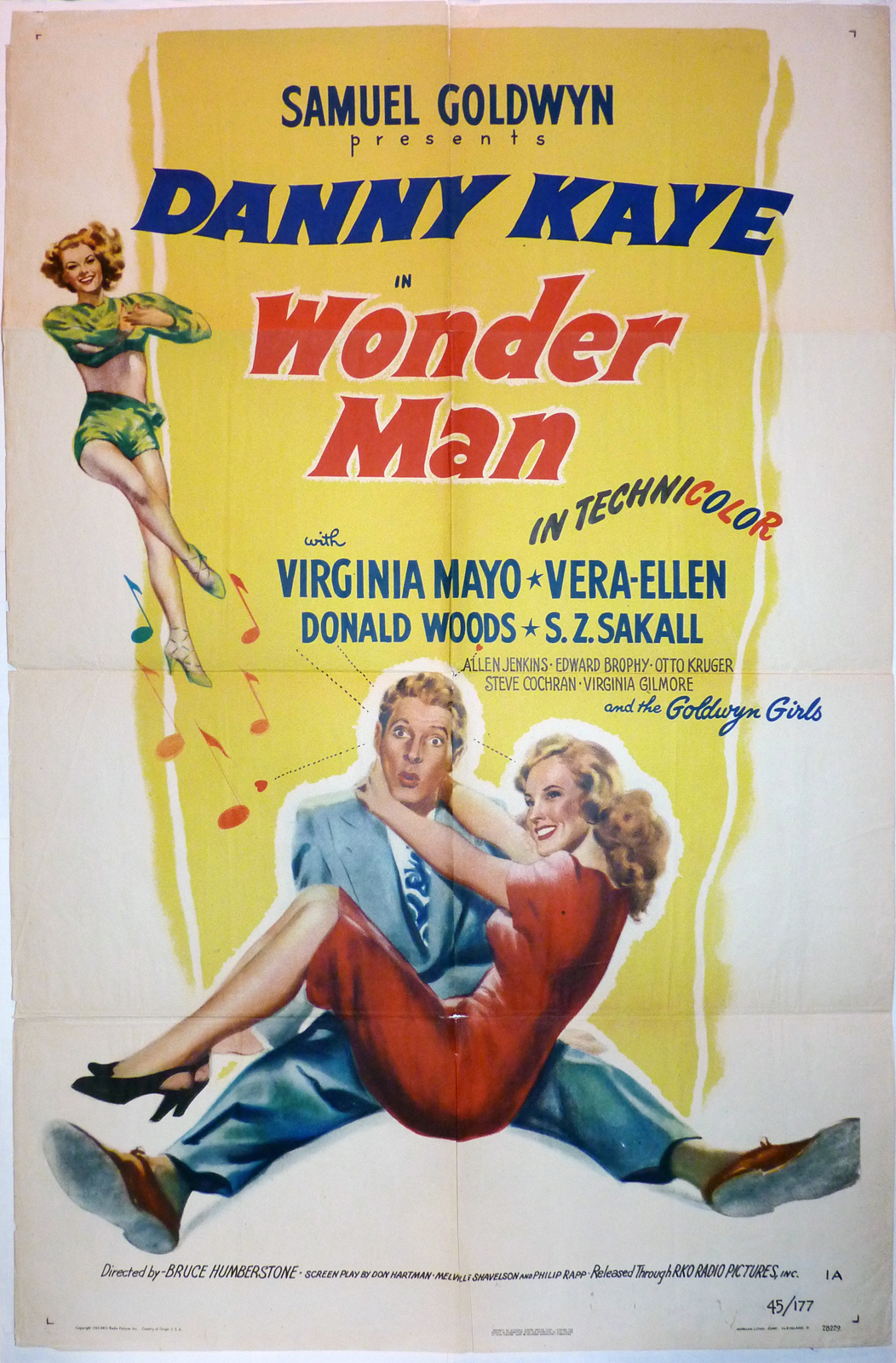
Wonder Man: Potato Salad Days!


It’s been said that our late loved ones are always with us, watching over us in the hereafter—but Danny Kaye takes the concept and runs with it in 1945’s supernatural RKO/Samuel Goldwyn comedy Wonder Man (WM)!  If you thought Danny was hilarious on his own, wait’ll you see him in the dual roles of famous nightclub star Buzzy Bellew and his brother Edwin Dingle!  As the Doublemint gum commercials, say, it’s double your pleasure, double your fun!

Directed by H. Bruce Humberstone (I Wake up Screaming, Sun Valley Serenade; several Charlie Chan films, among others), WM’s screenwriters included Up in Arms’ Don Hartman; Melville Shavelson from Kaye’s 1946 boxing romp The Kid From Brooklyn; Philip Rapp, creator of Fanny Brice’s Baby Snooks; Arthur Sheekman, gag writer for The Marx Brothers; and Jack Jevne, Eric Hatch, and Eddie Moran from Topper and Way Out West. If these fellas didn’t know their comic ghosts, I don’t know who would!  They say that too many cooks spoil the broth, but in this case, WM turned out to be a musical-comedy smorgasboard and a hip, hilarious, tuneful romp indeed!

From Borscht Belt tummler to Broadway star to multitalented movie star, Danny’s  secret weapon was Sylvia Fine, Danny’s brilliantly talented lyricist, composer, manager, and his wife from 1940 until Danny’s death in 1987.  Sylvia was truly the woman behind the man.  With her brilliant lyrics and wordplay, and Danny’s unbeatable talent and energy, they were an amazing power couple!

Sylvia & Danny:
They're so fine!
Danny’s first film, the 1944 service comedy Up in Arms, was a box-office hit. But with the theatrical release of WM in June 1945, Danny really knocked it out of the park—Brooklyn’s Prospect Park, that is!  As I’ve said in other TotED blog posts, as a native New Yorker, I enjoy watching movies where the action is set in any of New York City’s five boroughs.  I don’t even mind that WM was actually filmed at the Samuel Goldwyn Studios in California and not NYC, since the cast, writers, and sets all have that New York feeling (not to be confused with that Barton Fink feeling).  Even better, the cast includes Huntz Hall, one of our favorite Bowery Boys, as a young sailer who unwittingly gets entangled in the wacky, ghostly hijinks.

We viewers first meet Buzzy Bellew (Kaye) as the star attraction at New York City’s posh Pelican Club (what the world needs now are more affordable swanky nightclubs!  But I digress….).  The brash and brassy Buzzy is as likable as he is zany and hyper, likable, bursting with energy.  To borrow a line from Steve Martin back in his stand-up comedy days, Buzzy is a wild and crazy guy (in the most entertaining ways, of course)!
Enough bad news! Where's the sports page?
Buzzy and his Pelican Club co-star, singer/dancer Midge Mallon (dynamite dancer and former Radio City Music Hall Rockette Vera-Ellen in her movie debut, followed by The Kid from Brooklyn; On the Town; White Christmas, and so much more!) have been a couple for a long time.  Although it’s clear that Buzzy and Midge are both into each other, somehow the cute, talented couple never quite manage to actually get hitched at any of their attempted weddings.  But Midge is a good sport about it, perhaps because Buzzy is always funny, sweet, and apologetic—or maybe because their Pelican Club colleague Monte Rossen (Donald Woods from Watch on the Rhine; True Grit; The Beast from 20,000 Fathoms, and more), is a decent, patient joe who’s willing to wait until Midge finally comes to her senses and realizes the devoted Monte is a better bet when it comes to building a life together. 

*POP* goes the marriage proposal!
Buzzy and Midge are betrothed at last!
Ah, but Buzzy’s serious this time, giving Midge a jack-in-the-box attached to a diamond ring!  Vera-Ellen is adorable as Midge, and she and Danny have delightful chemistry.  And what a dancer she was!  Ironically, according to the TCM Web site, even though Vera-Ellen had a perfectly swell singing voice, her numbers were dubbed!  I guess it was like when Audrey Hepburn’s singing voice was dubbed by Marni Nixon for Breakfast at Tiffany’s and My Fair Lady:  they could sing, but apparently not quite well enough for the movies.  Go figure!

People can’t help loving Buzzy—except for notorious mobster, counterfeiter, and killer Ten-Grand Jackson (Steve Cochran, also making his film debut here)!  See, DA O’Brien (Otto Kruger of Murder, My Sweet; Saboteur; High Noon) and the Assistant DA (Richard Lane, best known to Boston Blackie fans as Inspector Farraday) needs Buzzy to testify in the murder trial, one of whose victims include one Choo-Choo Laverne, a fan dancer who was in the wrong place at the wrong time.  Our antic, overly optimistic entertainer is too overconfident to let New York’s Finest provide him with police protection—not a smart move for a high-profile witness in a murder case, especially when Ten-Grand has just been released on bail!

What's this? Inspector Farraday in league with Jules Amthor?!


Alas, Buzzy realizes too late that he should’ve taken advantage of that police protection, or at least taken the time to read those ominous newspaper headlines splashed all over the news.  Instead, Buzzy makes a fatal splash as Ten-Grand’s strong-arm boys Chimp (Allen Jenkins of Ball of Fire, but this time in funny-yet-sinister-villain mode, as he was in Lady on a Train) and Torso (Edward Brophy, ditto, as he was in The Thin Man and All Through the Night) send Buzzy to sleep with the fishes in Prospect Park’s lake. You have to hand it to the writers for being able to make cold-blooded murder funny without being depressing!

Onstage, Buzzy and Midge are on a Bali high!
Enter Buzzy’s twin brother Edwin Dingle (also played by Danny, natch), a quiet, bookish librarian and researcher.  Edwin and Buster (Buzzy’s real name) haven’t been in touch since young Buster ran away to try his hand at show business, rechristening himself as Buzzy Bellew.  Well, the Dingle boys are about to have a family reunion to catch up with each other, avenge Buzzy’s death, and put Ten-Grand Jackson behind bars for good—but that doesn’t mean ectoplasmic Buzzy won’t liven things up with merry, macabre hijinks along the way!  This isn’t Hamlet, you know! What’s more, romance is blooming between Edwin and his charming co-worker Ellen Shanley (Virginia Mayo, my favorite among Danny’s leading ladies since I saw her in The Secret Life of Walter Mitty).  Keep your eyes peeled for Natalie Schaefer—yes, Gilligan’s Island’s Lovey Howell herself!—appearing briefly and amusingly as a pesky patron of the local library who’s both bewildered and fascinated by Edwin’s ambidextrous abilities.  But Edwin’s date with Ellen takes a hilariously crackpot turn when Buzzy’s ghostly music gets Edwin all farshimmelt on the way to pick up potato salad for their dinner date, and…well, you may never look at deli food with a straight face again, especially with the hilariously frustrated S.Z. “Cuddles” Sakall as the deli proprietor!   Another highlight: Danny’s madcap sneezy rendition of the classic Russian song “Otchi Chornniya,” and the climactic opera that collapses into a side-splitting free-for-all!  Hey, wouldn’t WM and A Night at the Opera be a swell double-feature? 

I love a man who can cook and wear an apron with confidence!
Fun Fact:  In addition to WM, Steve Cochran and Virginia Mayo also co-starred in such Oscar-nominated and Oscar-winning classics as White Heat and and The Best Years of our Lives.  Cochran also co-starred in many of Chester Morris’ aforementioned Boston Blackie movies (a favorite here at Team Bartilucci HQ).  I love the charming chemistry between Kaye and Mayo!  WM was Virginia Mayo's first leading lady role with Danny; before that, she had a brief uncredited role in Up in Arms.

"You can lose your mind/
When brothers are two of a kind!"
Exasperated S.Z. Sakall is his usual "Cuddles"-some self! 
WM did very well indeed come Oscar time, winning for the Best Special Effects for John Fulton’s cinematography and A.W. Johns’ sound effects. Leo Robin and David Rose’s number for Vera-Ellen, “So in Love,” got an Oscar nomination for Best Music, Original Song, as well as Best Music Scoring for a Musical Picture, under Ray Heindorf’s direction.  But I can’t complain about  Heindorf losing, considering the Best Music Scoring Oscar that year went to another of my all-time favorites, Miklós Rózsa for Alfred Hitchcock’s Spellbound!   According to the TCM Web site, at one point in WM, Buzzy impishly slips his torso (no, not Edward Brophy’s character!) on a bust at Prospect Park, quipping, “What is this, trick photography?”  Definitely not “palpably inadequate!”  WM is one of  Danny Kaye’s very best movies!


Dead or alive, Buzzy sure knows how to make an entrance! Hiya, Bro!
Sailor Huntz Hall & pals are gobsmacked at Edwin's supernatural powers, courtesy of Buzzy!

All right, opera singer dame, give someone else a turn!

Aw, don't you just love a happy ending?


Monday, January 28, 2013

Review - Danny Kaye: King of Jesters

Danny Kaye was the first performer ever to be personally requested by His Highness to headline a Command Performance, making him King of Jesters and Jester of Kings—but as far as we of Team Bartilucci are concerned, he’s always been royalty in our book!  As longtime TotED readers know, I’ve been a big fan of Danny Kaye (1913—1987) since I was a kid. 

If you’re as much as a Danny Kaye fan as I am, author David Koenig’s latest book: Danny Kaye: King of Jesters (Bonaventure Press, 2012) is a MUST-read!  Koenig’s previous books include Mouse Tales: A Behind-the-Ears Look at Disneyland; and Mouse Under Glass: Secrets of Disney Animation & Theme Parks. He truly does Kaye justice with his affectionate yet clear-eyed view of Kaye’s long, remarkable career—a refreshing and welcome change of pace from certain other biographers who flaunt unfounded rumors about him, using un-called-for scandal-sheet tactics!  Koenig’s book focuses on Kaye’s film and TV work, and the behind-the-scenes info about the making of Kaye’s 17 theatrical films, as well as his TV shows, including his award-winning variety series The Danny Kaye Show (1963—1967).

Like so many great entertainers, the former David Daniel Kaminski was a native New Yorker, born in Brooklyn.  Back then, I was a child growing up in the Bronx in the early 1960s, seeing Danny Kaye for the first time on TV.  One weekend afternoon, WPIX was broadcasting Samuel Goldwyn’s delightful and surprisingly soulful 1947 film adaptation of James Thurber’s The Secret Life of Walter Mitty, and it quickly became one of my all-time favorite movies (and still is!).  Moreover, our mother was a Danny Kaye fan with a passion for fashion; in fact, Mom and my Auntie Joy had been models in their youth, getting opportunities to wear the fashions of designers like …Mitty’s Irene Sharaff, including fabulous hats, some almost as daring as the ones from …Mitty’s  “Anatole of Paris” number. Mom could rock a chapeau like nobody’s business!  Anyway, at home, our whole family often enjoyed Danny’s films, with their catchy music, clever slapstick, and zany wordplay, courtesy of the brilliant, talented woman behind the man:  the amazing Sylvia Fine, Danny’s lyricist, composer, manager, and in 1940, his wife for the rest of his life. The talented Sylvia was responsible for many of Kaye’s most popular songs and musical routines; no wonder Danny became my first celebrity crush, with him and Sylvia as one of my favorite show-biz power couples!

Actress and co-star Betty Garrett (On the Town; Neptune’s Daughter; TV’s Laverne & Shirley) recalled the chemistry between Sylvia and Danny when they met at the Sunday Night Varieties: “I was with Danny in the little Manhattan club when Sylvia was brought in to write some special material. I observed the magic moment when they discovered each other. It was truly love at first sight. I think they fell in love with one another’s talent as much as with one another.”


As Koenig says in his introduction, Wonder Man wasn’t merely the title of one of his hit movies. With his remarkable range, Kaye was versatile as all get-out, racking up triumphs in the worlds of records, television, stage and screen.  To some extent, the versatile, multifaceted Kaye was almost too good, at least from a branding standpoint!  Then as now, agents had to market their clients, but Kaye had so many talents and hooks, the powers that be apparently didn’t quite know where to start with him, as Koenig explains:

“…Kaye’s greatest obstacle to mass popularity was that he could do too much, too well.  He was impossible to classify. Without a brand, he found it difficult initially to make a name for himself and ultimately to keep that name remembered. For his most celebrated triumphs were live on stage, creating an in-person experience that could not be preserved to its full effect except in the memories of the individuals in the audience.  Film, as it turned out, was possibily the worst medium at capturing a Danny Kaye experience—trapping him in a particular character and story, awkwardly trying to show off as many of his divergent talents as possible…Nonetheless, the motion picture is entertainment’s most faithful time capsule, and consequently, offered Kaye his best-remembered roles: the storyteller Hans Christian Andersen, the daydreamer Walter Mitty, and the tongue-tied Court Jester with the vessel in the pestle.  Or was it the flagon with the dragon?”

Danny Kaye and frequent co-star Virginia Mayo
When Danny signed with his first agent, Harry Bestry, in 1937, he'd developed a “Mad Russian” character, to introduce a thickly-accented version of the song “Dinah” (“Deenah, is there anyone feenah/In the state of Caroleenah?”)  Bestry began marketing Danny as The Mad Russian. This character was also spoofed in Warner Bros’. Looney Tunes: the hilarious 1945 short Book Revue (a.k.a Book Review), directed by Bob Clampett.  How fitting, considering Danny’s comedy was broad early on, from his years as a tummler in the Borscht Belt. As you can well imagine, Kaye had audiences in stitches with his over-the-top accents, screaming, and facial contortions.  How could anyone not laugh?

According to the IMDb, although Danny made his Broadway debut in Straw Hat Revue (1939), it was the stage production of the musical Lady in the Dark (1940), starring Broadway superstar Gertrude Lawrence, that brought agents flocking to Danny’s door at last.  Sylvia helped create the routines and gags, and wrote most of the songs that he performed. Danny could sing and dance like many others, but his specialty was reciting those tongue-twisting songs and monologues.. Danny could sing and dance like many others, but his specialty was reciting those tongue-twisting songs and monologues.


Koenig goes on to say that Samuel Goldwyn had intended to use Kaye as a new Eddie Cantor. Goldwyn did end up hiring Thurber to contribute to the script, but most of his suggestions were ignored. The ones that were used justifiably got the boot (and I don’t mean the film’s villain!), including a melancholy Irish daydream and lots of small talk between Mitty and his dreary so-called loved-ones. I'd heard that other …Mitty scenes left on the cutting-room floor included a pub scene (meant as part of the Irish scene, perhaps?) included a scene with our hero dealing with a Frankenstein monster (to play off co-star Boris Karloff, maybe?), or something like it!

Then there was the epic comedy The Court Jester (1956), now justifiably hailed as a classic. It was well received upon its original theatrical release, but it ended up being so expensive to produce that it seemed doomed to lose money—sheesh, it’s always something! Even more frustrating, Kaye’s star had begun to fade, since he’d  been off movie screens for two years, albeit for humanitarian reasons:  he’d been traveling the world for UNICEF (more about that shortly).  Luckily, time has been kind; over the years, The Court Jester started to turn up frequently on TV and on Blu-Ray and DVD, getting discovered by new audiences who love to laugh.


Danny enjoyed appearing onstage, but seemed uncomfortable doing interviews, talk shows, or other promotional work on his days off; to be fair, who can blame him?  Still, by the early 1950s, his agent thought he needed better rapport with the general public.  Fate stepped in on a jet plane, where Danny found himself sitting next to the head of UNICEF. Their work helping the impoverished children of the world touched Danny deeply. He agreed to travel to promote the organization, and did so tirelessly for the remaining 32 years of his life. 

Furthermore, earlier this month, TCM celebrated Danny Kaye’s 100th birthday (give or take a year) with a 24-hour marathon of virtually every one of his classic movies, hosted by Robert Osborne and Danny's journalist daughter Dena Kaye, as well as airings of The Danny Kaye Show and a 1968 episode from his stint on The Dick Cavett Show.  Dare we hope there might also DVD/Blu-Ray editions of Kaye’s classic films in the near future, too?

Click here to read John Greco's great Twenty-Four Frames interview with author David Koenig!

Coming Soon to TotED: Wonder Man!
Enjoy the Looney Tunes cartoon "Book Review" playfully spoofing Danny Kaye!

Saturday, January 19, 2013

Saluting our Real-Life Auntie Mame


Auntie Joy and Mom in Florida, 2007
Auntie Mame has done it all!  Author Patrick Dennis (pseudonym of Edward Everett Tanner III)  took irresistible, unforgettable Mame Dennis’ fictional exploits, inspired by Dennis’ own free-spirited aunt, Marion Tanner, and let them happily run amok in every form of storytelling, including Dennis’ original 1955 novel and its sequel, Around the World with Auntie Mame as well as:
  • The 1957 Broadway stage hit Auntie Mame, earning a Tony nomination for leading lady Rosalind Russell and a Tony Award for Best Supporting Actress Peggy Cass as naive stenographer Agnes Gooch;
  • The 1966 Broadway musical hit Mame, starring Angela Lansbury and Beatrice Arthur, with both actresses winning Tony Awards. The show  was adapted for the stage by Jerome Lawrence and Robert E. Lee;
  • And of course, the Oscar-nominated 1958 Warner Bros. film version of Auntie Mame!  Broadway.com reports that Oscar-winner Tilda Swinton (Michael Clayton) is working on a new film version!
  • 1974 brought us the Warner Bros. musical version, Mame (1974), starring Lucille Ball. It was a mixed bag at best,but that didn’t stop Mame from becoming a box office hit at Radio City Music Hall, where I saw it with my Girl Scout Troop.  I guess it just goes to show that some movies are bulletproof, especially with Jerry Herman’s wonderful musical score (like Mame's "Bosom Buddies")!

But in a way, I feel like I’ve always known all these versions of Auntie Mame so well, because our family had our own real-life Auntie Mame:  our beloved mother, Jacqueline Tenore Kehoe (1927—2009), or “Jackie,” as friends and loved ones called her.  No doubt you’ve already realized this post is as much about Mom as it is about the classic 1958 movie!  With Mom’s warm, loving, colorful, multifaceted personality, we’ve enjoyed many memorable family anecdotes about her exploits and her overall amazing life, including this one (click here). 

Enter the Dragon! Patrick and Norah
find Auntie Mame in Asian mode
Patrick meets Auntie Mame's spectacular coterie!
Mame wigs out when Babcock makes a surprise visit!
On January 22nd, 2013, our family will commemorate what would have been Mom's 86th birthday.  Those who knew and loved Mom can attest that she was strong, stylish, and mesmerizing, yet also kind, warm, and witty in the great Cherry Girl tradition. Yes, Cherry happened to be the maiden name of Mom and her sister, our late Auntie Joy (they died a few months apart from Pulmonary Fibrosis).  And yes, The Cherry Girls were equally smart, witty, and soignee, as well as being Auntie Mame fans.  In their teens, Mom and Auntie Joy were sometimes the subject of racy jokes about their surname from those naughty boys—but of course, the Cherry Girls would glide past those insolent youths without a second thought!  Mom and Auntie Joy also loved Auntie Mame on both stage and screen.  As my cousins and I grew up (variously in New York and Wilmington, Delaware), Mom and Auntie Joy were both dubbed “Auntie Mame” at various times.  With both the Cherry Girls gone now, but by no means forgotten, I sometimes wonder if Mom and Auntie Joy each thought the other was the Vera Charles of the pair!  For more about Mom’s fond, funny life and times, feel free to check out my salute to Mom and the movie that became her favorite during the last two years of her life, The Coen Brothers' No Country for Old Men:

http://doriantb.blogspot.com/2011/01/no-country-for-old-men-tell-mother-i.html

In a delightful parallel to Mom, even Auntie Mame’s kaleidoscope opening credit sequence is perfect in showing how multifaceted Mame Dennis is, just like our mom.  The music by Bronislau Kaper (Whistling in the Dark; Gaslight; Them!) is perfect, sprightly yet swanky. And who could bring the lives and times of such real and fictional characters as Mame Dennis and our real-life Cherry Girls better than Betty Comden and Adolph Green?  Comden and Green, both fellow native New Yorkers (Betty was from Brooklyn, Adolph was from The Bronx) were legendary for their hit musical comedies such as Singin’ in the Rain; On the Town; Bells are Ringing; Applause; Wonderful Town; and so much more.  However, Comden and Green adapted Auntie Mame as a straight comedy for the movie version, and it was as sparkling and delightful as if it were indeed a musical.  I like the theatrical way the film’s scenes fade out on Rosalind Russell’s face just like on Broadway.  For those who thought Comden and Green were husband and wife, sorry—they were only good friends and collaborators, both happily married to others.  Even Mom had been sure Comden and Green were a married couple!

Onstage, Mame's jewels go jingle-jangle-jingle!
Peachy-keen Mame in Georgia!
Superstar Rosalind Russell’s long, triumphant career ranged from her 1934 film debut in Evelyn Prentice (co-starring William Powell and Myrna Loy, though this was definitely not a light-hearted comedy-mystery a la The Thin Man!) to her final role in the made-for-TV 1972 mystery The Crooked Hearts.  Russell was nominated for four Oscars in addition to Auntie Mame: My Sister Eileen (1942); Sister Kenny (1946); Mourning Becomes Electra (1947).  Russell won plenty of Golden Globe Awards, though, for ….Electra; Sister Kenny; A Majority of One (1961); Gypsy (1962); the Jean Hersholt Humanitarian Award in 1973.

Good thing Patrick brought Auntie Mame's copy of
Riding Side-Saddle on Horseback for Dummies!
Patrick Dennis’ beloved fictional heroine walked into my life one rainy day when my family and I happened to be watching the 1958 movie version on TV on one of our local movie programs (on WPIX, if I recall correctly).  We were all delighted by the warm, funny film about the irrepressible Mame Dennis, with Russell reprising her Broadway triumph. Sitting there enjoying ourselves, we kids affectionately dubbed Mom “Auntie Mame.” In particular, Mom was pleased as punch when I said, “Mommy, she’s like you, only you’re even prettier.”  High praise, considering Rosalind Russell was stiff competition (no, I don’t mean Auntie Mame’s morning sidecars)!
Foxy Auntie Mame wins Beau's heart, and Patrick has a dad!
Auntie Mame’s zany yet tender saga ranges from the days of bathtub hooch and the Charleston, through The Great Depression, the 1940s and the 1950s.  We first meet young Patrick Dennis (Jan Handzlik, reprising his Broadway role) at the tender age of  9, coming to 3 Beekman Place with his adult companion Norah Muldoon (Connie Gilchrist of A Letter to Three Wives; Long John Silver; Song of The Thin Man; and many TV appearances) to live at Auntie Mame’s luxurious (and constantly changing) pad  after his dad dies unexpectedly. It’s one of Mame’s wild parties, but she makes them feel at home right away, with Mame’s fabulous coterie of wild-and-crazy yet likable Bohemian types. Patrick jumps into life with Auntie Mame feet-first, bless him.  I like the kid's willingness to go with the flow of Auntie Mame’s cheerful screwball antics, trying new foods and such, unlike many modern kids. Maybe kids were less finicky back then. (Can you tell I’m the mother of a finicky yet adorable kid?)  I love when Patrick reads from Auntie Mame’s list of new words to learn:  “‘Karl Marx.’  Is he one of The Marx Brothers?”  Although young Handzlik was talented and endearing in the role, he eventually dropped out of acting completely, and grew up to be a successful law partner at the renowned law firm of Kirkland and Ellis in Los Angeles, where he's a specialist in white collar crime.  He's  been listed several times in Who's Who in America. (Kids grow up so fast!)  I’m glad to hear Handzlik didn’t become one of those child actors who came to a tragic end— but I digress!
At Peckerwood, Mrs. Burnside is not to be sneezed at!
But Mame and Patrick’s happy household is in jeopardy when The Great Depression wreaks havoc on the nation.  A battle of wills begins between our heroine and Patrick’s trustee, Mr. Dwight Babcock (Fred Clark, one of the masters of the slow burn, deft at playing everything from a vicious villain in Ride the Pink Horse, to comic foils in Bells are Ringing, as well as many TV classic sitcoms).  Mame’s longtime friend, stage star Vera Charles (Coral Browne of Theatre of Blood; The Roman Spring of Mrs. Stone; The Ruling Class. She was also Mrs. Vincent Price!) lands Mame a small role in her new play, Midsummer Madness, to earn money to get Patrick back. (Mame’s name is dead last and in teeny-tiny letters on the theater poster; gotta start somewhere!) Mame's jangly jewelry infuriates Vera, but wreaks hilarious havoc for us viewers. But Rosalind Russell wasn’t the only scene-stealer.  Look and listen very carefully to the actors onstage, and you’ll recognize Margaret Dumont of The Marx Brothers fame!  Nobody looks and sounds as much like Margaret Dumont as Margaret Dumont, by golly!

A tip of the hat to Mom & all us Cherry Girls!
Russell and young Jan Handzlik reprise their Broadway roles here, and you can’t help loving the mother-and-son-style bond between Auntie Mame and the “little love” she takes under her wing, eager to open new windows for her nephew after his dad’s death. It’s soon clear that Patrick’s late dad wasn’t exactly the “open new windows” type, but the endearing lad quickly takes to Auntie Mame’s joyful approach to life. I know Patrick’s dad died of a combination of too much exercise and arrogance, but I’ve always wondered whatever happened to Patrick’s mother?  Did the poor dear woman die of Old Movie Disease?  By the way, that’s director Morton DaCosta (The Music Man) playing the voices of both Edwin Dennis and “Manny, Moe, and Jack” of Pep Boys fame during the Christmas scene.

Invasion of the Patrick Snatchers?!  Oh noooo!!!


Peggy Cass thinks it's hilarious to tell the truth!
I love the wonderfully theatrical fade-outs with Rosalind Russell; very appropriate, since the book became a Broadway hit, and then, of course, a hit movie!  I especially love Auntie Mame’s priorities.  Her response to her publisher beau Lindsay Woolsey (Patric Knowles of The Adventures of Robin Hood as Will Scarlett; The Charge of the Light Brigade; Another Thin Man) makes me smile when he suggests they marry. Mame replies:  “How can I be a wife?  I’m too busy being a mother.”  I also like the irony that Patric Knowles was a bookbinder in his youth, and went on to play a publisher in Auntie Mame!  Knowles also has the funniest double-takes when responding to Mame’s wacky wit.  Other members of the Broadway cast  (at the Broadhurst Theatre, appropriately enough) include Yuki Shimoda (Career; A Majority of One; the British TV series A Town Like Alice) as playful houseboy Ito, and Peggy Cass as Mame’s “Boswell,” the hapless but lovable stenographer Agnes Gooch who, to borrow a lyric from Bye Bye Birdie, finds herself with a lot of living to do, getting a Best Supporting Actress Oscar nomination in the bargain. Cass’ long career also included one of Vinnie’s favorite game shows, To Tell the Truth! 

Brian O'Bannion approves of Agnes Gooch's' makeover!
Mame, Patrick, Ito, and Norah end up having a Merry Christmas after all when her goof at her Macy’s salesgal gig results in love and marriage between kind-hearted Southern oil millionaire Beauregard Jackson Pickett Burnside (Forrest Tucker of The Yearling; Boston Blackie Goes Hollywood; TV’s F-Troop).   Soon the family are off to Peckerwood, Beau’s family ancestral home.  It’s The Big Apple vs. The Georgia Peaches! But if Mame can’t outsmart them, nobody can.

With rakish memoir-collaborator Brian around,
will Mame become a merry widow?
When Beau is accidentally (albeit in a dark comedy way) killed on the Matterhorn, the now-adult Patrick comes home from college to help, and he’s engagingly played by 1950s/1960s heartthrob Roger Smith (Man of a Thousand Faces;  TV’s 77 Sunset Strip; *snap snap*; and the TV series version of Mr. Roberts. He’s also Ann-Margret’s husband of many years).  Patrick suggests this would be a great opportunity for Auntie Mame to work on her memoirs.  He hires poet Brian O’Bannion (Robin Hughes from Dial M for Murder as Police Sgt. O’Brien; Cyrano de Bergerac; and many TV series episodes, including an episode of 77 Sunset Strip!)  With Beau’s death and Brian’s brooding Irish charm asserting itself (and eating them out of house and home; good thing Mame can afford this chowhound!), Patrick is starting to feel jealous, making him susceptible to Mr. Babcock, or as Patrick has begun to call him, “Uncle Dwight.”  Yikes, brainwashing!  Under Babcock’s influence, will Mame’s “Little Love” wind up a Babbitt, an “Aryan from Darien”?!  Would Auntie Mame let that happen? As if!


Patrick Dennis, the gent
behind the woman!
In her wily yet ultimately helpful way, Mame tackles snobbery, stupidity, and bigotry in the form of Patrick’s  beautiful but dreary fiancée Gloria Upson (actress-turned-writer Joanna Barnes, from both the 1961 and 1998 versions of The Parent Trap) and Gloria’s jolly yet equally dreary parents Doris (Lee Patrick, so memorable as Sam Spade’s Girl Friday Effie Perrine in The Maltese Falcon) and Claude (Willard Waterman, who deftly filled in Harold Peary’s shoes as The Great Gildersleeve on Radio and TV from 1950 to 1955).  Don’t get me started on the Upsons’ recipes for the clam juice-and-peanut butter ground-meat hors d’oeuvres, not to mention Claude’s diabetes-inducing daiquiri recipe; makes me glad I’m a teetotaler! 

Peggy Cass won the 1957 Tony Award for Best Featured Actress in a Drama for Auntie Mame, and she reprised her scene-stealing role in the film.  As an understudy, Cass took Jan Sterling’s role in a national tour of Born Yesterday.  Cass was finally cast in her own right in the 1949 Broadway musical Touch and Go. The mid-1950s brought her the defining role of Agnes Gooch in Auntie Mame.  Her stage and screen performances earned her a Tony and a Best Supporting Actress Oscar nomination. Of course, my quiz show-loving husband Vinnie first knew of Cass from her regular television quiz show appearances, such as Password All-Stars and To Tell the Truth, as well as guest appearances on Alfred Hitchcock Presents and The Phil Silvers Show, among others. The IMDb adds, “She was very smart and very funny, but her signature was her unmistakably raspy voice.” (Which I’ve always liked, by the way!)  Sadly, Cass died of heart failure on March 8, 1999, at Manhattan's Sloane-Kettering Hospital, but for her fans here at Team Bartilucci HQ, Peggy Cass’ delightful performances on stage and screen live on!

Actual dialogue from Auntie Mame:
Secretary Pegeen Ryan (Pippa Scott of The Searchers) and adult Patrick discuss Mame's Danish designer.
Pegeen: "It's by the famous Danish designer Yul Uhlu."
Patrick: "Who?"
Pegeen: (slowly, with innocent yet sensuous lips): "Yul Uhlu."
Patrick:"Say that to the right fella and you'll get kissed."

I bet the Upsons think Mame is serving fish for dinner!

And what became of author Patrick Dennis in later years?  Well, according to Wikipedia, he led a double life:  conventional husband and dad by day, bisexual man-about-town by night.  In later life, Dennis became a well-known participant in Greenwich Village's gay scene. Sadly, Dennis' rollicking tales fell out of fashion in the 1970s, and all of his books went out of print. In his later years, he left writing to become a butler—and he liked it!  In fact, Dennis  worked for McDonald’s founder Ray Kroc!   Apparently, although he was finally using his real name, Dennis was in essence working yet again under a pseudonym, since his boss hadn’t a clue that their butler, Tanner, was the world-famous author Patrick Dennis!  I wonder if Dennis thought it was a hoot to play butler after all his escapades?

Alas, Dennis died of pancreatic cancer in Manhattan in 1976 at the age of 55.  But a memorable character can never truly die:  the 21st century has gotten Auntie Mame and Patrick new young readers and movie buffs interested in Auntie Mame’s exploits — HOORAY!  With many of his novels available in print again, Dennis’ son, Dr. Michael Tanner, wrote introductions to several reissues of his dad's books, as well as some of Dennis' original manuscripts at Yale University and Boston University.

And remember Auntie Mame’s wise advice:
"Live!  Life is a banquet, and most poor suckers are starving to death!"

Tuesday, January 1, 2013

On How Crime Does Not Pay - Even in the Movies

Team Bartilucci's hubby half, Vinnie Bartilucci, is in the spotlight this time, with one of our favorite genres, Heist movies!  Take it away, Vinnie!
Heist movies have been around as long as movies.  The Great Train Robbery was one of the first films, made in 1903, a staggering twelve minutes long.  And for almost all of that time, until the Seventies at least, the rule was that the criminals could not get away with their gains. They'd be caught, shot, betrayed, done under by their own greed, or some combination of the above. The idea was all based around what we now call "Imitable Action," what they analyze children's TV shows for. The idea is if something looks cool, people will try to do it. We claim that's a lot of flummery, but about 47% of YouTube videos put the lie to that.

Even Alfred Hitchcock, on his classic TV show Alfred Hitchcock Presents, was forced to add codas to his stories that revealed that no matter how perfect the murders or crimes were, the miscreants were found out after the cameras stopped rolling.   Sometimes they were witty epilogues, like the one in the classic Lamb to the Slaughter, but more often than not they were almost throwaway, half mumbled, "Of course they were eventually found out and convicted for their crimes" that almost ended with a wink. That rule about The Guilty Must Suffer was all but inviolate.

Heck, even in The Treasure of the Sierra Madre, they couldn't get the money, and they didn't even STEAL it. All they did is get greedy, and it was only ONE of them. One almost gets the impression that the message trying to be hammered home wasn't "Don't steal," but "Don't try to better yourself, stay in your place."  But of course, that would be excessively paranoid, wouldn't it?

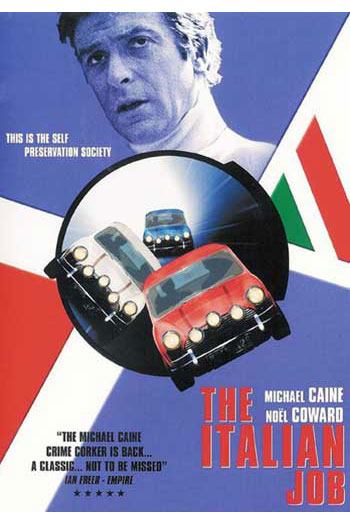
Come the Sixties, we started to see a subtle shift to the Caper Movie; the planning was much grander, and the payoffs larger than ever. Instead of a mere carefully-planned bank robbery or some such, we'd see a meticulously organized break-in, or perhaps a complicated con job. Plans so outlandish and daring that you want them to get away with it out of sheer respect.   But still that rule had to go and piss on the fish. They came up with a new twist, though; the caper-planners might be able to avoid incarceration, but they could still never get away with the money. So in the original Ocean's Eleven, the money gets burned up as carcinogenic co-conspirator Tony Bergdorf  (Richard Conte) gets unexpectedly cremated. Michael Caine and the gang from The Italian Job get placed in a deadly balancing act with the escape bus teetering on the brink, with the lovely lolly at the far end over the cliff. Every time they try to creep forward to grab it, the bus CREEEEKS precariously forward. I always thought this ending was what was being tributed at the end of Guy Ritchie's Lock, Stock and Two Smoking Barrels. Even my beloved Fitzwilly couldn't get away with the money, no matter how benevolent his reasons.

The Wife analyzed Topkapi a few months back, another example of a cast that you really want to see get away with it, but simply can't. We admire and  appreciate the work of the mastermind of a fine caper, and enjoy watching the exploits of such films come together, as much as we hate watching them fall apart at the end.

The more outlandish the capers got, the more you wanted them to get away with it. They tried everything - they made the miscreants likable, even noble. Two films with somewhat similar capers were also forced to slap on the ironic punishment.  1967's Who's Minding the Mint? (available from the Warner Archive) put Jim Hutton (TV's Ellery Queen) in a position where he's forced to break into the mint to print off legal tender to make up for an accidental destruction of fifty thousand dollars to avoid incarceration.   Long story short, it balloons into printing millions of dollars, and results in a goddamn brilliant madcap comedy. But again, they can't possibly be allowed to get away with the money, so it accidentally gets picked up as trash, leading to a mad chase across town to catch up with the garbage truck before the money is dumped on a barge and lost. This being one of the cases where the crime was for a good reason, enough is salvaged to save Jim's bacon, but no more. At least in this case, they added a coda to suggest they might yet succeed, as over the closing credits, the cast is in scuba gear, heading down to try to retrieve their surreptitious spondulix.  Another house favorite, Gambit, has a similar "Maybe it's not too sad an ending," where while Michael Caine won't benefit from his crime, another cast member might.

Ocean's 11 (1960)
A year later, Seven Times Seven was released in Italy with the same crime - break into the Mint and print a bunch of cash. This one was a bit more complex - the plotters were in prison, so they would have to break OUT of prison, INTO the Mint, then back INTO prison, wait out their sentences, and pick up the cash when they're released. The big soccer final gives them a perfect opportunity, as the guards' eyes will all be glued to the TV, and only occasionally to the security monitors. So a film loop of the convicts milling around the common area will suffice for their cover. It goes pretty smoothly, even with a last-minute reprieve at the end, and they make it back in time.   But of course, The Guilty Must Suffer, so when they go for the money after they're all released, it turns out they used the wrong ink in the printing, and it's faded, rendering the bills worthless. Now one could ask why they had fading ink in the Mint, but that would just confuse things, wouldn't it? It also had a damn fine theme tune.

Ocean's 11 (2001)

It wasn't for some time that the film industry decided there were some cases where it was okay to see the caperists get away with it. Maybe they're really doing it as part of a larger benevolent action like The In-Laws, or they're stealing from a bad guy like in The Sting, or in the case of the remake of Ocean's 11, someone whom we've been educated is just Not Nice. The rise of the antihero helped this along, where we're supposed to like the bad guy, so theoretically that helped. One could argue that the desire to see the bad guy win had been there for years - John Dillinger and Bonnie & Clyde were folk-heroes at the time they were in action, on and off the screen. But on the whole, people just like to see people get away with it, especially if, as mentioned, they're stealing from a person or organization that is deemed "bad". Brett Ratner's recent Tower Heist was better than the attention it got, and is worth a look on cable. And while I didn't get a chance to see Robot and Frank, everything I've heard suggests I should.

I've mentioned before how much I look forward to the return of the Gentleman Bandit genre. George Clooney's version of Danny Ocean is very close to that; I've often said I think Will Smith could do a great Raffles. Combined with an outlandish Caper Plot, a new Raffles film could burn up the box office.