Wednesday, August 14, 2013

Happy Third Anniversary to TALES OF THE EASILY DISTRACTED!

As The Flintstones would sing: "Happy Anniversary, Happy Anniversary, Happy Anniversary, HAAAAAPY Anniversary!"  All of us here at Team Bartilucci HQ are stunned, amazed, and delighted that on Sunday, August 22nd, 2010, Tales of the Easily Distracted was born!

Fred, Wilma, and Pebbles are still fine-tuning the wheel, so we're celebrating with the ever-soignee, sweet, and snappy Nick and Nora Charles!  And what a year this alone has been! Here's the highlights so far:


* I've been elected as Chairwoman of the Board of the CMBA with my fearless co-leaders Page, Marsha, Lara, Patty (I haven't forgotten anyone, have I?  There's a reason my blog is titled Tales of the Easily Distracted, so please forgive me if I've unwittingly left anyone out!)

* My pal and fellow Blogger R.A. Kerr (Ruth to her pals) of Silver Screenings teamed up with me for the Mary Astor Blogathon from May 3rd through May 10th, to resounding success!

* I also contributed a blog post for another of our pals and fellow Bloggers, Jo Gabriel of The Last Drive-In and Goregirl's Dungeon for the William Castle Blogathon.  My post was the hilarious horror-comedy The Spirit is Willing.

Thanks a million  for being wonderful friends, readers, bloggers, and awesome people overall, everyone!

Friday, August 2, 2013

William Castle in Duo-Vision! The Spirit is Willing and ZOTZ!


This post is part of the William Castle Blogathon, hosted by The Last Drive-In and Goregirl's Dungeon, running from July 29th through August 2nd, 2013!  Enjoy! 

With all the horror and suspense in William Castle's filmography, we of Team Bartilucci thought it'd be neat to feature two of the gimmick-meister's comedy turns for the Blogathon—especially, as Vinnie so sagely pointed, out: "Mr. Sardonicus is probably already taken."

When my talented friend and fellow film blogger Jo Gabriel of The Last Drive-In invited me to take part in the William Castle Blogathon with her fab co-host Patti of Goregirl’s Dungeon, I admit I was a little nervous at the prospect, because horror movies usually send me to The Coward’s Corner, scaredy-cat that I am.  But when my Pal Joey recommended Castle’s 1967 comedy-thriller The Spirit is Willing (TSIW), I knew I was in for a frightfully funny good time!  Besides, Castle’s own come-on come was irrisistable, too:  “Kiss-Hungry Girl Ghosts Looking for a Live Lover in a Haunted House of Mayhem!”  Brava on a great choice, Jo—beaucoup thanks!

But first, a bit of background:  William Castle was born in 1914 as William Schloss in New York City (I’m always glad to see my fellow native New Yorkers making good!).  Sadly, Castle’s parents each died fairly young, leaving the boy an orphan.  Even then, young Castle knew how to get noticed:  a dexterous lad, little Billy wowed the other kids by taking his legs and putting them behind his neck, earning the nickname “Spider Boy.”  The kid became an applause junkie! His chutzpah took him far; for instance, he kept  renowned German actress Ellen Schwanneke from being forced or tricked into a German film festival that would have trapped her among the Nazis forever, thus combining patriotism and ballyhoo—and a tall tale or two!  Yes, that was all young Bill Castle’s idea to get publicity for the show, even going so far as to paint swastikas on the theater, then denouncing the Nazi swine trying to muzzle free speech!


Castle’s clever ploy grabbed the attention of the notorious and powerful Harry Cohn, head honcho of Columbia Pictures.  He was impressed by Castle’s youth and eagerness, so he hired Castle as a dialogue coach—before he even knew what a dialogue coach was supposed to do!  Now there’s an eager beaver, considering that in the 2007 documentary Spine Tingler! The William Castle Story, fellow director Budd Boetticher described Cohn as “probably except for Hitler and Mussolini, the most frightening, despicable man you ever saw in your life.”  But surprisingly, Cohn took a shine to young Castle’s enthusiasm and determination—go Bill!

Castle directed his first film at Columbia Pictures with the 1943 Boston Blackie adventure The Chance of a Lifetime.  Talk about a good omen!  Then Castle bought the film rights to the mystery novel If I Die Before I Wake.  Castle took it to his old pal Orson Welles to direct—and Welles took the book to Cohn without him!  Sure, Bill was irked, but ultimately decided working with Welles as his Assistant Director was still a darn good place to start.  Besides, Castle found himself learning plenty from working with Welles, including a taste for expensive cigars, and making sure that when Castle himself became top dog, he’d make sure his name was on the picture—and so it was!  Even more important, the Castle Family was lucky to find themselves in a longtime loving marriage and a great family life, which is more than many other filmmakers can say!


 And so, Team Bartilucci's double-feature begins!

The Spirit is Willing (1967) - Behind the ghastly green door

Bizarre love triangle!
Accompanied by Vic Mizzy’s sprightly, playful score, the prologue of TSIW opens in 1898 with Captain Ebenezer Twitchell (Robert Donner), who’s just recently rescued an important cargo and survived a mutiny to boot.  (Call me cynical, but I wonder if Ebenezer somehow did something to make the crew mad!)  His client (Nestor Paiva) wants to give Ebenezer all kinds of riches and land—including  the boss’ unmarried daughter, Felicity  (Cass Daley).  Unfortunately for Ebenezer, poor plain whinnying Felicity is what Webb Wilder would describe as "un-voluptuous."  Still, she’s rich, available, and  looking forward to her wedding night—until she discovers that Ebenezer finds lovely housemaid Jenny Pruitt (Jill Townsend  in the first of her three roles) to be much more his type, and the feeling is mutual with Jenny.  Too bad romance and adultery don’t mix harmoniously, especially when Felicity makes her point with sharp cleavers!

But love never really dies, especially in a William Castle movie with a wicked sense of humor like this one.  The credits sequence show decades of the ghosts of Felicity, Captain Twitchell, and Jenny wreaking deadly havoc on unsuspecting renters over the centuries.  Too bad these folks apparently couldn’t afford less lethal accommodations; if only Hotel.com had been around back in 1967!  Still, that cheeky Addams Family-style opening credits sequence is drolly entertaining. If only the Internet had been around back in 1967, our heroes could have scrammed pronto and saved themselves a lot of funeral expenses! 

Sure, we wanted fresh air, but enough already!
Now it’s a whole new decade (1967, the year TSIW was released).  The Powells, a new family of would-be victims from New York City (my hometown!), arrives to rent this charming New England seaside cottage on their summer vacation. Let the supernatural screams of horror and hilarity begin, in a nutzoid take-off of The Haunting and other classic supernatural thrillers!  Despite Mama Kate (Vera Miles) assuring Papa Ben (Sid Caesar) that his boss simply recommended the vacation because of Ben’s bad back.  I bet it’s like in Rear Window: Ben sounds like the kind of guy who’s just too valuable to his magazine to fool around with!  Nevertheless, worrywart Ben is convinced that instead of enjoying a vacation, he’s actually about to be fired from his long-time writing gig in The Big Apple, fretting, “They haven’t changed my typewriter ribbon in months…Twelve years on a job, you think you’re doing great, and all of a sudden (Ben snaps his fingers), you get a vacation!”  (To be fair, most of us native New Yorkers have often felt paranoid that way, too!)  Well, maybe the sea air and the quaint villagers will relax him, with their part-beatnik/part Irish sports clothes—“when in Rome,” and all that jazz! 

Gloria Tritt sure knows how to
roll out the red carpet for guests—blood-red?!
The frightful fun starts as soon as they step inside, with local denizen and cleaning woman Gloria Tritt (Mary Wickes)—who almost accidentally clobbers the Powells!

Gloria:“I wasn’t expecting you till later.”
Steve: “Who are you?”
Gloria: “I’m the cleaning woman.”
Kate: “Have you ever tried using a broom?”
Ben, Kate, and their teenage son Steve (Gordon) opt for the New England rental.  Oh, that poor unsuspecting family!  Steve’s already bummed-out  and a tad surly because this New England trip is a drag for him without his city pals:
Steve:  “I didn’t ask to be born.”
Ben: “You’ve asked for everything else!”

Still, Ben and Kate look forward to some romantic “couple time” together on this trip. I must say that even with the encroaching ghosts, possible employment worries, and Ben’s back problems, Caesar and Miles really do make an unexpectedly sweet and sexy screen couple in their love scenes!  Even with the traditional NYC-style yelling and kvetching, you can see this family really does care about each other.

But these ghosts aren’t just any old poltergeists:  they’re ectoplasmic squatters.  What nerve!  Ebenezer, Jenny, and Felicity are vindictive little imps, and they’re taking their anger out on young Steve—the poor kid’s being framed!  Well, at least now Steve has a good excuse to be an “angry young man! “ Even when Steve gets to spend a night on a yacht with the family's rich, pompous Uncle George (John McGiver), a toilet bowl tycoon, those ornery ghosts turn out to be good swimmers, too!  Ghosts continue to literally haunt Steve everywhere, from land to sea. The kid can’t even ditch the ghostly trio in the sea when he gets a part-time job underwater salvaging Uncle George’s luckless yachts  to earn money (Steve’s saving up for a car)! 

Luckily, Steve finds allies with the locals at the neighborhood bar, Mother’s, including the lovely Weems sisters, teenage Priscilla and sexy librarian Carol.  They both happen to be Jenny Pruitt’s descendants, also played by Townsend.  I know director/producer William Castle was tight with a buck, but I hope he gave the busy Townsend a decent wage for her triple-threat performance!  Anyway, our heroes brush up on their ghost lore, including picking up cosmetics and other girly things to lure the spirits of Jenny, Felicity, and Ebenezer, to lay them to rest at last—though not before the befuddled adults get all bent out of shape looking for *ahem* gender issues where there are none. Kate in particular is mistakenly convinced that Ben’s research on the ghosts with Carol means he’s attracted to her (granted, Carol is a looker).  Kate, you misguided hot mama you, you’re thinking of “Marian The Librarian” from The Music Man!  But I digress…)

By a waterfall, I'm drowning yoo-ooo...
It's The Shining with less blood and more laughs!
 The young folks know their ghost lore, at least enough for TSIW’s purposes. Priscilla gives Steve helpful hints:

Priscilla:  “Be at the cemetery at—”
Steve: “I know, be at the cemetery at midnight.”
Priscilla:  “That’s only in books.  See you at eight, after the ghosts have dinner.”

Even babysitting comes in handy when Steve and Priscilla bring little Miles Thorpe (little Ricky Cordell from The Singing Nun), to lend a hand (not literally!), since he too is a descendant of the ghostly love triangle.  What the heck, Priscilla had to babysit the kid anyway; she’s such a multitasker, bless her!  All manner of mirthful menace breaks out in the frenetic finale as our heroes set things right on Steve’s birthday, in a plot involving pirate-garbed men (apparently Felicity liked the bad boys), gals who look like Jenny did back in the day, and…well, let’s just say Steve might not need a Bar Mitzvah to prove this boy has definitely become a man!


About time Ben and Kate got "couple" time, by George!


Our heroes tiptoe thru the gravestones in the moonlight!

The sprightly, cheeky music by Vic Mizzy (The Addams Family; Green Acres; The Busy Body), sets the tone delightfully, and  Ben Starr’s whimsically macabre screenplay was based on the novel The Visitors by Nathaniel Benchley—yes, that Nathaniel Benchley, kin to Robert and Peter!

The amazing cast of ghoulish goofballs include a swell gaggle of gals, goons, and ghouls!  Check out this lineup:

*Sid Caesar, legendary star of Broadway, films, and TV, including the classic Your Show of Shows, and movies including Mel Brooks’ Silent Movie; The Busy Body; and It’s A Mad, Mad, Mad, Mad World.

*Vera Miles, whose beauty and talent caught  Alfred Hitchcock’s eye, resulting in her unforgettable roles in Psycho and The Wrong Man, as well as Henry Hathaway’s 1956 suspense thriller 23 Paces to Baker Street.

*Barry Gordon:  As a child actor, Gordon had his film debut in the movie version of Herb Gardner’s Broadway hit A Thousand Clowns, which won a Best Supporting Actor Oscar for Martin Balsam—and who just happened to play Arbogast, the detective in Hitchcock’s Psycho.  Talk about a small world! Gordon has been in films and on TV from everything from sitcoms, dramas, and animated films and TV shows (our daughter loves Teenage Mutant Ninja Turtles and SWAT Kats), and nowadays he’s also a rabbi!

*John McGiver: Midnight Cowboy; Breakfast at Tiffany’s; Fitzwilly;

*Robert Donner:  Cool Hand Luke; Vanishing Point; High Plains Drifter; TV’s Mork and Mindy, as Exidor.

*Mary Wickes: The Man Who Came to Dinner; The Music Man; the Sister Act movies.

 *Jesse White: Harvey; The Reluctant Astronaut; Matinee; the beloved Maytag Repairman!

 *Nestor Paiva: The Creature from the Black Lagoon; Mr. Blandings Builds His Dream House; The Southerner. (TSIW was Paiva’s last film before his death.)

*John Astin: That Touch of Mink; TV’s The Addams Family and I’m Dickens, He’s Fenster.

*Jill Townsend:  British actress, beauty, and journalist known in both the U.S. and the U.K., the latter including the popular TV series Poldark and the film Alfie Darling, the sequel to Alfie. Townsend met renowned actor Nicol Williamson during the filming of Herbert Ross’ film version of The Seven-Percent Solution (1976), in which Williamson played Sherlock Holmes.  Townsend and Williamson had a long, tempestuous marriage, and eventually she divorced Williamson for good. Townsend became a financial columnist for The Daily Mail and Windsor Cable Television.  She later returned to the U.S. and became a spiritual counselor.  The talented and versatile Townsend also shows off her versatility in TSIW in three different roles; talk about the Triple Crown!

*Cass Daley:
Daley started as a chanteuse, but Red Skelton brought out Daley’s funny side.  According to the IMDb, Daley started as just a traditional torch singer, but one night, she was upstaged during one of her singing performances by a buffoonish emcee—Red Skelton!  She decided full-tilt wacky comedy was a lot more fun and lucrative.  She blended singing and slapstick, and a star was born as Daley stole the show in such films as Duffy’s Tavern; Red Garters; Olsen and Johnson’s Crazy House. *Jay C. Flippen as “Mother” (no, he’s not in drag) who runs the titular bar and finds allies in Steve and the Weems sisters, Priscilla and Carol (also played by Townsend). 

*Doodles Weaver (The Birds; Topper; Pocket Full of Miracles)


*Harvey Lembeck (Stalag 17; The Unsinkable Molly Brown; TV’s Sgt. Bilko)
Ben and Steve get unexpected Father and Son bonding time!


Director William Castle is having some thumb now in this cameo!


Memorable Lines from The Spirit is Willing:

“Kiss-Hungry Girl Ghosts Looking for a Live Lover in a Haunted House of Mayhem!

Ebenezer Twitchell (Donner) to his soon-to-be father-in-law, after almost accidentally klonging him in the head: “Sorry, sir.  I’m always a bit jumpy after a crew mutinies on me.”

At Mother's Bar:
Fess Dorple
(Jesse White): “Mother, will you make her (Mary Wickes as Gloria) shut her yap?”
Mother (Jay C. Flippen), to Fess, dryly:  “I’ve had a request from you to ‘shut your yap.”
Gloria: “The Constitution guarantees Freedom of Speech.  Anybody thinks different is welcome to go outside.”
Mother:  “Your move.”
Fess: “I know her type.  You hit ‘em once, and you’ve got a lawsuit on your hands...”
Mother: “I’ve heard from that party again concerning your big mouth.”

ZOTZ! (1962)

Tom Poston likely is best known to modern audiences from his many appearances on Bob Newhart's various shows.  He got his start as one of Steve Allen's stable of performers, with recurring roles in his "Man on the Street" sequences.  He made a great name for himself as a character actor, with a great deadpan delivery.  He didn't get to play the lead very often, but one of William Castle's early films for Columbia, "ZOTZ!", is a notable exception.  It's also an exception in that it's one of Castle's few comedies.  As mentioned in the intro, Castle dealt mostly in horror, albeit often with his tongue in his cheek. 

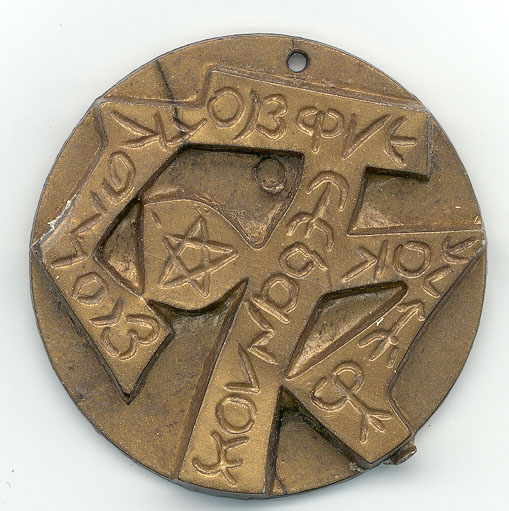
Poston plays Professor Jonathan Jones, a traditional "Bookish" type teacher, complete with wacky health diet of wheat germ and sauerkraut juice, tho a sight short of the Absent-Minded variety.  His niece receives a letter from her boyfriend, not working as an archeologist in a non-existent but real-sounding country.  He sends her as a gift an ancient coin, covered in words from an ancient language. A language which Professor Jones, an expert in ancient languages, can translate.  It's a magic talisman in honor  of an ancient god, one that gives the bearer great powers if they engage in the of both drawing and drinking blood (Which Jones accidentally does by prinking his finger and sticking it in how mouth. 

The weirdness starts early after Jones unwittingly activates the coin - a freak thunderstorm shakes the house, and causes a passing bystandard to be struck by lightning, blowing all her clothes off.  He assists her in her moment of full-body wardrobe malfunction, and gets back to his studies.  People in his company begin experiencing odd pain when he gestures at them. He sets out to translate the rest of the coin's inscriptions - it's amazing how much detail they crammed in.  If the bearer points at a person, the target experiences agonizing pain.  If coin-older speak the name of the god, the eponymous "Zotz"  anything they stare at slows to a crawl.  If they point at something AND speaks the magic work, the target is destroyed instantly.

Eager to demonstrate this power, he plans to exhibit it at the home of the college's Dean (Cecil Kelleway).  The Dean has been trying to decide who should succeed him, a decision rival professor Horatio Kellgore (Jim Backus) has made every attempt to guide by pointing out Jones' various odd behaviors. The Dean holds a cocktail party to introduce the new professor to the faculty - imagine Jones' surprise when "Professor Fenster" turns out to be the woman he assisted the night before!  After a bit of less blush-worthy conversation, he remembers his plan to display hiw new ability. Jones releases a cage full of white mice at the Dean's cocktail party, expecting to disable them.  Of course, his niece has taken the coin back, resulting in his great embarrassment and her suddenly gaining the ability to reduce people to a wincing fetal position. 

Jones is requested to see a psychiatrist (James Milhollin, another character actor who got a lot of work playing psychiatrists and other stuck-up authority types), and eventually asked to take some time off.  He realizes it's his duty to take this power to the military.  He sets off to the Pentagon, where an apathetic colonel (Fred Clark) is sick of hearing from kooks who claim to have invented the next super weapon.  He completely ignores the Professor's demonstration...but a somewhat Slavic-looking window-washer doesn't.  Sent home all but laughed at, he is quickly contacted by an agent from "The Government" ... he coyly neglects to mention WHICH government.  Yep, he's a Dirty Red, who whisks the Professor onto a plane headed for Russia.  Jones attempts to escape, but when he's told his niece and Professor Fenster are in custody by one of their agents (a largely silent but still hilarious Mike Mazurki), he must resort to strategy.  Telling them he doesn't have the coin with him, they turn back and head for the damsels in distress.  A mad chase ensues where Jones ends up using the power on both the Commie rats and himself, before the ladies can eventually find assistance for them all.

The film features one of Castle's cameos, right over the opening credits.  In one of only a handful of times they allowed people to mock the Columbia Logo, Castle sits in his director's chair at her feet and attempts to ensorcel her with the mystic title of the film.

gif courtesy GoreGirl's Dungeon

It's a wacky bit of fun that, like The Spirit is Willing, offered work for a large number of character actors.  In addition to one of Margaret Dumont's last films, it's also got a cameo by Louis Nye, another of Poston's fellow cast members from the Steve Allen Show.  Somewhat dated due to the whole Red Scare subplot, it's still fun as a sort of time capsule of the era.  In a couple of goofy visual gags, the pilot of the aircraft in which they whisk away the Professor resembles Khrushchev, and his driver resembles Stalin.  Ever the self-promoter, Jones niece and her date go to the drive-in, which is showing Homicidal.  Also, given his propensity for a gimmick with his pictures. first-run theatergoers received a replica ZOTZ! coin that glowed in the dark. 

Castle always brought a bit of whimsy to his films, and in these two rare comedies, he had the opportunity to bring that comedy to the fore. 

Saturday, July 13, 2013

It’s an Asphalt Jungle Out There!

May Emmerich (Dorothy Tree) : “Oh, Lon, when I think of all those awful people you come in contact with—downright criminals—I get scared.”

Alonzo D. Emmerich (Louis Calhern): “Oh, there's nothing so different about them.  After all, crime is only... a left-handed form of human endeavor. “

The Asphalt Jungle (1950) is a dynamic, suspenseful combination of character study and tense thriller.  W.R. Burnett’s hard-boiled 1949 novel was snapped up for the movies by producer Arthur Hornblow Jr. of Witness for the Prosecution. Oscar-winning writer/director John Huston had always been a fan of Burnett’s work, which included the novels Little Caesar and High Sierra, also adapted into classic suspense films.  Huston joined forces with screenwriter Ben Maddow (The Secret of Santa Vittoria; The Chairman), and the result was one of the best caper thrillers ever made. The intense score by the great Miklos Rosza (Alfred Hitchcock’s Spellbound; The Lost Weekend; The Power) accompanies the film with a sense of urgency that keeps you riveted.  The title theme always makes me think of bullfighting somehow, as if Huston himself is daring the film’s characters to get away with their meticulously-planned jewel heist.  In any case, you know you’re in good hands when you have the writer/director of the classic 1941 version of The Maltese Falcon on your team!

Watch your back in this town, Dix, or the "Happiness Boys"
will have you zigging when you oughta be zagging!
Gus sure knows how to keep his customers safe!
Fred Flintstone in a lineup?!
How will he ever explain this to Wilma?
The first character we meet among The Asphalt Jungle’s characters is rugged Dix Handley (Sterling Hayden from Dr. Strangelove; Johnny Guitar; The Godfather), slipping in out of columns in the early dawn, walking stealthily yet with a sense of purpose.  Harold Rosson’s cinematography  lends the early dawn an Ansel Adams look.  At six-foot-five with a booming voice, Dix is easy to hear and see, so it’s no surprise that with the police cracking town on suspicious characters, Dix gets hauled in for questioning for a series of stick-ups.  Indeed, Dix barely has time to grab some chow at The Pilgrim House, where his friend Gus Minissi (James Whitmore of Battleground; THEM!; Give ’em Hell, Harry!) serves up good old “American Food—Home Cooking,” like it says right on the brick signage!  Chain restaurants?  We don’t need no stinkin’ chain restaurants!  Gus happens to be a hunchback, but that doesn’t stop him from being kind to folks who need food and money, including the ever-broke Dix.  Gus is also kind to stray cats and stronger than he looks—disaster to the jerk who threatens cats in Gus’ place!
Dix is always trying to earn money, either from borrowing money from Cobby (Marc Lawrence from Key Largo; Marathon Man; Foul Play), an alcoholic bookie who sweats like a human waterfall, or getting it at gunpoint.  But his gambling and stick-ups just aren’t doing the trick.  As a result, Dix always seems to be borrowing money from Gus:


Dix: “I just can’t be in Cobby’s debt and keep my self-respect.”
Gus: “I guess it’s all right to owe me, huh?”
Dix (as sheepish as a lug like Dix can ever be): “I guess.”
Gus: “Yeah. It’s just my luck.”

Sam Drucker's gonna need a shady rest
after the cops sweat him!
Still, dig the company Dix keeps in the lineup scene!  That first doleful-looking guy is Henry Corden, prolific character actor and voiceover artist, who took over the voiceover role of Fred Flintstone after the original Fred, actor Alan Reed, died in 1977; Corden continued in the role until his death in 2005.  While you’re at it, look at the way Dix glowers at the Night Clerk as he stands in the lineup, giving that poor nervous witness the Hairy Eyeball.  That clerk is played by Frank Cady from Alfred Hitchcock’s Rear Window and TV’s Petticoat Junction.  No wonder the Night Clerk can’t bring himself to I.D. Dix to the hardnosed Lt. Ditrich (Barry Kelley from The Manchurian Candidate; Elmer Gantry;The Love Bug).  Frank’s not in Hooterville anymore! 

The setting in The Asphalt Jungle is identified only as an unnamed Midwestern city.  With all that crime, maybe that burg is ashamed to identify itself!  Police Commissioner Hardy (John McIntire from Psycho; Winchester ’73; Scene of the Crime) is fed up with lazy, shifty incompetents like Ditrich who whine that they don’t know what to do.  Hardy reads Ditrich the riot act:  “Lock up the witness!  Scare him worse!  It’s your job, knowing what to do!”  Hardy’s even more fed up with the gambling rackets, as Ditrich whines, “I close them down, but they only open up again.”  Hardy is unsympathetic:  “You don’t close them hard enough!  Rip out the phones, smash up the furniture!”  On top of that, the notorious jewel thief Erwin “Doc” Riedenschneider  (Sam Jaffe from Gunga Din; Ben-Hur; TV’s Ben Casey) has just been released from prison, looking all spiffy and dignified in his Sunday best as he ditches Doc’s tail with the greatest of ease.  Ditrich is behind the eight-ball, so Hardy gives him three options:  “I can reduce you to the rank of Patrolman and send you down to Five Corners; I can bring you up for departmental trial on charges of incompetence; or I can give you one more chance to make good on your responsibilities.  I think that’ll be the greatest punishment of all.”

Would YOU dare to say "No!" to a guy like Dix Handley?

Doc loves, he loves, he loves his calendar girls!
Now that Doc’s a free man again, maybe he’ll spend his new-found freedom hanging out with the neighborhood kids, teaching them from his experiences that crime doesn’t pay.  Yeah, and Christmas comes in July!  But Doc is interested in spending quality time with the girls—you see, Doc prefers pretty girls of a tender age, dirty old man that he is!  With no young babes to drool over, Doc gets down to business, bringing Doc and Cobby to the posh pad of the eminent, high-powered lawyer Alonso D. Emmerich (Louis Calhern from Duck Soup; Annie, Get Your Gun; Alfred Hitchcock’s Notorious). 
Doc’s caper involves a jewel heist that, if it succeeds, would net our perpetrators more than enough money to live on for the rest of their lives!  Their target: Belletier’s, one of the Midwest’s biggest, most fabulous jewelry stores. Doc makes the pitch in his calm, assured way: “Everything is here, from the observed routine of the personnel to the alarm system, the types of locks on the doors, the aging condition of the main safe, and so forth.  Take my word for it, Mr. Emmerich, this is a ripe plum ready to fall.”  But can they be sure this ripe plum won’t slip through their fingers, leaving a mess behind?  Our thieves do their best to protect themselves from potential peril, with the following personnel:

*Gus as the getaway driver.  His take would be $10,000.

*Louis Ciavelli (Anthony Caruso from Across the Pacific; My Favorite Brunette; His Kind of Woman).  Louis is a professional safecracker, or “boxman,” so he’ll be earning the most money: $25,000.  He needs it, too, for his family’s sick baby; the poor little tyke sounds like he has whooping cough!

*And last but not least, the gang decides on their “hooligan” for the tough stuff: our man Dix Handley, getting the gig for $15,000!  That would be more than enough for Dix to get back to his family farm in Kentucky and start fresh, if he stays focused and all goes well….

Doll Conovan comes to Dix in fake eyelashes and real tears!
All that Doc and his crew would need to put the plan in motion is $50,000, with way more to come if the robbery succeeds, of course.  That sure sounds more lucrative than the dollar and a dream the lottery commercials always ballyhoo!  Our thieves could have quite a haul—in a perfect world, anyway.  (If it were me, I’d be happy with just the fifty-grand!)  They’ve got to be careful, though; the “Happiness Boys” on the police force are giving folks like our thieves the push, leaving bookies, “dime-a-dance” dames, and other folks with livelihoods of questionable repute in jeopardy.  It’s hard out there for a crook lately, as well as the people who depend on them to make ends meet.  And you thought New York City’s Mayor Bloomberg was tough on crime with his soda wars!
Oh, that Emmerich—what a heel!

"Uncle Lon"s kept-tootsie Angela
is "some sweet kid"!
Uh-oh!  Is it curtains for Doc, Dix, and Louis?
And then he kissed meeee!  It's about time Doll got a smooch in this movie!
Fellas, please tell me that's just the Mister Softee truck I'm hearing, not alarms!
Diamonds are a guy's best friend! Wish Angela were here to sing a few bars!
They're in the money—or are they?  Watch the whole movie for the suspenseful conclusion!

Good morning, and welcome to Breakfast with Doll and Dix!
Today, Doll whips up her special Corncracker pancakes, and Dix recommends his favorite colts!
But can Emmerich be trusted?  After the conspirators leave, Emmerich admits to his right-hand man, private detective Bob Brannon (Brad Dexter of The Magnificent Seven; Violent Saturday; Von Ryan’s Express), that his extravagant lifestyle has left him broke, and he’s trying to keep it from his sickly, unsuspecting wife May (Dorothy Tree, veteran actress and speech coach, with films including The Men; Crime Doctor; Knute Rockne, All-American) and his gorgeous young mistress Angela Phinlay (Marilyn Monroe in one of the early roles that put her on the map, including Gentlemen Prefer Blondes; All About Eve; and Niagara). Sheesh, what’s the world coming to when you can’t even trust a rich guy with a caper?  Emmerich agrees to cough up the dough, then suggests that he help the gang out by taking charge of safekeeping of the loot himself, instead of divvying it among several “fences” like most robbers do.  Aw, isn’t Emmerich thoughtful?  Hmm, what’s that smell—a king-size rat, perhaps?

Doll has been working at this clip joint, The Club Regal.  Wouldn’t you know Hardy has closed it down, and on pay night, to boot?  Poor Doll; she tries to be brave when she comes to Dix’s door, with nowhere else to turn, but she dissolves in tears, her pretty face smudged with make-up and wet false eyelashes when she admits her dilemma.  She’s in love with Dix, even if having horses on the brain 24/7 has Dix virtually blinded.  Dix isn’t so great at winning money, but he loves horses, and he’s OK with letting Doll stay around for a while, even as Dix gruffly adds, “But don’t get no ideas, Doll.”  That said, I was touched that Dix let Doll stay in her time of need, and how she made breakfast for him.  In Dix’s tunnel-visioned way, he even seemed to appreciate it, even asking for her  forwarding address.  When Dix waxes rhapsodic about the colt he loved back in Kentucky, it just seems to make Doll love Dix even more, and it made me wish those crazy kids could’ve somehow carved out a future together.  Despite his unfortunate habit of getting money by sticking people up, Dix isn’t really a bad guy; he’s just really, really focused on his dream of getting his Kentucky horse farm back.  The heist could solve his problems, and maybe Doll’s problems, too.

The great cast of character actors is unforgettable, and the robbery itself is 11 minutes of nail-biting suspense.  The Asphalt Jungle isn’t some slick, stylish entertainment that melts out of your brain like cotton candy by the end (not that there’s anything wrong with that!).  Suspenseful though it is, it also made me feel for these characters long after I watched it, especially poor hard-luck Doll Conovan, played so movingly by Jean Hagen of Adam’s Rib; Sunrise at Campobello; and Singin’ in the Rain, for which Hagen was nominated for the Best Supporting Actress Oscar of 1952 for her hilarious performance as obnoxious, tone-deaf silent film star Lina Lamont.  Wow, did Hagen have range, or what? 

Dr. Drew Casper, who holds the Alfred and Alma Hitchcock Chair at the USC School of Film & Television in Los Angeles, points out on The Asphalt Jungle’s DVD/Blu-Ray commentary track how unusual it was to have Metro-Goldwyn-Mayer producing this stark crime thriller: “What’s a movie like this doing at MGM, or what’s MGM doing with a movie like this?”  Indeed, where were the glamorous musicals and their splashy production numbers, and the wholesome entertainment of the Andy Hardy movies and such?  Well, the post-war days of MGM in 1950 had just begun, and Toto, we sure weren’t in Kansas anymore!  Broadway producer/playwright Dore Schary brought his biopic play Sunrise at Campobello to both stage and screen, including Oscar nominations.  Schary inevitably climbed the ladder at MGM, becoming its Chief of Production in 1948. 

As post-war America rapidly became a very different animal, Schary and Louis B. Mayer were in synch—or so they thought.   It turned out Mayer was looking toward mirroring the past, while Schary was looking toward how people lived now, in this brave new world where things weren’t always pretty, happy and peppy.  During Schary’s MGM reign, social consciousness was encouraged in both the “A” film and the so-called “B” film units, so a novel based on the likes of W.R. Burnett seemed to be just what Hollywood needed to shake up the 1950s.

On the DVD/BluRay commentary track, Whitmore actually quotes Emmerich’s famous line: “Crime is just a left-handed form of human endeavor.”   Whitmore adds, “I always liked that, and that’s exactly what John got on the screen, that they were just people. Hayden and ‘Jeannie’ Hagen , and Sam Jaffe and I became lifelong friends after The Asphalt Jungle wrapped.”  The Asphalt Jungle’s movie ads boasted: “80 minutes of continuous excitement’,” according to Bennett Cerf of the Saturday Review of Literature.  But The Asphalt Jungle’s running time is 112 minutes!  Maybe they didn’t factor in the Coming Attractions?

I feel for these characters, especially Louis and his wife and their sick baby; Gus, with his kindness to cats; and especially poor sweet hard-luck Doll , who breaks my heart and who’s stuck on Dix, even if he’s slow to pick up on her feelings for him.  I love the way Dix gets so much more talkative when he starts talking with Doll about horses, and how Doll tries to understand him.  You know how in Some Like It Hot, hard-luck Marilyn Monroe says, “Why do I always get the fuzzy end of the lollipop?”  Well, in The Asphalt Jungle,  Marilyn Monroe’s character Angela is  the one who’s got it made—for now, at least—while poor Doll is the one who’s getting the fuzzy end of the lollipop, and worse!  Still, Dix is kind to Doll in his blinkered way; he gives her money when she’s broke, and near the end of the film, it seems Dix is slowly but surely getting it through his horse-happy head that Doll loves Dix, and the feeling seems to be mutual—but is it already too late for these poor poignant losers?

The one thing John Huston always thought was most important in staying alive (and it must have worked, since he had a great life) was his interest in life, and how to enjoy it and appreciate it.  No doubt that’s why John Huston and Sterling Hayden worked so well together.  Hayden’s one lifelong regret was that he’d cooperated with the House Un-American Activities Committee (HUAC) for what he considered “ratting.”  Ironically, rugged tough-guy Hayden began his movie career as a Paramount heartthrob!  My dear late mom was a big Hayden fan, and she’d filled me in on Hayden’s career, including his four-year marriage to the beautiful and talented Madeleine Carroll (The Prisoner of Zenda and My Favorite Blonde, as well as Alfred Hitchcock’s The 39 Steps and Secret Agent), and his love of sailing and writing (he’d written two best-selling books, his 1963 autobiography Wanderer, and his 1976 novel, Voyage).  Indeed, Hayden was up for the role of Quint in the 1975 film version of the terror classic Jaws; alas, he couldn’t take the part due to tax problems.  (Would that have been cool, or what?)  The Asphalt Jungle had legs, spawning three remakes: The Badlanders (1958), Cairo (1963); and Cool Breeze (1972), with an all-African American cast.  There was even an Asphalt Jungle TV series starring William Smith and Jack Warden, with theme music by Duke Ellington, though the show only lasted one season.


To slightly paraphrase a line from a later quote in Marilyn Monroe’s career, it looks like “Uncle Lon’s” luscious kept-tootsie Angela Phinlay (Marilyn in her big break!) will be getting the fuzzy end of the lollipop once the caper unravels.  Come to think of it, just about everyone in The Asphalt Jungle seems to get the fuzzy end of the lollipop eventually.  With the agita these thieves have to put up with, maybe working for a living wouldn’t be so bad after all.  Considering “Crime Doesn’t Pay” was still pretty much the norm in movies back in 1950, moviegoers might not be guaranteed a happy ending—but at least Dix finally gets a colt at last.  And let this be a warning to everyone eager for easy money:  Beware of dapper little men eager for quick money and very young ladies!  And remember what "Uncle Lon" always says above: "After all, crime is only a left-handed form of human endeavor."  (No offense meant to the southpaws in the audience!)


If you love The Dark Pages, it's available in two ways!

Online: http://www.allthatnoir.com/newsletter.htm

http://hqofk.wordpress.com/2013/06/24/first-look-dark-pages-latest-issue-3/

And in print just like Mama and Papa used to make:
The Dark Pages
P.O. Box 2716
Chicago, Illinois
60609-2716

Saturday, June 29, 2013

Dark Passage: The Softer Side of Bogart and Bacall

Husband-and-wife stars Humphrey Bogart and Lauren Bacall teamed up again for the 1947 film noir Dark Passage (DP, not to be confused with our favorite noir magazine, The Dark Pages).  I could have sworn that Philadelphia-born author David Goodis had originally titled this novel The Dark Road after Warner Bros. snapped up the movie rights for Bogie and Baby, giving it the more suspenseful title Dark Passage; does anyone here know for sure?  On a recent TCM Friday Night Spotlight on noir authors, film historian Eddie Muller explained that many of these suspense writers had to suffer the slings and arrows of seeing their books “chopped up and channeled as B-movies before they ever got A-list recognition, but Goodis did it backwards with DP, his first crime novel.  It was serialized in The Saturday Evening Post, and then Warner Bros. snapped it up for Bogart and Bacall for the silver screen."  Nice work if you can get it!  Goodis was touted as the new Dashiell Hammett, writing pulps and radio serials in the 1940s.
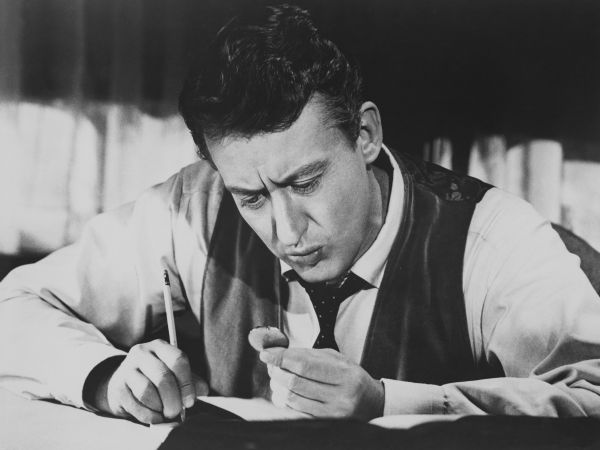
Author David Goodis hard at work


Travel tip: If you're going to San Francisco,
be sure to hide inside a huge prison drum!
Goodis was apparently one of those maverick types who had his own ideas about what he wanted to write and how to go about it—imagine that, writers with minds of their own!  Back in the day, filmmakers didn’t always know what to make of quirky types like Goodis, but he was nevertheless prolific with novels such as The Blonde on the Street Corner and Street of No Return (both from 1954); The Moon in the Gutter and The Burglar (both from 1953), and Cassidy’s Girl (1951).  Goodis eventually returned to Philly to take care of his ailing brother, spending the 1950s writing paperback originals with moody, broody plots focusing on troubled protagonists who couldn’t win for losing.  Somehow, I get the feeling Goodis wasn’t exactly the kind of guy who faced each day with a smile on his face and a jaunty tune on his lips—but whether or not that was true, Goodis sure could write.  In fact, nowadays, a first edition of the 1946 hardcover of Dark Passage is now valued at more than $800! 

4th floor, framed fugitives from justice, everybody off!
The DVD’s absorbing documentary featurette suggests that Bogart and Bacall’s participation in the star-studded Committee for the First Amendment, which was intended to defend colleagues called before HUAC, might have been among the reasons that DP wasn’t as big a hit as the real/reel-life couple’s earlier screen collaborations.  However, I suspect that audiences past and present may have found DP harder to cozy up to because instead of the cool, wisecracking, insolent-yet-playful Bogart and Bacall of To Have and Have Not and The Big Sleep, this film version of Goodis’ novel presents a more melancholy, vulnerable Bogart and Bacall—which, in my opinion, is not at all a bad thing, just unexpected from this star team at that time!  That Bogart & Bacall chemistry is still there, but it’s sweeter, as if they’d decided to let their collective guard down and allow tenderness to take over.  Instead of the cocksure Bogart character we all know and love, DP protagonist Vincent Parry is wary, fearful, fumbling in his attempts to clear himself of his wife’s murder, escaping the cops like he escapes from prison in the film’s opening scenes.  Vincent has few allies, but the ones he has are at least willing to help.   There’s Irene Jansen (Bacall), whose father had died in prison after being framed for murder.  Irene has been following Vincent’s case during his trial, and she ends up in a position to help hide him while he does his best to prove his innocence.

You realize this means an angry letter to the Times!
Then there’s Sam, the cab driver (Tom D’Andrea from Pride of the Marines; Night and Day; Humoresque).  Sam is cynical, yet he’s basically a kind, lonely soul, as are many characters in DP.   Sam suggests that Vincent should go to back-alley plastic surgeon Dr. Walter Coley (Houseley Stevenson from Sorrowful Jones; Crime Doctor; Native Land).  Dr. Coley may have been kicked out of his practice for being ahead of his time, but like others in DP, he too got a bum rap and is also a decent guy.  The proof is in the pudding: Vincent’s operation went so well that he now looks like Humphrey Bogart!  Isn’t 1940s medicine wonderful?  Wasn’t Vincent lucky to get comrades like Irene and Sam and Dr. Coley?  If only they didn’t have to keep their secrets so close to the vest, they could put together a support group; how about Wrongly Accused Protagonists Anonymous?

Meet Dr. Coley, brilliant hush-hush plastic surgeon to the wrongfully accused!  Highly recommended by Sam the Lonesome Cab Driver!  Free cigarettes for new customers!
Trippiest face-lift ever! Lauren Bacall can blow our minds anytime!
1947 seemed to be The Year of the Subjective Camera, between DP’s first hour shot from Bogart’s viewpoint, and Robert Montgomery doing the same in Lady in the Lake, using the technique throughout the film.  Unlike Lady…, DP’s  plastic surgery gimmick provides a good plot reason for the audience not to initially see Bogart’s face, though we frequently hear that unmistakable Bogart voice to make up for it.  It may take a while before they actually get Bogart out of his bandages as Vincent Parry, but on the positive side, we also get to see more of the lovely Lauren Bacall as Irene, as well as all those great spellbinding Warner Bros. character actors in lieu of Bogie.  The tenderness between Irene and Vincent is palpable.  There isn’t an uninteresting face or a bad performance in the bunch, with standout performances from Bogart and Bacall and a superb array of character actors.  In addition to D’Andrea and Stevenson, there’s Rory Mallinson (Cry Wolf; Nora Prentiss; Possessed) as Parry’s musician friend; and the ever-dependable Bruce Bennett (The Treasure of the Sierra Madre; Mildred Pierce; Mystery Street).


A kiss isn't just any old kiss with
Bogart and Bacall as Irene and Vincent!
The man I love to hate most in DP is cheap hood Clifton Young, a former Our Gang star (oh, the irony!).  As the villainous Baker, the adult Young grew up to have an oily grin and a cleft chin that looks like it got lost on the way to Cary Grant’s face by mistake; you might also see Young on TCM, where he was a hoot in the hilarious “So You Want To…” shorts.

Vincent gets the drop on would-be blackmailer Clifton Young!
To think he was such a cute little tyke in Our Gang!


Director Delmer Daves has a cameo as
Irene's late wrongly-accused dad!


The Hates of Rapf—Madge Rapf, Dangerous Dame!
And the woman I love to hate in DP?  None other than the wonderful Agnes Moorehead, with a resume ranging from The Mercury Theatre with Orson Welles, to stage and screen, including four Oscar nominations (Hush…Hush, Sweet Charlotte; Johnny Belinda; Mrs. Parkington; The Magnificent Ambersons); and scene-stealer Endora on TV’s Bewitched!  Moorehead steals the film as Madge Rapf, the kind of woman who won’t join any club that would have her as a member.  Madge is some piece of work: she’s a stylish dame who goes out of her way to spread stress and misery wherever she goes.  Sticking her nose into everyone’s business, Madge manages to lure people to her and push them away at the same time, and if she can’t have you, she’ll make damn sure nobody else can have you, even if that means murder!  With her delivery dripping honey one minute and venom the next (especially in her climactic scene with Bogart), the commanding presence of the quicksilver Moorehead and her unconventional yet undeniably striking good looks ensure that you can’t take your eyes off her whenever she’s onscreen.

If you’re looking for a tight mystery plot, this ain’t the place!  While DP has many suspenseful moments, it’s primarily a character study and a mood piece about loneliness, redemption, and starting over, with a strong undercurrent of postwar paranoia, all underscored beautifully by Franz Waxman’s stirring music (with contributions by an uncredited Max Steiner.  I love the use of “Too Marvelous for Words” as Vincent and Irene’s song).  The bus station scene is a touching example of this.  Incidentally, that lady at the bus depot, Aunt Mary, is Mary Field from Ball of Fire (as Miss Totten); The Dark Corner (as the eavesdropping movie ticket-taker); Wonder Man (as the stenographer); and Ministry of Fear (as avant-garde artist Martha Penteel)!  Mary’s so versatile, bless her!


Vincent's pal George Fellsinger, young man with a horn!
But the reactions of people who meet protagonist Vincent with with his post-op face and new name, “Allan Linnell,” are so suspicious I wondered if writer/director Delmer Daves (who cameos as the photo of Irene’s doomed dad.  His real-life kids have bit parts, too) was indicating that Parry was really projecting his own paranoia onto the people around him.  His new name in particular makes people look at him like he just dropped in from the planet Neptune:  “Linnell?  That’s a very unusual name.”  What’s so freakin’ unusual about it?!  What, it’s not blandly Anglo-Saxon enough?  I wonder if singer/songwriter John Linnell from They Might Be Giants (one of Team B’s favorite bands) ever had to field such absurd questions?   But I digress… 

Madge shows her true colors!
Even when DP drops the subjective camera style so we can see Bogart in all his glory, the visuals are striking thanks to Sid Hickox’s moody black-and-white photography.  That said, I recently saw a colorized still of Moorehead as Madge, and I must admit it looked pretty darn impressive!  With the emphasis on Madge’s love of all things orange, I can imagine a partly-colorized version a la Sin City, with everything black-and-white except Madge’s orange clothes and belongings! The Lodger, perhaps?  Speaking of Hitchcock, DP and Hitch’s 1958 classic Vertigo might make an interesting double feature since they share themes of loss, loneliness, new identities and fresh starts as well as a San Francisco setting.  (That could also work for another San Francisco film I like, Impact, but that’s a blog post for another time!) If you want to see a softer side of Bogart and Bacall, DP is well worth watching.  You may also enjoy the DVD’s fun and interesting extras, like the original theatrical trailer (for me, the hyperbole of movie trailers of that era is part of their charm) and “Slick Hare,” one of the Bugs Bunny cartoons that affectionately lampoon Bogart; it’s been claimed that Bogart liked to pal around with the animators at Warner Bros.’ “Termite Terrace” and he actually did his own voice work for Slick Hare and 8-Ball Bunny! 
Nevertheless, Director of Photography Sid Hickox had plenty of  innovative visual techniques in glorious black-and-white.  I particularly liked the use of the glass floor when Vincent discovers a dead body (I won’t say who); a tip of the hat to Alfred Hitchcock’s

Baby, you're smokin'!


Oh, no!  George, Vincent's only friend, has clearly played his last song!
After all the agita Irene and Vincent have been through, they deserve a happy ending!
Good luck, you crazy kids!

According to Wikipedia, the TV series The Fugitive became a hit in 1963—and Goodis took the producers to court, considering the show had many elements in common with Dark Passage.  In 1963, ABC television began airing the television show The Fugitive, the story of Richard Kimble, a doctor wrongfully convicted of murdering his wife. Kimble subsequently escapes and begins a long search for the "one-armed man", the person he believes to be the real killer.  For that matter, the whole case was originally inspired by real-life Dr. Sam Sheppard, who’d been accused of murdering his pregnant wife.  It just goes to show that there’s nothing new under the sun, in fiction or real life!