Sunday, March 24, 2013

NIGHTMARE ALLEY: You've Got the Power!

No doubt about it:  Back in 1947, 20th Century Fox’s Nightmare Alley (NA) left movie audiences shaken and stirred in ways that would’ve startled even James Bond!  Even the ominous score by Cyril Mockridge (My Darling Clementine; The Dark Corner; Miracle on 34th Street) plays like a carnival from Hell, deftly setting the sordid tone, and I mean that as a compliment.  How ironic that producer George Jessel was a multi-talented entertainer who had a big hit with what I consider the evil opposite of Nightmare Alley, namely the heartwarming classic song “My Mother's Eyes,” one of my dear late mom’s favorite tunes. Even though the movie version of NA was softened a bit to give star Tyrone Power at least a little shot at redemption, it was still strong stuff to unnerved audiences seeing their beloved matinee idol in smooth scoundrel mode.

Jules Furthman (The Big Sleep; To Have and HaveNot; Rio Bravo) adapted the film based on William Lindsay Gresham’s controversial 1946 novel which, according to Wikipedia, had in turn been inspired by conversations with a former carnival worker while they volunteered with the Loyalist forces in The Spanish Civil War. Gresham got started on the novel, his first, while working as an editor for a “true crime” pulp magazine in New York City in the 1940s.  He outlined the plot and wrote the first six chapters over a period of two years, then finished the book in four months. Each chapter was represented by a different Tarot card.  Director Edmund Goulding’s films included The Great Lie, Grand Hotel; and The Razor’s Edge, the latter reuniting him with star Tyrone Power. I’ll admit I used to think Power was just another handsome pretty-boy matinee idol who was mostly style and little substance.  It took Witness for the Prosecution to make me realize that, to borrow a line from The Producers, "there’s more to him then there is to him," and NA confirmed my change of mind!

Forget the "missing link" - this carnival needs hot young
Stan Carlisle in a T-shirt! You're hired, kid!
We meet handsome young carnival roustabout Stanton “Stan” Carlisle (Power), who’s just begun his carny career. Standing in the carnival crowd, Stan checks out the Ten-in-One, listening in almost morbid fascination to the spiel introducing the carnival’s geek.  The geek is usually a guy down on his luck who can only get work biting the heads off live chickens. Goulding cleverly keeps us viewers from actually seeing the geek show onscreen, distracting us with noisy crowds and shrieks from squawking chickens and customers, but they get the point across well.  Stan realizes he’s found his calling. As he explains to co-worker and casual lover Mademoiselle Zeena, a.k.a. Zeena Krumbein (the fabulous Joan Blondell of Public Enemy; Three on a Match; Dames and more, still looking fab to boot!), “Lady, I was made for it…This gets me.  I like it.  All of it.”

Pete predicts: "I see a little silhouette of a man...
Scaramouche! Scaramouche!"
Bruno and Molly: Beauty & the Big Lug!
Zeena takes care of her husband Pete (Ian Keith, who started in silent films like the 1935 Three Musketeers; the 1956 Ten Commandments; and many film, stage, and TV appearances).  She and Pete used to have a great mind-reading act, but Zeena cheated on Pete, breaking his heart and driving him to drink. Zeena feels terribly guilty about it, and she’s been trying to make it up to the melancholy Pete ever since, hoping to get Pete back on his feet with "the cure."  Meanwhile, Stan has his eye on Molly (Coleen Gray of Kiss of Death; Red River; Kansas City Confidienital).  She’s an innocent with a big boyfriend, Bruno, the carnival’s Strong Man  (Team Bartilucci favorite Mike Mazurki of Murder, My Sweet; The Shanghai Gesture; Some Like it Hot, and more!), who jealously tries to interrupt whenever Stan is nearby.

When Stan learns of the mind-reading act Zeena and Pete had before they joined the carnival, he tries to convince them to revive the act, but Zeena won’t go for it: she and Pete are saving the act to sell as money for their retirement, plus Pete is too drunk to do the bit well  any more.  Stan’s mind-reading act starts to catch on when even the crusty local marshal becomes convinced of Stan’s “second sight” after a poignant demonstration.  But Zeena is spooked when her tarot cards show death - and sure enough, Pete is found dead.  To his horror, Stan realizes he unwittingly gave Pete wood alcohol to drink instead of his usual moonshine!  Stan may be shocked, but he’s no fool, so he keeps his mouth shut.  By the way, I'd like to state  for the record that Joan Blondell and Coleen Gray are fabulous babes!

She was only Frankenstein's wife,
but she had a great pair of bolts!
Meanwhile, Stan and Molly become attracted to each other.  It doesn’t hurt that Stan also loves Molly’s ability with the mind-reading gimmick!  When Bruno eventually finds out Molly and Stan have become an *ahem* item, he and the rest of the carnies force him into a shotgun marriage, literally!  But it becomes a blessing in disguise, because  now Stan and Molly have the code to themselves, launching them into the Smart Set in the swanky Spode Room (Spode Room?!) in Chicago.  That code turns out to be a mighty useful wedding gift when Stan polishes up their routine, repurposing himself as the swanky and wildly successful mind-reader, The Great Stanton, with loving Molly as his lovely assistant!

"I'm tellin' ya, there was a stage where she worked,
and some booths!"
Stan's getting warm...warmer...you're red-hot, Doc!
As I’ve mentioned in the fabulous film noir magazine The Dark Pages, Mazurki’s 56-year screen career began in his uncredited film debut, 1934’s Belle of the Nineties, and he continued to work in films and TV until his death in 1990.  His roles ranged from comedies (Neptune’s Daughter; Some Like It Hot) to suspense and film noir (The Strangler in Jules Dassin's 1950 noir Night and the City), including one of Mazurki’s earliest roles in the 1945 movie version of Dick Tracy, as villain Splitface—and in one of his final roles, the 1990 film version of Dick Tracy!  In fact, I first saw Mazurki on TV’s The Monkees when I was a kid, making him literally part of my childhood!  Fittingly, Mazurki and his old friend actor/producer Dick Powell also appeared together in several Dick Powell Theatre episodes. Mazurki even appeared in singer Rod Stewart’s 1984 music video “Infatuation,” as a bodyguard forcefully protecting alluring Kay Lenz from obsessed shutterbug Stewart.

Nightmare Alley has long since been hailed as a classic, but upon its 1947 release, it wasn’t exactly the feel-good movie of the year!  20th Century-Fox gave it a strong ad campaign, but audiences protested what was then scandalous content. 


The Great Stanton's next great feat: guessing what's
in the pinata at the fabulous Spode Room!
In the great tradition of “Six Degrees of Separation,” Murder, My Sweet and Nightmare Alley led to great changes for the better in the careers of both Mazurki and Dick Powell. As a result, neither Nightmare Alley nor Murder, My Sweet would pack as much of a punch without Mazurki!

As sordid as Nightmare Alley must have seemed back in 1947, the wily, out-for-himself Stan isn’t quite as sharp as he thinks he is.  Beneath the slick demeanor he’s created for himself, there are chinks in Stan’s armor, especially when he encounters Zeena and Bruno again.  Even with The Great Stanton’s nightclub success, the small but smoldering spark of Stan’s guilt over Pete’s accidental death, and the superstition underlying Zeena’s tarot cards, are slowly, surreptitiously wearing down Stan’s confidence, like Chinese water torture.

At the height of Stan and Molly’s success with their mind-reading act, who should drop by to say “Howdy” but Stan and Molly’s old carny friends Bruno and Zeena!  Innocent Molly is happy to see them, but Stan is less than thrilled, certain that Molly must have blabbed about using Zeena and Pete’s code for their classy act.  A friendly game of cards should loosen things up — until Zeena goes for her Tarot deck.  Stan doesn’t want Zeena to flip that tarot card, but she does so anyway.  It comes up as “The Hanged Man”— uh-oh, maybe Stan should quit while he’s ahead!  Anyone for Go Fish?  Later, Stan gets a massage to calm himself down, only to find he can’t help smelling the rubbing alcohol, reminding Stan of the wood alcohol with which he’d accidentally fatally poisoned Pete.

Dr. Lilith Ritter's a shrink,
but no shrinking violet!
An elegant woman turns up at the Spode Room and catches Stan’s act.  She looks very interested — a groupie, perhaps?  It turns out the lady in question is Dr. Lilith Ritter (Helen Walker, from Call Northside 777; The Big Combo; the 1945 version of Brewster’s Millions). The lady also happens to be a shrink, though I’m sure she’d prefer to be referred to as a psychiatrist. She’ll be called another name or two as the film goes on when she and Stan forge an unholy alliance to exploit Lilith’s patients for fun and profit!  *Tsk tsk*, what’s the world coming to when you can’t even trust your therapist to keep your confidences?  Wait’ll the AMA hears about this!  Walker makes a magnificent femme fatale, with her Mona Lisa smile hiding plenty of trouble.

Is it all just nerves, or is fate messing with Stan, or is it payback time for all of Stan’s chicanery? Things come to a head when Stan collapses while doing a reading in his act about a young girl named Caroline, now deceased.  Now it seems the resourceful Stan has branched out again and become a mentalist (where’s Simon Baker when you need him?) with the ability to talk to the dead — so versatile!  Of course, it helped that Stan’s new cohort Dr. Ritter has joined forces with Stan to get her unsuspecting patients’ files for authenticity.  The rich, powerful Ezra Grindle (Taylor Holmes), who misses his late daughter terribly, is interested in what Stan has to say, explaining to Molly, “I told him he wasn’t ready yet for spiritual communion. He should prepare himself a little more with prayer and good works.  He gave me enough to start building the finest tabernacle in the country…and he’s going to buy me a radio station of my own.”
Stan, you've let yourself go!
Life ain't pretty when you're a carny geek!
There’s always a catch, of course.  Stan’s catch is that Grindle wants proof.  So Stan fixes Molly up to look like his beloved “Dory,” despite Molly’s misgivings.  The ruse is nearly completed when Molly’s guilty conscience gets the best of her.  Dr. Ritter swaps Stan’s money from the scam for a measly $150, and she tries to convince Stan that he’s losing his mind because of his guilt complex — as if!  Trying to do the right thing for Molly’s sake (for once!), Stan puts Molly on a train, and he lives the hobo life.  Sooner or later, all roads lead to Rome, er, home eventually, and Stan finds the only job available in the carnival: the geek!  Oh, how the mighty have fallen!  But there’s hope for redemption and love after all when it turns out Molly is working at this carnival as well.

Vinnie games the rig - It's amazing how good a look at the world of a carnival sideshow this film is, and from so many years ago.  It's fun to hear them talking about the "Ten-in-one", a classic setup of carnivals where they promise ten unique acts or performers for one fee, a dime back in the day.  Of course, in a classic ten-in-one, each act would be selling souvenir photos, or pamphlets on how to juggle, or the like, and a ten-cent admission could end up costing you a couple dollars at the end.  It's also always fun to hear the original definition of "geek" as well.
One of the things about this film that just amazes me is the fact that they explain, clearly and distinctly, for all to see, how carny psychics (a term which here means "all psychics") con people.  Stan is briefly fooled by a fortune telling that seems to speak to him personally, only to learn that he's just had a "cold reading."  The psychic will drop a bunch of very generic statements onto the table that could refer to anything.  The mark will do all the work for them, figuring out what the vague clues mean.  Saying "I see an 'M'..." will get the mark to pore through all the dead people they know for one whose name starts with M.  It's easy to learn, as Stan does in the film, and soon he's got people wrapped around his finger.
Of course, people will ever claim that yes, sure there are some fraudsters out there, but THIS guy is the emis.  And all I say is to watch any of the TV psychics, like the guy on the Sci-Fi channel (a delicious irony), and watch how they throw out only the most tenuous of feelers, and the person being read will grab onto them, inferring meaning where none was implied.

Here's the address for more of this awesome film noir magazine:

The Dark Pages
P.O. Box 2716
Chicago, IL 60609-2716
http://hqofk.wordpress.com/2013/01/12/first-look-dark-pages-special-nightmare-alley-issue/

Monday, March 11, 2013

The Mary Astor Blogathon is Coming in May!


May 3rd through May 10th, 2013
Co-Hosted by Dorian Tenore-Bartilucci of Tales of the Easily Distracted
and R.A. Kerr of Silver Screenings.

It all started in February with the CMBA’s recent Fabulous Films of The 1940s Blogathon.  For my TotED post, I blogged about one of my longtime favorites, the World War 2 comedy-thriller Across the Pacific (1941), starring three of my favorite classic film stars, Humphrey Bogart, Mary Astor, and Sydney Greenstreet.  (They were all awesome in The Maltese Falcon, too, of course, but I’m sure others would love to tackle this classic; don’t want to be greedy!)  As the comments rolled in, it became clear that many of us participating in the Blogathon also love the witty, beautiful, versatile Ms. Astor!  (As a bonus, Mary has always reminded me of my Auntie Joy, my wonderful Mom’s older sister; but I digress…)  I began to joke with other bloggers about the possibility of a Mary Astor Blogathon, and people were liking the idea, and happily, a Blogathon was born!

This wouldn’t be strictly a CMBA blogathon, but simply a fun, casual affair open to all who love Mary's movies, and wish to participate.

While we won't keep people from doing the same films, we will let everyone know what films have been "taken" on this page, so you can keep track. 

Young Mary Astor anxiously awaits the Blogathon in her honor!
To sign up, visit the main Blogathon page and leave a comment with your info, or contact either myself, Dorian Tenore-Bartilucci or R.A. Kerr to ask any questions!

Click for more details about signing up for our Mary Astor Blogathon HERE!


Saturday, March 2, 2013

Dangerously They Live - Garfield and Fiends

This post is part of the John Garfield Blogathon, hosted by Patti of They Don’t Make ’Em Like They Used To, running from March 1st through March 4th, 2013. Enjoy!

In 1941, John Garfield’s often-turbulent life was in transition—and this was before World War 2 sent the whole world reeling!  Having achieved stage stardom in New York City’s Group Theatre with his performance in Awake and Sing, then moving on to bigger Broadway success as the title character in Clifford Odets’ Golden Boy, and then becoming a movie star with the Lane Sisters in Four Daughters in 1938, Garfield was on a roll—until William Holden got the the Golden Boy role in the 1939 movie version that our man Garfield had created on the Great White Way!  Warner Bros. stepped in with the sweet consolation prize of a long-term contract.  But according to Richard Harland Smith at TCM's Web site, Garfield wasn’t really feeling it with his next projects, such as The Sea Wolf, in which Garfield was billed below co-stars Edward G. Robinson and Ida Lupino.  So Garfield kicked his agents at Lyon & Lyon to the curb, joining forces with super-agent Lew Wassermann and business manager Bob Roberts to help Garfield set up his own production company.

Smiling Jane Graystone, visiting the U.S. for the first time, looks forward to a vacation chock full of baseball, hot dogs, apple pie, and Chevrolets….
…until Eddie Mars turns up! Didn’t that bounder
learn his lesson in The Big Sleep?!
Smith makes an excellent case that Garfield was eventually drawn to Dangerously They Live (DTL) (1941) because the script by writer/producer Marion Parsonnet (Gilda; My Forbidden Past; I’ll Be Seeing You) surely would have appealed to him because he was a member of the Hollywood Anti-Nazi League long before America entered World War 2 in December, 1941.  No doubt Garfield enthusiastically approved of the film’s uncompromising depiction of German agents wreaking havoc in the free world; I sure would!

Directed by Robert Florey (from Murders in the Rue Morgue; The Cocoanuts; Meet Boston Blackie; TV’s Alfred Hitchcock Presents, The Dick Powell Theatre), we meet our heroine, Jane Graystone (Nancy Coleman in her film debut; she also co-starred in Kings Row; Mourning Becomes Electra; The Gay Sisters; and TV’s Ryan’s Hope), a lovely lass with a slight British lilt in her voice.  Jane seems to be checking out the sights and sounds of The Big Apple as she checks in with another British gent. What’s with all the U.K. visitors? Is there a Doctor Who Con in town?  But judging from the men giving Jane the hairy eyeball as she innocently grabs a cab, our heroine will be forced to confront the aforementioned Big Apple's worms lurking in our otherwise fair city!

Hmm, I’m kinda liking the way Dr. Mike Lewis
displays his bedside manner!
Before you can say, “Where’s Traveler’s Aid?,” a henchman identified as John (John Ridgely of The Big Sleep; The Man Who Came to Dinner; Air Force) hangs around the the British Export Bureau.  Somehow I don’t think John's there to buy Travelers Cheques. Sure enough, Jane’s cab driver deliberately smashes the car into a wall, with a little help from from the fiendish cabbie.  Pandemonium reigns, and Jane is brought to the hospital as evil John and his cabbie cohort beat a hasty retreat!

Enter chipper, cocky-yet-likable Dr. Michael “Mike” Lewis (Garfield), as he gives Jane a through examination:

Jane: “I’ve got all my arms and legs and everything?”
Mike: “Yes, and believe me, they’re worth keeping.”
Dr. Mike looks forward to treating temporary amnesia victim Jane
like other doctors look forward to Christmas!
Nice to know he’s serious about his work!
As Mike admits Jane to the hospital, our anxious damsel-in-distress can’t remember a thing about herself.  Mike’s examination of his pretty new patient indicates temporary amnesia all right, giving Mike a perfect opportunity to fully examine a temporary amnesia patient, something he’s apparently been wanting to do for ages. How’s that for on-the-job training?

Before long, Mike gets a visit from Jane’s dad, John Goodwin (Moroni Olsen of The Glass Key; Pride of the Marines, also starring Garfield; and Alfred Hitchcock’s Notorious) turns up to aid his darling daughter.  Looks like a real fatherly, pillar-of-the-community type…but Jane doesn’t recognize him, either, and she swears the photos he brought to help kick-start her memory aren’t doing the trick, either.  It’s gradually dawning on our stalwart sawbones that Jane’s scared, and not just because of this alleged amnesia!  She finally gets alone with Mike — no, not because of his bedside manner or his attractive tush:

Jane: “You’re a good doctor, but you weren’t there when I was born, and I was.  That’s not my father.”

Mike (humoring her): “Now take it easy.  Everything will be all right.”

Jane:  “Yes, if you’ll stop humoring me and listen!  I work for British Intelligence, and that man is not my father.  He and his gang are trying to find out what I know.  Would you do me a favor?  Keep your eyes and ears open, and please never be far away from me?”

Call me paranoid, but Jane’s Dad strikes me as creepy,
not fatherly. Maybe he needs cuddlier glasses!
Mike does so, and during Jane’s hospital stay, she and Mike get to know and become increasingly fond of each other during their otherwise increasingly sinister predicament. But now Jane must keep the amnesia gambit going, or it’ll be curtains for both of them—and we don’t mean the drapes in the Psychotic Game Room! In the meantime, at least Mike and Jane can enjoy the lovely melody “You’re Not So Easy to Forget” in the background.  If fans of MGM’s Thin Man movies listen carefully, they’ll hear that song in the final Thin Man movie, Song of the Thin Man (1947).  It’s a nice touch, considering the film’s amnesia motif!

Dr. Mike and Head Nurse Johnson (Lee Patrick from The Maltese Falcon; Auntie Mame; Vertigo) discuss who’s going to pay for Jane’s hospital tab:
Mike: “Don’t worry, I’ll pay for it.”
Head Nurse Johnson:   “With what?”
Mike:   “Don’t tell me you prefer blood.”
Head Nurse Johnson: “Not yours; I like it red.  Did you find out who she is yet?”
Mike: “No, she can’t remember a thing.”
Head Nurse Johnson:
“I don’t know what a brilliant student of mental diseases would do to find out a girl’s name, but I’d check her laundry mark.”


Mike:  “Not bad, Sherlock—but they may be in Chinese.”
Hmm, could it be mere coincidence that Jane’s laundry mysteriously goes AWOL soon afterward?  Are Head Nurse Johnson and/or the other busy little elves at the hospital just being unwittingly overzealous about putting away patients’ clothes, or is there something more sinister afoot?  If this story wasn’t set in 1941, I bet there would be lawsuits galore!

When it comes time for Jane to leave the hospital, it seems she and Mike just might catch a break:  Mike’s older colleague, Dr. Ingersoll (Raymond Massey from Abe Lincoln in Illinois; The Woman in the Window; Arsenic and Old Lace) agrees to let Mike come home with Jane to help her emotional healing—where we find out for sure that Dr. Ingersoll is, to borrow a line from cartoonist Mark Martin of CBG’s 20 Nude Girls 20, a “bad mans!”  Mike and Jane’s lives get more fearful and paranoid every day.  Seems Jane’s faux dad Mr. Goodwin and Dr. Ingersoll are really Nazi scum, and they’re tormenting the poor groundskeeper,  Mr. Steiner (Christian Rub from You Can’t Take It With You; he’s also the voice of Geppetto in Walt Disney’s Pinocchio), who’s under these creeps’ collective thumb.  With the villains packing heat and doing a fine job of keeping our heroes under control and away from anyone who could help them  (their most potent weapon seems to be the aforementioned Hairy Eyeball), the war of nerves alone makes escape harder than getting Alicia Huberman out of Alex Sebastian’s house in Alfred Hitchcock’s Notorious!  Where are Humphrey Bogart and his tough yet lovable Runyunesque pals from All Through the Night when you need them?!

Jane and her protector Mike couldn't be safer in Dr. Raymond Massey’s care; after all, he’s Honest Abe Lincoln! Then again, he was also evil Jonathan Brewster in Arsenic and Old Lace! Yikes!


Aha! It’s the ol’ Halifax trick, like in Across the Pacific!

In today's news, minor accident on Fifth Avenue leads to romance!

Sunday, February 17, 2013

Across the Pacific: Pan-ama-demonium!


This post is part of the CMBA’s Fabulous Films of the 1940s Blogathon, running from February 17th through February 22nd, 2013. Enjoy!

After The Maltese Falcon became a hit in 1941, Warner Bros. wasted no time in following up with Across the Pacific (AtP) in 1942, reuniting its powerhouse stars Humphrey Bogart, Mary Astor, Sydney Greenstreet, composer Adolph Deutsch,  and of course, director John Huston, this time working from a script by Richard Macaulay (They Drive By Night; The Roaring Twenties; Born to Kill), based on the serial Aloha Means Goodbye.  (Macauley was later known for testifying as a “friendly witness” before HUAC during the McCarthy era, but that’s a story for another time.)

AtP has plenty of suspense, romance, and flag-waving, what with the U.S. poised to enter World War 2 any minute.  The result was an entertaining adventure with that cheeky Huston feel, at once suspenseful and playful, while never forgetting that war is on the horizon and you can never be sure who to trust.  Only Peter Lorre was missing among the AtP cast—but he turned up just long enough to horse around, according to TCM’s Bret Wood: “Without informing his cast, Huston had Lorre enter the background as a waiter, clumsily disrupting the scene until announcing his presence with a wet kiss on the back of Astor’s neck.”  Oh, those impish Warner scamps!

Love, exciting and new! Come aboard, we're expecting you!
Would you believe I first saw AtP in colorized form?  Yes, that was back in the bad old days when Ted Turner thought people would turn up their pert little noses at black-and-white movies.  Instead, the colors looked muddy and just plain awful. Lovely Mary Astor’s lips looked grayblecch!  Give me glorious black-and-white anytime!

Even Canada, our friendly neighbor to the North,
won't let Rick fight!
Our story is set in 1941, where our hero Rick Leland (Bogart) is in the very un-heroic position of being dishonorably discharged from the U.S. Army, with woman trouble indicated.  So our antihero Rick comes aboard the Genoa Maru, a ship heading toward Panama; after all, there’s always something a freelance adventurer can do to earn a few bucks!  Rick meets Dr. Lorenz (Greenstreet), an American who seems to be a lot more sympathetic to the Japanese than most of us Yanks would’ve been during that era, being on the brink of war and all.  Another passenger, Joe Totsuiko (Victor Sen Yung, a.k.a. Sen Yung of The Letter; Number Two Son Jimmy Chan in the Charlie Chan movies; and Hop Sing on TV’s Bonanza, among others), is a sharp young Japanese-American who grew up in the U.S., and has almost the same hepcat lingo as Kookie from TV’s 77 Sunset Strip (*snap snap*).  But don’t underestimate his boyish charm and thick glasses; Joe’s jujitsu moves will knock you on your butt!

Romance on the high seas for Rick and Alberta...
War or no war, there’s always time for romance, by George!  Rick romances passenger Alberta Marlow (Astor, for whom I’ve always had a soft spot, as she reminds me of my late Auntie Joy), who’s pretty gosh-darn glamorous for an unassuming little lady supposedly from a town called Medicine Hat.  (By the way, there really is a town called Medicine Hat in Alberta, Canada!)  But hey, aren’t cruises supposed to be exciting and romantic?  While I don’t always agree with venerable New York Times film reviewer Bosley Crowther, I do agree with his comment about our leading lady: “Miss Astor is so beautiful a creature that you naturally know you must reserve your trust.”

...til mal-de-mere strikes! Can Alberta get a refund?
TCM’s Bret Wood goes on to say: “Once war was declared, it was difficult for the crew to hold onto their Japanese-American actors, who were suddenly considered a threat to security.  According to Astor, ‘a little indignation and some wire-pulling held them at least until the picture was finished.’ The Japanese actors were forced to endure a fair amount of racial stereotyping in the wartime film. Most speak pidgin English, while Victor Sen Yung was required to wear grotesque magnifying spectacles. In spite of this thinly disguised racism, Across the Pacific is in many ways respectful of Asian culture and in several instances attempts a serious understanding of the Japanese character and the philosophy of Judo.”

A pleasure cruise on the fab Genoa Maru!
Hope they got entertainment & all-you-can-eat buffets!
Our travelers sure do get their share of adventure and intrigue, eventually foiling a dastardly Japanese plot against the Panama Canal (keep in mind this was wartime in the 1940s, well before WW2 ended and the U.S. and Japan became chummy so everyone could make money on electronics and such.)  Happily, we discover Rick really is on the side of the angels; he’s working for amiable spymaster A.V. Smith (Charles Halton of To Be or Not To Be; The Best Years of our Lives; Alfred Hitchcock’s Foreign Correspondent), who’s basically Rick’s spymaster for this mission. (He was gonna be reinstated once his mission was over, wasn’t he? I assume nothing!)  I enjoyed the swell repartee between Rick and Alberta. The dialogue is witty, fast, and peppery. For example:

Alberta: “I can do without money.”
Rick: “Stick with me and you’ll get plenty of practice.”

Rick notices Alberta’s comparatively skimpy cruise garb:
Rick: “I never saw anybody like you. You never have any clothes on.”
Alberta: “Well if anyone heard you complaining about it, they would put you in a psychopathic ward.”  (Note: Alberta’s so-called skimpy sea togs just looked like nice bathrobes and skirts to me, but this was 1942, so Astor’s fashions may well have seemed racy at the time!)

According to the TCM Web site, John Huston and many other Hollywood actors and filmmakers accepted commissions to become a lieutenant in the U.S. Army Signal Corps after the attack on Pearl Harbor.  Huston was called into service just before AtP wrapped.  Vincent Sherman (Mr. Skeffington; The Young Philadelphians; and one of my favorites, All Through the Night) took over.

Um, this guy is just here to put
a refreshing mint on Rick's pillow, right?


Huston and his cast work together as beautifully as they did in their previous hit. Astor has always been deft at drama (The Great Lie, for which she won her 1942 Best Supporting Actress Oscar), but she’s also always had a flair for comedy, too (The Palm Beach Story being a delightful example).  Astor and Bogart are an engaging onscreen couple, whether they’re playful or serious.  In one running gag (literally), Astor’s Alberta Marlow makes a prim, hilarious victim of seasickness: “Even if I live, I’ll never be the same again.”  And don’t get her started on the ship’s bread pudding!  The action goes from sea to land, from New York City (where Alberta insists on Rick buying a new suit. Guess she never heard that line from The Spanish Prisoner: “Beware of all enterprises which require new clothes.”), and finally, from Cristobal to Panama where the action gets red hot.  No wonder Crowther had more to say about AtP: “It’s like having a knife to your ribs for an hour and a half.”  That’s in a good way, I assure you!
Careful who you drink with, Rick! Remember when you drank with that Gutman character who slipped you a Mickey in San Francisco?

Don't mind me, Mr. Leland, I'm just looking for my cufflinks!


Anyone got a compact?  My lips are delightfully schmeared after all this gunplay!


"Mine's bigger than yours." Actual dialogue from the movie!
Alberta tells Rick that passenger T. Oki is not okey-dokey! So much for all Japanese looking alike!

"Hey, hon, if we have a great time on this cruise, let's make a date at the Empire State Building a year from now!"
A great cast is worth repeating! Sydney Greenstreet, Humphrey Bogart, Victor Sen Yung, Mary Astor


Sunday, February 10, 2013

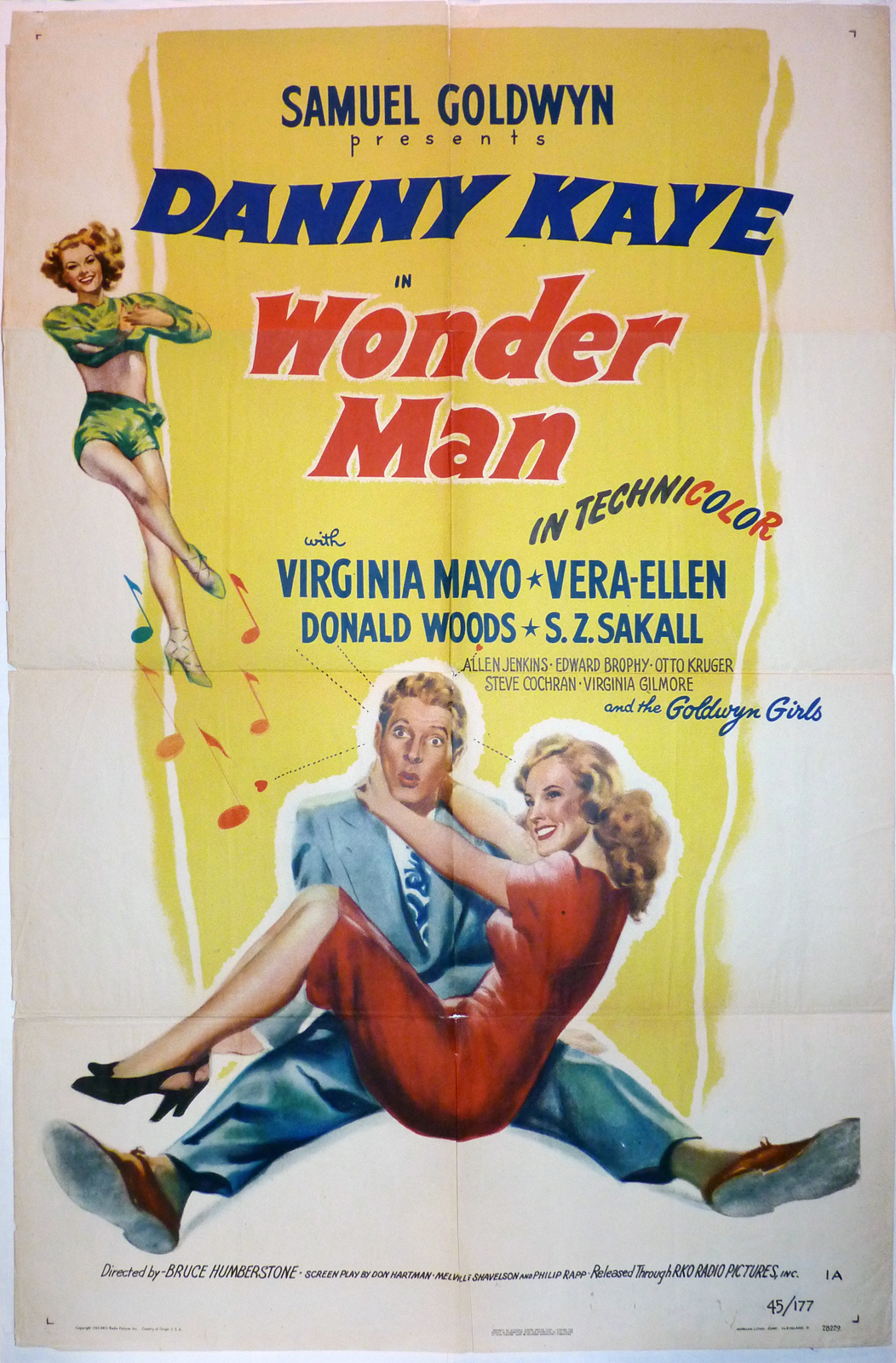
Wonder Man: Potato Salad Days!


It’s been said that our late loved ones are always with us, watching over us in the hereafter—but Danny Kaye takes the concept and runs with it in 1945’s supernatural RKO/Samuel Goldwyn comedy Wonder Man (WM)!  If you thought Danny was hilarious on his own, wait’ll you see him in the dual roles of famous nightclub star Buzzy Bellew and his brother Edwin Dingle!  As the Doublemint gum commercials, say, it’s double your pleasure, double your fun!

Directed by H. Bruce Humberstone (I Wake up Screaming, Sun Valley Serenade; several Charlie Chan films, among others), WM’s screenwriters included Up in Arms’ Don Hartman; Melville Shavelson from Kaye’s 1946 boxing romp The Kid From Brooklyn; Philip Rapp, creator of Fanny Brice’s Baby Snooks; Arthur Sheekman, gag writer for The Marx Brothers; and Jack Jevne, Eric Hatch, and Eddie Moran from Topper and Way Out West. If these fellas didn’t know their comic ghosts, I don’t know who would!  They say that too many cooks spoil the broth, but in this case, WM turned out to be a musical-comedy smorgasboard and a hip, hilarious, tuneful romp indeed!

From Borscht Belt tummler to Broadway star to multitalented movie star, Danny’s  secret weapon was Sylvia Fine, Danny’s brilliantly talented lyricist, composer, manager, and his wife from 1940 until Danny’s death in 1987.  Sylvia was truly the woman behind the man.  With her brilliant lyrics and wordplay, and Danny’s unbeatable talent and energy, they were an amazing power couple!

Sylvia & Danny:
They're so fine!
Danny’s first film, the 1944 service comedy Up in Arms, was a box-office hit. But with the theatrical release of WM in June 1945, Danny really knocked it out of the park—Brooklyn’s Prospect Park, that is!  As I’ve said in other TotED blog posts, as a native New Yorker, I enjoy watching movies where the action is set in any of New York City’s five boroughs.  I don’t even mind that WM was actually filmed at the Samuel Goldwyn Studios in California and not NYC, since the cast, writers, and sets all have that New York feeling (not to be confused with that Barton Fink feeling).  Even better, the cast includes Huntz Hall, one of our favorite Bowery Boys, as a young sailer who unwittingly gets entangled in the wacky, ghostly hijinks.

We viewers first meet Buzzy Bellew (Kaye) as the star attraction at New York City’s posh Pelican Club (what the world needs now are more affordable swanky nightclubs!  But I digress….).  The brash and brassy Buzzy is as likable as he is zany and hyper, likable, bursting with energy.  To borrow a line from Steve Martin back in his stand-up comedy days, Buzzy is a wild and crazy guy (in the most entertaining ways, of course)!
Enough bad news! Where's the sports page?
Buzzy and his Pelican Club co-star, singer/dancer Midge Mallon (dynamite dancer and former Radio City Music Hall Rockette Vera-Ellen in her movie debut, followed by The Kid from Brooklyn; On the Town; White Christmas, and so much more!) have been a couple for a long time.  Although it’s clear that Buzzy and Midge are both into each other, somehow the cute, talented couple never quite manage to actually get hitched at any of their attempted weddings.  But Midge is a good sport about it, perhaps because Buzzy is always funny, sweet, and apologetic—or maybe because their Pelican Club colleague Monte Rossen (Donald Woods from Watch on the Rhine; True Grit; The Beast from 20,000 Fathoms, and more), is a decent, patient joe who’s willing to wait until Midge finally comes to her senses and realizes the devoted Monte is a better bet when it comes to building a life together. 

*POP* goes the marriage proposal!
Buzzy and Midge are betrothed at last!
Ah, but Buzzy’s serious this time, giving Midge a jack-in-the-box attached to a diamond ring!  Vera-Ellen is adorable as Midge, and she and Danny have delightful chemistry.  And what a dancer she was!  Ironically, according to the TCM Web site, even though Vera-Ellen had a perfectly swell singing voice, her numbers were dubbed!  I guess it was like when Audrey Hepburn’s singing voice was dubbed by Marni Nixon for Breakfast at Tiffany’s and My Fair Lady:  they could sing, but apparently not quite well enough for the movies.  Go figure!

People can’t help loving Buzzy—except for notorious mobster, counterfeiter, and killer Ten-Grand Jackson (Steve Cochran, also making his film debut here)!  See, DA O’Brien (Otto Kruger of Murder, My Sweet; Saboteur; High Noon) and the Assistant DA (Richard Lane, best known to Boston Blackie fans as Inspector Farraday) needs Buzzy to testify in the murder trial, one of whose victims include one Choo-Choo Laverne, a fan dancer who was in the wrong place at the wrong time.  Our antic, overly optimistic entertainer is too overconfident to let New York’s Finest provide him with police protection—not a smart move for a high-profile witness in a murder case, especially when Ten-Grand has just been released on bail!

What's this? Inspector Farraday in league with Jules Amthor?!


Alas, Buzzy realizes too late that he should’ve taken advantage of that police protection, or at least taken the time to read those ominous newspaper headlines splashed all over the news.  Instead, Buzzy makes a fatal splash as Ten-Grand’s strong-arm boys Chimp (Allen Jenkins of Ball of Fire, but this time in funny-yet-sinister-villain mode, as he was in Lady on a Train) and Torso (Edward Brophy, ditto, as he was in The Thin Man and All Through the Night) send Buzzy to sleep with the fishes in Prospect Park’s lake. You have to hand it to the writers for being able to make cold-blooded murder funny without being depressing!

Onstage, Buzzy and Midge are on a Bali high!
Enter Buzzy’s twin brother Edwin Dingle (also played by Danny, natch), a quiet, bookish librarian and researcher.  Edwin and Buster (Buzzy’s real name) haven’t been in touch since young Buster ran away to try his hand at show business, rechristening himself as Buzzy Bellew.  Well, the Dingle boys are about to have a family reunion to catch up with each other, avenge Buzzy’s death, and put Ten-Grand Jackson behind bars for good—but that doesn’t mean ectoplasmic Buzzy won’t liven things up with merry, macabre hijinks along the way!  This isn’t Hamlet, you know! What’s more, romance is blooming between Edwin and his charming co-worker Ellen Shanley (Virginia Mayo, my favorite among Danny’s leading ladies since I saw her in The Secret Life of Walter Mitty).  Keep your eyes peeled for Natalie Schaefer—yes, Gilligan’s Island’s Lovey Howell herself!—appearing briefly and amusingly as a pesky patron of the local library who’s both bewildered and fascinated by Edwin’s ambidextrous abilities.  But Edwin’s date with Ellen takes a hilariously crackpot turn when Buzzy’s ghostly music gets Edwin all farshimmelt on the way to pick up potato salad for their dinner date, and…well, you may never look at deli food with a straight face again, especially with the hilariously frustrated S.Z. “Cuddles” Sakall as the deli proprietor!   Another highlight: Danny’s madcap sneezy rendition of the classic Russian song “Otchi Chornniya,” and the climactic opera that collapses into a side-splitting free-for-all!  Hey, wouldn’t WM and A Night at the Opera be a swell double-feature? 

I love a man who can cook and wear an apron with confidence!
Fun Fact:  In addition to WM, Steve Cochran and Virginia Mayo also co-starred in such Oscar-nominated and Oscar-winning classics as White Heat and and The Best Years of our Lives.  Cochran also co-starred in many of Chester Morris’ aforementioned Boston Blackie movies (a favorite here at Team Bartilucci HQ).  I love the charming chemistry between Kaye and Mayo!  WM was Virginia Mayo's first leading lady role with Danny; before that, she had a brief uncredited role in Up in Arms.

"You can lose your mind/
When brothers are two of a kind!"
Exasperated S.Z. Sakall is his usual "Cuddles"-some self! 
WM did very well indeed come Oscar time, winning for the Best Special Effects for John Fulton’s cinematography and A.W. Johns’ sound effects. Leo Robin and David Rose’s number for Vera-Ellen, “So in Love,” got an Oscar nomination for Best Music, Original Song, as well as Best Music Scoring for a Musical Picture, under Ray Heindorf’s direction.  But I can’t complain about  Heindorf losing, considering the Best Music Scoring Oscar that year went to another of my all-time favorites, Miklós Rózsa for Alfred Hitchcock’s Spellbound!   According to the TCM Web site, at one point in WM, Buzzy impishly slips his torso (no, not Edward Brophy’s character!) on a bust at Prospect Park, quipping, “What is this, trick photography?”  Definitely not “palpably inadequate!”  WM is one of  Danny Kaye’s very best movies!


Dead or alive, Buzzy sure knows how to make an entrance! Hiya, Bro!
Sailor Huntz Hall & pals are gobsmacked at Edwin's supernatural powers, courtesy of Buzzy!

All right, opera singer dame, give someone else a turn!

Aw, don't you just love a happy ending?